

This post is a deeper dive into the concepts found in part 1 of our Power Shift Revisited Series. This deeper dive article is focused on practical application of concepts covered in part 1 as discussed in the following articles:
Chapter 1: Embrace the Community
Chapter 3: The Thread of Interbeing
Chapter 4: Build on Bedrock
I encourage you to subscribe to this publication to recieve new posts in this series series.
Mercy without justice degenerates into dependency and entitlement, preserving the power of the giver over the recipient. Justice without mercy is cold and impersonal, more concerned about rights than relationships… Relationships built on need are seldom healthy. —Robert Lupton, Toxic Charity
For years, I labored in the furniture bank – collecting donated furniture, raising money, hiring staff and building programs.
We gave away furniture. We found housing. We connected people with services. Yet too many families returned to homelessness.
I was understandably disillusioned.
What were we missing?
During my final semester in seminary, I did a mission immersion experience at the Romero Center in Camden, New Jersey. It was there that I began to dig a little deeper.
Kevin Moran, the Executive Director of the center, said something I will never forget.
“Christian social teaching has two feet – mercy and justice.”
Mercy says, “My neighbor is hungry, I will give him some food.”
Justice asks, “Why is my neighbor hungry?” —and then works alongside the neighbor to overcome the cause of the underlying condition.
Mercy and justice are two feet of the same body, and they must move together for us to have any real impact in our efforts to end the suffering we see all around us.
I realized in that moment that through our Furniture Bank efforts, we had gotten really good at moving the mercy foot, but in our focus on giving more stuff, we neglected the justice foot. As a result, we were going in circles. One foot firmly planted while the other just seemed to hop around it.
When we began working with families exiting local shelters, we were a small group of friends. We got to know and served alongside those we were seeking to support. We shared our stories, we ate meals together, and we shared our gifts with one another and our community. As a result, we were able to help many avoid challenges that would have resulted in them losing their housing, such as a sudden illness, lack of access to transportation, or unexpected job loss.
As we grew, we instituted systems that were designed to help us scale up, streamline, and become more efficient at one thing – giving out furniture. It worked.
We began serving more and more families – but only transactionally. We had no time for stories, meals, and authentic relationships. I knew no one’s names. They became case files.
This fate befalls far too many well-intentioned efforts. Our funders and donors understood how to measure service delivery. It was much harder to explain—and measure—the value of stories, meals, relationships, and supportive community.
In her book Reviving Ophelia, Mary Pipher describes her work as a therapist as that of an ambulance driver who is waiting at the bottom of a cliff to treat girls when they fall off and is pleading on behalf of these girls for someone to build a fence at the top of the cliff to prevent them from falling.
When we began, I felt like we were constructing a fence for very vulnerable people who were getting reestablished.
The relational nature of those early years allowed us to walk in solidarity with several families through some rough seasons. Many of these stories are documented in my first book, From the Sanctuary to the Street.
Not all the individuals that we have accompanied in this way were able to maintain housing, but I know that many would have become homeless again if they had not been a part of this supportive community.
When the furniture bank aspect of the work took over, we drifted downstream, catching people who had fallen off the cliff, fishing them out of the water, not realizing that the same cliff was all around them with no guard rails.
Making the shift from relief to development moved us upstream and provided us with an opportunity to keep people from falling in the first place.
Moving upstream allowed us to ask different questions like, “Where exactly is the cliff? What could prevent the falls?”
Answering these questions required us to dig deeper, listen more intently, and required that we leave the safety of our building and our programs and follow the sound of the genuine into the community.
Three Approaches to Meeting Needs
While poor people mention having a lack of material things, they tend to describe their condition in far more psychological and social terms. They typically talk in terms of shame, inferiority, powerlessness, humiliation, hopelessness, depression, fear, social isolation and voicelessness.
Until we embrace our mutual brokenness, our work with low-income people is likely to do more harm than good.—When Helping Hurts by Steve Corbett & Brian Fikkert
My seminary training helped me understand the problem intellectually, but I still didn’t have clarity about how to move forward.
I understood that we needed to move upstream, but I still didn’t know what that looked like in practice.
Shortly after graduating from seminary, I was introduced to Jay Van Groningan. At the time, Jay was the Executive Director of an organization called Communities First Association.
Jay recognized that many, like me, were stuck in mercy mode and did not have the tools they needed to move beyond this transactional way of engaging in their communities.
When Jay learned about John McKnight’s work and the Asset-Based Community Development framework, he knew this methodology was what could help move both feet.
We invited Jay to come to Richmond to train our team in Asset-Based Community Development.
During the training, Jay asked, “Have you heard the saying, ‘Give a man a fish, feed him for the day; teach a man to fish, feed him for a lifetime?’”
We all nodded our heads enthusiastically, thinking we knew where this was going.
“This adage assumes that there are two approaches to meeting needs: relief, giving people fish, and Individual Betterment, teaching people vocational skills so they can supply their own fish.” Jay explained.
Then he asked, “But what if the pond is unhealthy? What if there are no fish?”
We all sat in stunned silence. The lack of goods and services was a visible need. The need for vocational skill building was likewise tangible, measurable, and easy to address.
None of us had ever considered that the community – the waters we all swim in – was at the root of the problem.
For the first time, I understood that the question wasn’t simply, “How do we help this person?” It was, “What is happening in the pond that keeps producing the same suffering?”
The graphic below summarizes the three approaches to meeting needs and identifies when each is most appropriate.
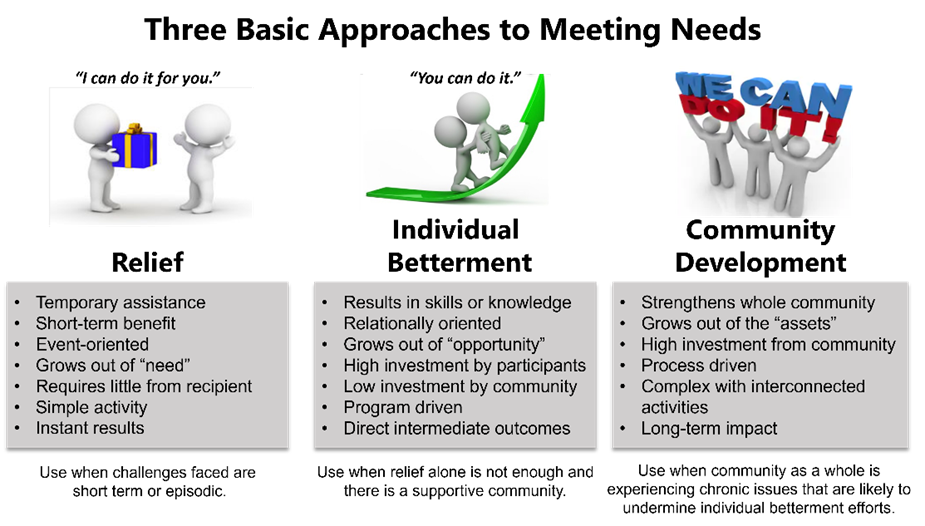
Relief is focused on service delivery.
Relief alone is appropriate when someone is experiencing situational challenges such as a job loss, death, or some other situation that causes them to experience a short-term need.
Individual betterment is focused on growing the capacity of the individual to address their individual needs.
Individual betterment is appropriate when someone is lacking in skills but has a relatively healthy social support system.
Community development is focused on building the capacity of the community to address its own needs.
Community development is appropriate when the community as a whole is in need of strengthening.
The challenge, of course, is knowing which approach is needed—and recognizing when it’s time to move from one to another.
The Fishing Pond Tool
Wherever there was sustained one-way giving, unwholesome dynamics and pathologies festered under the cover of kindheartedness… When relief does not transition to development in a timely way, compassion becomes toxic.—Robert Lupton, Toxic Charity
There is a lot of confusion about this distinction between different methods. To help his trainees grasp these concepts, Jay developed a tool which I now use in my own trainings, called the Fishing Pond. I have adapted it over the years for my own training and coaching clients.
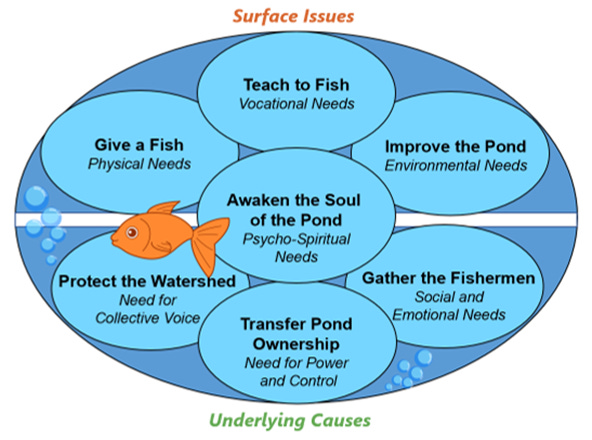
Imagine that the community is the fishing pond represented by the larger oval in the image above.
There are seven basic needs found in every community, represented by the smaller ovals.
At the surface of the pond are the needs we can easily see.
The first are the physical needs, and we address those by “giving fish.” We do this through feeding programs, homeless shelters, providing school supplies and Christmas gifts, and so on. For our congregational partners, these kinds of activities generally constitute 90 percent of the activities they support.
These fish-giving programs often grow into programs that help people become more self-sufficient.
Addressing the second basic need which is vocational needs. We address by “teaching people to fish.” This includes all activities in which we engage that help people build skills and abilities. Examples are after-school tutoring programs, ESL classes, job training programs, and so on. For most of our non-profit, governmental, and educational partners, these generally constitute 90 percent of the activities in which they are engaged.
Some programs are focused on the aesthetics of the pond.
They address the third need, which is environmental by “improving the pond.” This includes activities such as picking up trash, blight reduction, code enforcement, developing green spaces, and so on. For most of our neighborhood civic associations, these generally constitute 90 percent of the activities in which they are engaged.
But Jay wasn’t asking us to stop there. He was inviting us to look beneath the surface.
Imagine that the white line in the illustration above is the surface of the pond. These first three basic needs are often symptoms of underlying causes that are rarely addressed by any of the helping organizations named above (as evidenced by the fact that our feeding lines are getting longer, the streets refill with trash as quickly as they are cleaned, and far too many of our individuals are not able to make a living wage). So, I invite you to look below the surface.
My fellow community cultivator, Amy Moritz, added the “5 Why’s” exercise to Jay’s pond.
“If you ask “why” people are experiencing the surface issues five times, you will most often find your way below the surface.” Amy shared:
I have done it many times and have found it a helpful way of moving deeper.
Below the surface, the needs become less visible.
The first of these deeper needs is for social and emotional support. We can address this need by gathering the fishermen together to support one another. This mitigates loneliness, a sense of isolation, and any mental health challenges being faced as a result. Organizations that develop connections between their community members see lasting change at far higher rates than those that do not. Groups like Alcoholics Anonymous, WW (formerly Weight Watchers), and Mothers of Preschoolers (MOPS) Groups know the power of peer-to-peer support.
The second of these deeper needs is for power and control. We can address this need by shifting ownership of the pond to those whom we currently label as recipients of services.
People care for and invest in what they own.
We can see this with neighborhoods with high levels of home ownership compared with those that have mainly renters.
Ownership means you have the power to make decisions and control over what happens. You have a vested interest in the outcome.
If you want high investment, you must be willing to give people decision-making power.
Of course, this truth is not limited to homeownership.
People can “own” the solutions to the problems their communities are facing if they are given the power and opportunity to do so.
The stories that I share throughout this book illustrate what this looks like in practice.
The third of these deeper needs is for collective voice.
Everyone is affected by systems that can either enhance or undermine the health of their community. When we give communities a voice in these larger systems, we can help to protect the watershed from harmful, often unintended consequences of systems that are beyond their control. Addressing this basic need involves activities like policy making, political representation, and advocacy.
The deeper we go, the harder these needs are to see—and yet they may be the most consequential.
The key to moving below the surface is in the center need, which is the psycho-spiritual health of the community.
Here, I use the word spiritual in a very broad sense to include things like hope, faith in a brighter future, the belief that change can happen, and the culture of the community that fosters a sense of identity and belonging.
Psycho-spiritual health encompasses both individual efficacy as well as collective efficacy.
Psycho-spiritual health is where the narratives that shape our communities are formed.
It is the collective sound of the genuine that animates the community.
It is the hardest to see, measure, and quantify, yet it has the greatest impact on our success in cultivating flourishing communities.
It includes the stories that people tell about themselves and their communities. These stories often reveal the bedrock truths or lies, feeding or depleting the community.
If a community believes nothing will change, nothing will.
If people believe they have no power, they will not take action.
The chronic apathy that plagues many communities is rooted in hopelessness born of decades of lived experiences within oppressive or exploitative systems.
There are many ways to inspire hope.
Sometimes inspiration comes from a charismatic leader, sometimes from a collective struggle.
However, growing relationships of trust and shifting power are the two most reliable means of cultivating a hope-filled culture over the long haul.
Both my forest metaphor and Jay’s fishing pond metaphor invite us to look below the surface while also expanding our vision to include the whole ecosystem.
The need for hope, belonging, agency, and a sense that change is possible cannot be measured as easily as the number of meals or beds given away. But they often determine whether any of our efforts bear lasting fruit.
Instead of investing most of our energy in tackling the symptoms, a community development approach is designed to strengthen the community as a whole.
Naming the Ponds
Once you decide to care for the pond, you have to answer a surprisingly practical question: which pond?
Undergirding the drive toward siloed approaches that have fractured our community ecosystems is the endless pressure to grow larger – to scale our efforts to larger and larger populations of people.
It was this drive for growth that killed the sense of community in my own work.
While it is true that the seven needs cannot be addressed by one entity at a large scale, when we expand our view to the ecosystem level, we begin to see that this is not only possible but is how humans have historically lived – in small clusters that relied on mutual aid.
One of the challenges we face is that many of our helping institutions can’t see the ponds – they only see oceans of need.
They are working at such a large scale, such as entire counties or cities, that they have no understanding of what is already happening on the ground at the neighborhood or village level.
One of the first tasks for those who decide they want to change the condition of the pond is to define the boundaries of the pond.
The biggest mistake I see is to define the pond too broadly.
In my experience, the ideal size of a community cultivation effort is to define a pond that is between 500 and 5,000 households and to do so in a way that reflects how people define their community.
While many in urban areas call these smaller pond-sized communities neighborhoods, I am going to use the word village in recognition that many, including myself, live in more rural areas.
These village-sized communities are generally geographically defined and are most often defined by neighborhood boundaries or municipal lines.
However, they can also revolve around educational communities, affinity-based groupings, and in some cases, around vocational networks.
Many organizations that do relief work have no idea where their clients live. One tool that I find particularly helpful for those who need assistance defining the villages, is Batchgeo (Batchgeo.com) a free online mapping tool.
When we decided to shift from providing furniture to those in need to a community development model, the first thing we did was to map where those we had been serving for the previous five years lived.
The largest clusters were in public housing complexes. We looked at where we already had strong relationships as a result of our aftercare program, and Hillside Court emerged as the focus of our community development efforts.
When we spun the Furniture Bank off to CARITAS, we retained a partnership with them. They would continue to provide furniture to those exiting local shelters, and when a family moved into Hillside, they would help us connect with them.
CARITAS’s mission is relief, and they were shifting toward an individual betterment focus by adding vocational opportunities afforded by the furniture bank. By linking their ongoing work to our community development efforts, together we could change the condition of the ponds that made up the larger ecosystem.
Different Roles One Ecosystem
The greatest mistake commonly made by those who strive to help the poor is the failure to see the assets and strengths that are always present in people and their communities no matter how poor they are. — Richard Stearns, The Hole in our Gospel
I published my first book, From the Sanctuary to the Streets, in 2010 about two years after we made the shift from relief to development.
Around the same time, many others were drawing attention to this need for a shift from relief to development including Toxic Charity by Robert Lupton (Oct. 2011), When Helping Hurts by Steve Corbett & Brian Fikkert (June 2009) and, The Hole in our Gospel by Richard Stearns (May 2010.)
When these books came out, many organizations read them. I even recommended them to several of my congregational partners. However, it had a disturbing outcome.
Rather than figuring out how to move the justice foot, they simply stopped moving!
Building genuine relationships is so much harder, so doing nothing felt like the appropriate response.
These books helped name the problem. But naming the problem didn’t tell us how to become part of a healthier ecosystem.
During this time, I was in a panel discussion at a Union Presbyterian Seminary in Richmond, Virginia.
One of the students asked me,
“The church I’m serving is very much still in a we serve them [kind of mentality] because they need something we have. Very few of our ministries involve forming relationships with other people. In fact, I was even told that the yearly mission trip “isn’t about meeting other people; it’s bonding time for our youth.”
The student was asking, “Is it better to serve poorly, or not to serve at all?”
Where is the line between “at least we’re doing something” and “toxic charity?”
I responded with a question of my own,
“How might your organization partner with those who are equipped to take on this more relational work?”
I realized simply reading a book was not going to solve this challenge. I began training congregations and, more importantly, engaging them in relational opportunities as partners in our community-building work in Hillside, which I will cover in more depth in upcoming chapters.
After nearly two decades of training organizations, I now recognize that partnering with community-based groups who were doing the deeper work is often the best next step for those that lack the capacity, cultural competence, or commitment to engage for the long haul in communities.
While the original version of Power Shift was written for those seeking to practice Asset-Based Community Development, though this Revisited Series, I am attempting to broaden the materials to include those whose role is to partner well with grassroots community cultivators.
If your organization is relief or individual betterment-focused and unlikely to make the shift to community development, we invite you to travel through this series with the goal of learning how you can partner with organizations who are seeking to cultivate community.
Building the connective tissue between those working at the surface and those working below the surface is one way we can restore the ecosystem to greater health.
So, what does it mean to cultivate community?
The term community development has come to refer largely to the built environment and economic engine of a community. While these are important, it is not what I am inviting us to focus on. I am inviting us to the relational side of community development.
Therefore, throughout my writings, I am using the words community cultivation.
Community cultivation is about relationships—relationships that are healthy, interdependent, life-giving, authentic, dignified, and empowering.
Community cultivation is not about programs but about the conditions that cultivate relationships between people.
It is not about doing things for people, but about working with people.
It is not about the destination but about our shared journey.
That journey is rarely a neat, tidy, linear path through a beautifully manicured garden but rather a curvy, steep, rocky, meandering, and overgrown trail through a forest.
Effective community cultivation is holistic and recognizes that we human beings have needs that are deeper than basic food and shelter.
Community Cultivation is the process of cultivating stronger, healthier communities in which all, (human and natural world) can thrive.
In this section, I have challenged you to gain clarity about the community you are seeking to strengthen.
As we have seen, the invitation is not simply to give fish, or teach fishing, or even improve the pond.
The deeper invitation is to dive deeper while seeing with a wider lens that takes in the whole ecosystem.
It is through this shift from relief to development that we begin to move from a focus on causes to a focus on community.
Tool for Getting Below the Surface
In my trainings, participants are invited to take a blank piece of paper and draw their fishing pond like this.
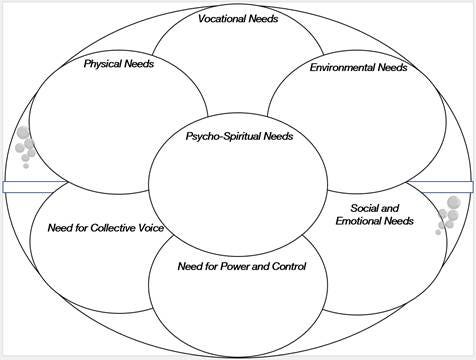
Then take each bubble in turn and list in it all the things their organization is doing in each category noted above.
I then ask them to consider these questions:
What percentage of your time, resources, and energy are you investing in above-the-surface activities?
What percentage of your time, resources, and energy are you investing in below-the-surface activities?
What are you currently doing to go below the surface and address the psycho-spiritual needs of your community?
Toward which of these pond areas would you like to steer your boat next? What makes that area the priority now?
How might you partner your above-the-surface activities with those who are doing the deeper work of community cultivation?
Additional Resources for Community Cultivators
I hope this deeper dive into the concepts found in part 1 of our Power Shift Revisited series has been helpful to you.
If you are a community cultivator and are interested in participating in an upcoming Power Shift Training, please send me a message or leave a comment.
I also encourage you to check out our Network Newsroom or join our ABCD Community Cultivator Network - HERE. It is a free network and I share resources and we host a number of communities of practice.
I encourage you to subscribe to this publication to recieve new posts in this series series. 100% of all paid subscriptions support community cultivation efforts across our network.