

The last woman exited the bus toting a baby carrier. Dreadlocks woven with gum wrappers and pipe cleaners framed her face. She wore a nose ring, tattoos, combat boots, and a T-shirt with a red anarchy symbol.
Everything about her said stay away—and that was exactly what I planned to do.
It was 2004. I was a seminarian, studying the practice of hospitality. I had been reading Howard Thurman and Dorothy Day, and I was fascinated by their stories of the mysterious moments when the boundaries between giver and receiver disappear.
Those moments when we experience a kind of deep oneness with another person.
I wanted to experience that mystery.
So, when I was given the opportunity to volunteer at a makeshift shelter at my church, I imagined this might be my chance.
As the families entered our church that evening, I did what many well-intentioned people do: I started sizing them up.
Who might be my doorway into the mystery Day and Thurman had described?
The families had been up since 5:00 a.m. They had traveled into the city, spent the day moving between the day shelter and service agencies, and then climbed back onto a bus to come to our church. They were tired and simply wanted dinner and a place to rest before they did it all over again the next day.
They were not interested in joining me on my quest for mystery.
So, I gave up.
Then the woman with the strange hair did something unexpected.
I later learned her name. It is not her real name, but we will call her Stephanie for the purpose of this story.
She gathered several children around her and asked if they wanted to help her make a thank-you book for the church. The children spread out on the floor, drawing pictures while Stephanie encouraged them and celebrated their creations.
Have you ever noticed that little children are pretty good judges of character?
I watched them with her, and something in me became curious.
Then her baby woke up.
Stephanie lifted a tiny three-week-old girl from the infant carrier. When I saw the baby’s face, I was startled by how much she reminded me of my own first child at that age.
I could stay away no longer.
I sat down beside her.
“What a beautiful baby,” I said.
She began telling me her story.
“I am so thankful I got locked up,” she said. “Now I can be the mom my baby deserves.”
She told me how an addiction to prescription drugs had led to street drugs, then crime, and eventually prison. She had been released only days before her daughter’s birth. With nowhere else to go, she had found her way to the shelter.
And there she sat, holding her newborn baby, grateful for a cot, a meal, and a second chance.
As she held her baby, she said, “This time I am going to make it.”
I hardly knew this woman, yet somehow, I felt connected to her.
As I left the room, a little voice inside me asked, what’s going to happen to Stephanie and her baby?
I turned around and found her.
“I know this is kind of strange,” I said, “but I really enjoyed visiting with you. Could I come visit you again?”
She smiled.
“I don’t have any friends or family here. I would really enjoy having someone to talk to.”
I had gone to church that evening thinking I was the host and Stephanie was the guest.
But somehow, she had become the host.
She had given me the only thing she had to give, herself and her story.
Stephanie had shown me the truth of Day’s teachings.
Genuine hospitality is never one way.
It is always mutual.
The guest becomes the host.
The host becomes the guest.
And both are changed.
Discovering Stephanie’s Dream
I visited Stephanie a few times at the day shelter, and eventually she got the keys to her own apartment.
I was thrilled for her.
I was also terrified.
The apartment was in a part of Richmond I knew only through the stories I had seen on the news.
It took me a week to work up the courage to go there alone. My husband stayed on the phone with me the entire time, just in case. He knew better than to try to talk me out of it.
When I finally reached Stephanie’s door, all my fear disappeared.
“Yeah! You found me!”
She threw open the door and hugged me.
Somehow, this woman who had been a stranger only weeks earlier had become my friend.
Stephanie led me from room to room, beaming with pride.
“The dining room.”
“The living room.”
“The baby’s room.”
I kept waiting to see a bed, a couch, a chair.
There wasn’t one.
She had been sleeping on her coat, while the baby slept in the infant carrier.
I blurted out, “Stephanie, where is all your stuff?”
She looked puzzled.
“I don’t need stuff. God got me this far. God will take care of the stuff.”
I stood there, a minister-in-training, looking at everything she lacked.
And she was reminding me of the one thing she did have:
hope in a brighter future.
I knew I had to do something.
I went home and sent an email to my friends.
There is a woman sleeping on the floor and a baby sleeping in an infant carrier. I am going to leave my garage door open, and in two days I am going to take her whatever you donate.
Within two days, we had completely furnished Stephanie’s apartment.
I was overwhelmed by the generosity of my neighbors. Many of them thanked me for finding a good home for things they no longer needed.
That experience taught me something simple.
There wasn’t a shortage of stuff.
It was simply misallocated.
But the larger lesson of this experience wasn’t about misallocated stuff.
It was about misallocating people’s gifts.
The Deeper Need
There is in every person something that waits and listens for the sound of the genuine in herself (or himself.)…
If you cannot hear the sound of the genuine in you, you will all of your life spend your days on the ends of strings that somebody else pulls…
Now if I hear the sound of the genuine in me, and if you hear the sound of the genuine in you, it is possible for me to go down in me and come up in you. So that when I look at myself through your eyes having made that pilgrimage, I see in me what you see in me and the wall that separates and divides will disappear and we will become one because the sound of the genuine makes the same music.
—Howard Thurman, Spelman College Commencement Address 1980
Over the next several months, I stopped by regularly. At first, Stephanie was joyful. Then I watched that joy begin to fade.
Finally, I asked, “What’s wrong? You’re not yourself.”
She looked at me and said:
“Day after day I sit in this apartment with nothing to do. I can’t afford childcare, and with my record, no one will hire me. I am scared. I am scared that if I don’t do something, I am going to go crazy—or worse, go back to the streets.”
I asked her.
“What is it you want to do with your life?”
She didn’t hesitate.
“I just want to help people because so many people have helped me.”
That was the moment that everything changed.
Her dream became visible.
The sound of what was most genuine in her began to sing.
And something shifted between us.
Until that moment, I had been trying to help Stephanie.
Now I recognized that the sound of the genuine in her was the same music in me – we both wanted to help others.
The walls that separated us crumbled as we began to dream together of what might be possible.
I asked Stephanie to learn more about the needs of her neighbors.
The little boy next door was seven years old and had never had a bicycle.
I sent out a request.
Four bicycles arrived.
Stephanie gave them away.
Then she learned that the woman upstairs needed a baby stroller.
One email produced three strollers.
Word spread through my suburban neighborhood that I knew people in need in the city. Soon people were bringing things to my garage.
I would collect the donations.
Stephanie would find them a home.
I jokingly called myself Robin Hood and Stephanie Santa Claus.
We were having a wonderful time.
But something much more important was happening.
Stephanie’s smile returned.
She had purpose again.
She wasn’t simply receiving help. She was using her gifts.
That was when I began to understand the lesson that would shape the rest of my life:
Everyone has a dream, and everyone has a gift. When we invest our gifts, we can bring our shared dreams to life.
I had never heard of Asset-Based Community Development, but this way of seeing community was embedded organically from the very beginning.
The question isn’t simply, “What does this person need?”
The more important questions are, “What does this person care about? What gift would they find joy in sharing? What dream might they help bring to life?”
I had gone looking for an experience of mystery, and I found it.
It did not appear when I tried to summon it.
Rather, it waited until I gave up, became still and listened.
The dominant narrative had labeled Stephanie as a homeless, ex-offender, single mother with a heroin addiction.
I came to know her as a compassionate, generous, self-sacrificing, and sensitive dreamer who, more than anything else, wanted to make the world a more giving place.
Connecting Around Shared Dreams
Stephanie’s dream soon grew beyond what the two of us could manage.
Her social worker, Robinette, noticed all the donated items in Stephanie’s apartment and asked where they had come from.
Stephanie told her about “this nice lady” and explained that we were giving everything away.
Robinette listened, then said, “Could you help other people who are exiting the shelters?”
We couldn’t store furniture in Stephanie’s little apartment, so we needed another place.
That is how we ended up at Highland Park United Methodist Church.
The congregation had dwindled to about twenty active members. Entire floors of the enormous building had been closed off. The boiler and air conditioning didn’t work.
To some people, the building looked hopeless.
Stephanie and I saw possibility.
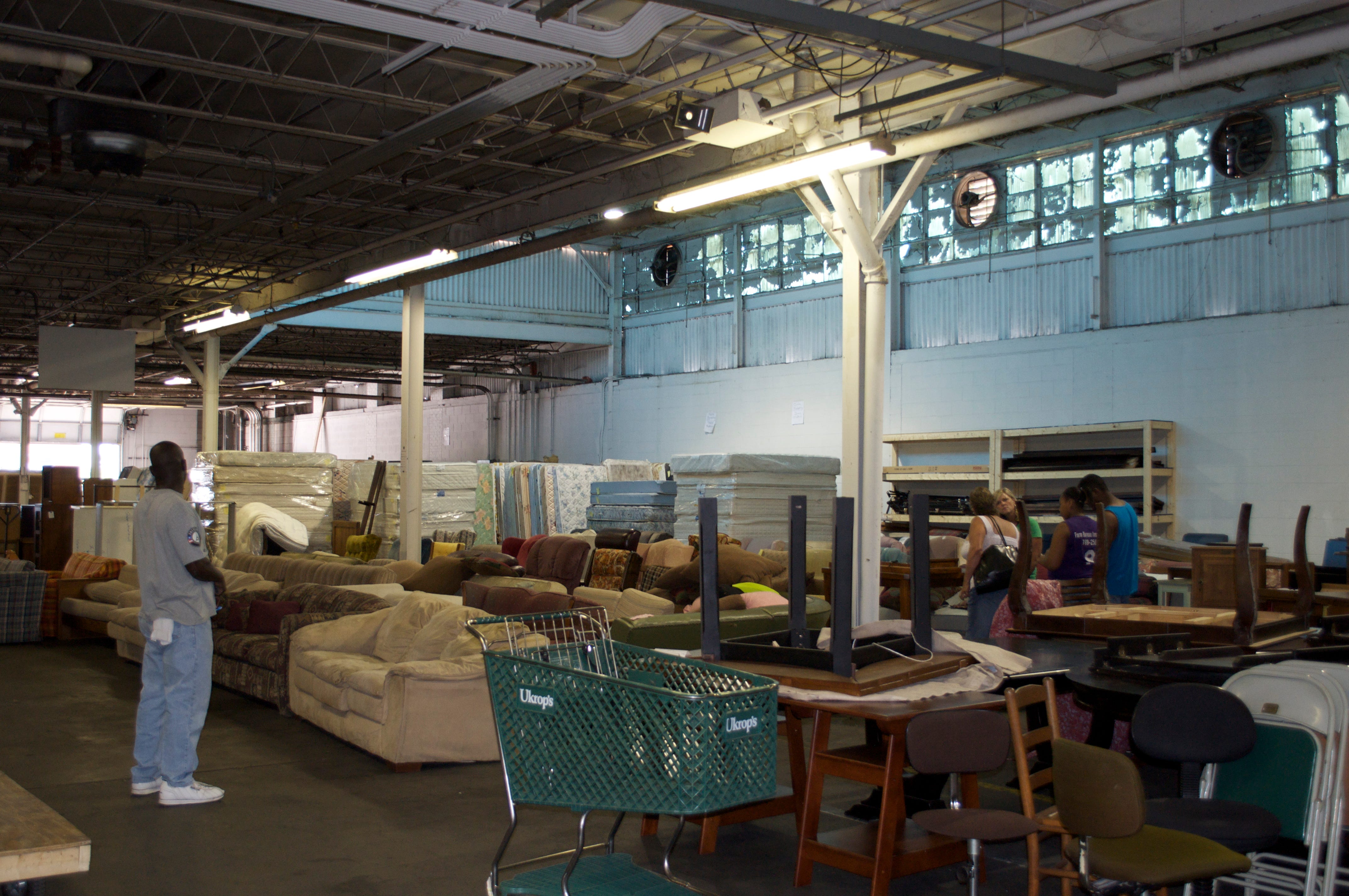
We began collecting furniture and household goods and giving them away to families moving out of shelters.
There was no formal process. The only thing we did was tell Stephanie’s story, and then we asked:
“Would you come back and help us?”
And they did.
People who had once received furniture paid it forward by helping the next family in need.
Neighbors wandered onto the church property, curious about what we were doing.
“Is this some kind of yard sale?”
“No. We’re giving everything away to families coming out of shelters. Would you like to help?”
Sometimes people walked away.
Sometimes they said, “Sure. What do you need?”
We began to form the most unlikely community.
There was Stephanie.
Then there was Rosalind, a mother of four who had fled New York City with almost nothing, whom I had met while visiting the shelter. She approached me after hearing Stephanie’s story and asked if she could volunteer while she was waiting for her housing.
Rosalind began showing up regularly. While Stephanie preferred working with the donations, making sure they were in good shape and placing them strategically around the room, Rosalind preferred greeting our guests.
Her beautiful smile brightened the room, and her warm welcome was a much-needed addition to our overstretched team of volunteers.
“Congratulations on your place. I know how excited you must be.” She would say as guests entered. She was also not shy about sharing her own journey through the emergency shelter system, putting guests at ease knowing that others understood at a personal level.
When guests finished shopping, I would hear her say,
“I do hope you will come back and join us as we help the next family in need.” With her encouragement, roughly 25% did.
I don’t remember Georgiana’s granddaughter, whom we assisted, but I will never forget Georgiana.
Georgiana, seventy years old and pushing a walker, traveled by bus every week so she could sort through boxes of donated kitchenware, neatly arranging them in “her” area. We all knew never to enter without her permission. She had memorized her entire inventory, and if we moved anything, we got a firm scolding.
Georgiana insisted on shopping personally with every guest. She loved asking the women what they liked to cook and how many people they cooked for before picking out the perfect combination of pots and pans.
“This is how I make my mac and cheese,” she would share.
Tony Brickhouse came with his granddaughter, who had just left the shelter. When I commented on how desperately we need people with trucks to help families, he smiled and said,
“Call me anytime.”
I did.
For the next five years, he delivered furniture to dozens of families until his eyesight prevented him from driving.
There were also a handful of friends from my suburban neighborhood. Beth, Aileen, Colleen, Karen, and others helped collect furniture and housewares, and some became regulars alongside Stephanie, Rosalind, Brickhouse, and Georgiana.
None of us would have known one another under normal circumstances.
But the sound of what was genuine in all of us had brought us together.
We became an odd little community.
A beloved community, to borrow Dr. Martin Luther King’s language.
We were caught up in the mystery of it all.
And then we grew.
Closing the Revolving Door
In 2007, after two years of trying to make our intake process as efficient as possible, adding a voucher system and other procedures, we began to notice a disturbing reality.
Many of the people we were serving were returning to the shelter system, and fewer of our guests were returning to serve as a part of the team.
When we were small and relationally oriented, we had been able to prevent many of those who served alongside us from returning to the shelter when they hit little bumps in the road—a sudden illness, an unexpected car breakdown, or some other crisis that could quickly unravel the fragile stability they had worked so hard to build.
As we grew, our focus went increasingly into securing enough furniture donations.
What we learned was that simply giving people furniture was having little long-term impact.
We responded the way nonprofits often do; we designed a program.
We called it Aftercare Support.
I was excited. We were going beyond relief and trying something new—an individual betterment approach working one family at a time.
Week after week, we divided into pairs, with one team member who had personally experienced homelessness and one who had not.
We visited families in their homes. We helped them find jobs, overcome barriers to employment, and connected them with services. We helped them navigate the challenges of maintaining housing.
On paper, the program worked.
But six months in, something troubled us.
Fewer families were staying connected.
I distinctly recall visiting a single dad and his two young boys. He was one of my favorite clients. Always upbeat and positive about the future.
When I arrived, I knocked on the door, and there was no answer. The next-door neighbor poked their head out and said,
“They were evicted last week.”
I was shocked. When I visited the prior month, the father was not home but I spoke to the eldest son. All seemed well.
I was heartbroken. I shared the experience with our team when we returned.
“It’s not enough,” Veronica, one of our team members who lived in the same community as our now-evicted family.
“Checking in once or twice a month for an hour is not enough. People will tell you ‘all is well’ because that is what they think you want to hear.”
She proposed something different.
“What if, instead of simply checking in, we created places where neighbors could come together and support one another?”
In other words, she was inviting us to shift from individual betterment to community development.
The solution to the revolving door was not simply more services.
It was ongoing and genuine connection.
By hosting weekly meals in the community, we began to build something that our aftercare program could never provide: a network of relationships that could hold people when life got difficult.
Our weekly gatherings in the three communities where we were engaged always included hospitality around a meal for groups of up to thirty residents. Because our aftercare program was tied to a grant with specific requirements, we continued the individual visitations. All this on top of running the Furniture Bank—stretched our mostly volunteer teams and very part-time AmeriCorps members to the breaking point.
We had discovered something important, but we had not yet figured out how to make it sustainable.
Reclaiming What We Lost
I never set out to start a Furniture Bank.
I never planned on being a case manager.
I simply wanted to experience the mystery of the practice of hospitality – of listening to and following the sound of the genuine that turns strangers into friends.
In 2008, we spun the furniture bank off to CARITAS, the largest homeless services provider in Richmond, and discontinued our aftercare support program.
Instead of spreading ourselves across three communities, we chose one – Hillside Court and committed all our energy and resources to community development.
We can become so good at meeting needs that we accidentally deprive people of the opportunity to be needed.
I know because I have done it.
Through this experience, I discerned my calling as a dream-releasing community cultivator.
I also learned something else:
DeAmon Harges, a fellow steward of the Asset-Based Community Development Institute, puts it this way:
“A community’s greatest need is to be needed.”
People are not problems to be solved.
They are gifts to be discovered, dreams to be nurtured, and the heroes we have been waiting for.
That is the mystery of hospitality that I was seeking all those years ago.
This is the first post in my Fall Power Shift Revisited series. A fuller version of this story was first published in my book From the Sanctuary to the Streets.
If you enjoyed this post, I hope you will consider subscribing, sharing your thoughts in the comment section, and sharing this post with others.
All materials on my site are free, and 100% of any paid subscriptions are donated directly to Embrace Communities, a public charity.
It wasn't about us, but we were hungry to be a part of the solution to so many things and we no longer wanted our hands tied by policies and strongholds , we wanted to empower all whom we embraced not just give things. What was constant , was change, and we rose to the calling every time respecting every new team member as a integral part of the team. I am forever a bridge. #community #communityassets #communityliaison #communitybuilding
What wisdom and impressive openness to learning!