

Welcome to the Discussion Guide for Howard Thurman’s book Jesus and the Disinherited. In the body of this article, you will find reflection questions for our journey together through this book, leading up to our group discussion at the conclusion of the readings.
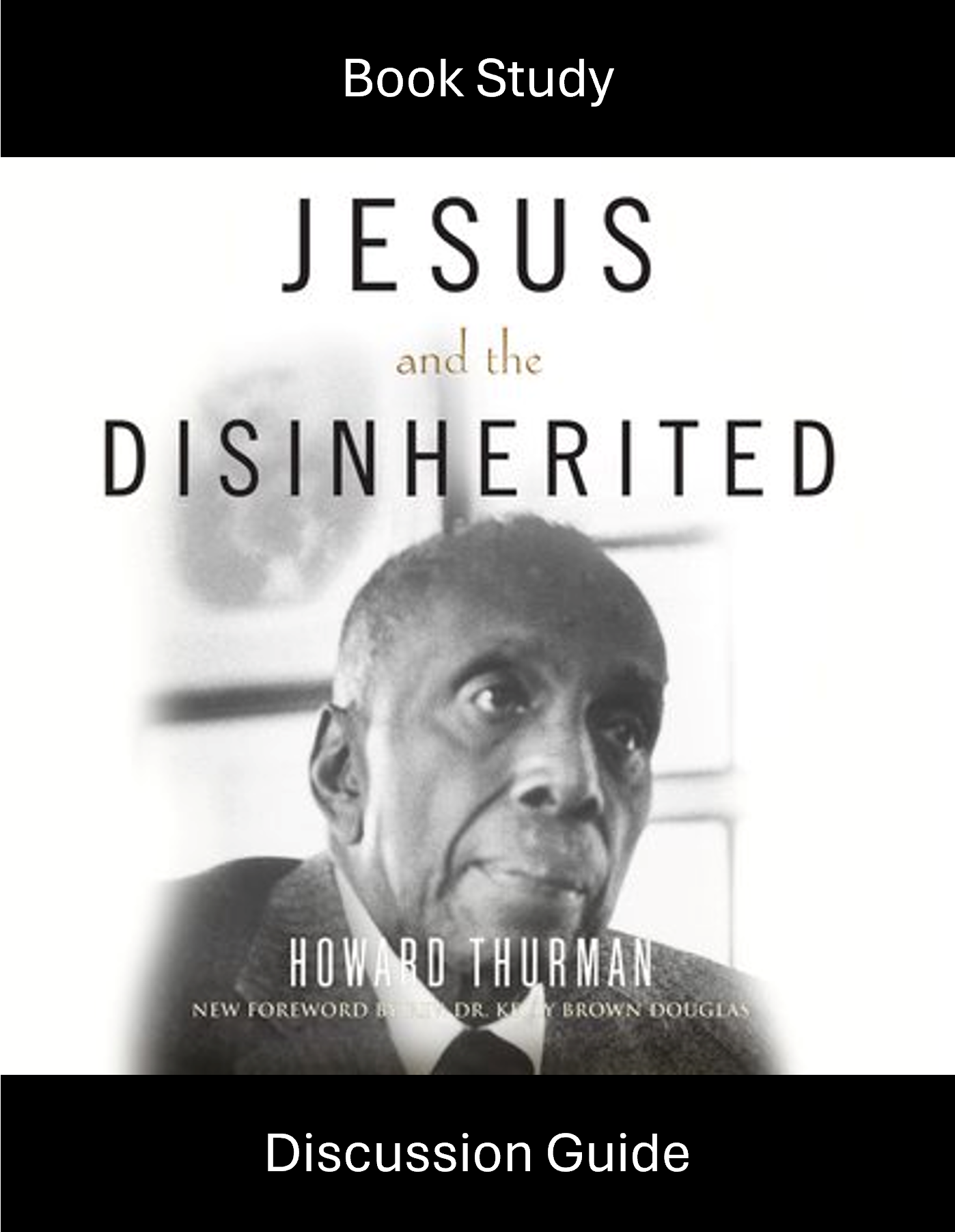
In the comment section, you will find responses from those engaging through both my personal Facebook page and those joining the conversation directly through Substack. You can use whichever platform you prefer. All comments will eventually find their way to this page so that we have a record of our full conversation. I will draw our discussion questions from those threads in the comments that seemed to resonate most deeply for those engaged in this conversation.
Why is it that Christianity seems impotent to deal radically and therefore effectively with the issues of discrimination and injustice based on race, religion, and national origin? Is this impotency due to a betrayal of the genius of the religion, or is it due to a basic weakness in the religion itself?
To those who need profound succor and strength to enable them to live in the present with dignity and creativity, Christianity often has been sterile and of little avail.
The conventional Christian word is muffled, confused, and vague. Too often, the price exacted by society for security and respectability is that the Christian movement in its formal expression must be on the side of the strong against the weak. - Howard Thurman, Jesus and the Disinherited
As I shared, Howard Thurman is one of my favorite theologians, and this book has been on my list of books to read for decades. While written between 1935 - 1949, I got chills reading the words above in our current context.
Thurman wrote this book expressly for “those who stand, at a moment in human history, with their backs against the wall,” and it speaks as profoundly today as it did to civil rights leaders of the 1960’s.
Through this article, which I will update weekly, I invite you to add your comments to the ongoing conversation on this timeless book. A similar conversation is happening on my Facebook page. I hope to bring the readers from both sites together for a conversation sometime in March, once we have worked our way through the whole book through these virtual discussions.
I know many of my pastorally trained friends and activists are very familiar with this book. I hope you all will dust off your copy and come to the text with fresh eyes, allowing it to speak into the longings and wounds of the present moment, and letting those contemporary questions reshape how the tradition lives.
If you don’t have time to read the full text, I will strive to pull those quotes that will give you a taste of the wisdom we find in Thurman’s pages. Feel free to comment on what is shared, adding your own stories and wisdom to our collective journey.
Insights from the Foreword, Preface, and Chapter 1
“The basic fact is that Christianity, as it was born in the mind of this Jewish teacher and thinker, appears as a technique of survival for the oppressed. That it became, through the intervening years, a religion of the powerful and the dominant, used sometimes as an instrument of oppression, must not tempt us into believing that it was thus in the mind and life of Jesus. “In him was life; and the life was the light of men.” Wherever his spirit appears, the oppressed gather fresh courage; for he announced the good news that fear, hypocrisy, and hatred, the three hounds of hell that track the trail of the disinherited, need have no dominion over them.”
What stood out to you from the Forward and Preface?
In the Forward, we are reminded to pay attention to the culture gap between the context of the 1930’s and 1940’s when Thurman was writing and our present reality. What shifts in culture should we hold as we move through the text?
What stood out to you from Chapter 1?
“Jesus, a poor non-Roman Jew, knew intimately what it meant to be “a member of a minority group in the midst of a larger dominant and controlling group...[in a time when] patriotic emotions were aroused to the highest pitch and then still more inflamed by the identification of national politics with a national religion.”
How does this historical context shape how we read the biblical accounts of that time?
Thurman points to Jesus’ focus on the inner life as an alternative to the political options of resistance or non-resistance.
“He recognized fully that out of the heart are the issues of life and that no external force, however great and overwhelming, can at long last destroy a people if it does not first win the victory of the spirit against them… Again and again he came back to the inner life of the individual…He recognized with authentic realism that anyone who permits another to determine the quality of his inner life gives into the hands of the other the keys to his destiny.”
How does this focus on the inner life inform our current reality? How does it inform our actions in the face of injustice?
Chapter 2: Fear
“The fear that segregation inspires among the weak in turn breeds fear among the strong and the dominant. This fear insulates the conscience against a sense of wrongdoing in carrying out a policy of segregation. For it counsels that if there were no segregation, there would be no protection against invasion of the home, the church, the school.”
“In this world, the socially disadvantaged man is constantly given a negative answer to the most important personal questions upon which mental health depends: “Who am I? What am I?”
“In the absence of all hope, ambition dies, and the very self is weakened, corroded.”
In Chapter 2, of Jesus and the Disinherited, Thurman examines the impact of fear, both on the oppressed and the oppressor.
What stood out to you?
What did you find most challenging?
What did you find most helpful and why?
Chapter 3: Deception
“It is a simple fact of psychology that if a man calls a lie the truth, he tampers dangerously with his value judgments.”
“The penalty of deception is to become a deception, with all sense of moral discrimination vitiated. A man who lies habitually becomes a lie, and it is increasingly impossible for him to know when he is lying and when he is not.”
In Chapter 3, of Jesus and the Disinherited, Thurman examines the impact of deception on both the oppressed and the oppressor.
I invite you to share in the comments below.
What stood out to you?
What was most challenging?
What was most helpful and why?
Chapter 4: Hate
“Hatred bears deadly and bitter fruit. It is blind and nondiscriminating.
But once hatred is released, it cannot be confined to the offenders alone.
Hatred destroys finally the core of the life of the hater.
There is a conspiracy of silence about hatred, its function and its meaning…Hatred becomes for you a source of validation for your personality. A strange, new cunning possesses the mind, and every opportunity for taking advantage, for defeating the enemy, is revealed in clear perspective.
Thus hatred becomes a device by which an individual seeks to protect himself against moral disintegration…It is not difficult to see how hatred, operating in this fashion, provides for the weak a basis for moral justification.
Jesus rejected hatred. It was not because he lacked the vitality or the strength. It was not because he lacked the incentive. Jesus rejected hatred because he saw that hatred meant death to the mind, death to the spirit, death to communion with his Father. He affirmed life; and hatred was the great denial.”
In the fourth chapter of Howard Thurman’s book, “Jesus and the Disinherited,” Thurman examines the impact of hate on both the oppressor and the oppressed.
This chapter hit a bit differently, given the bombing of Iran this week. It is amazing to me how timeless Thurman’s wisdom is.
What stood out to you from Thurman’s reflection on hate?
How are Thurman’s words relevant to us today?
Chapter 5: Love
“In a memorable story Jesus defined the neighbor by telling of the Good Samaritan. With sure artistry and great power he depicted what happens when a man responds directly to human need across the barriers of class, race, and condition. Every man is potentially every other man’s neighbor. Neighborliness is nonspatial; it is qualitative. A man must love his neighbor directly, clearly, permitting no barriers between.”
In Chapter 5, of Jesus and the Disinherited, Howard Thurman provides a path forward that destroys the three hounds of hell: fear, deception, and hate. In this chapter on the power of love, Thurman provides us with a clear path forward for those who take the Gospel message of Jesus seriously.
When we began this journey together, we were dealing with the three hounds of hell here in our own nation, being visited upon our own communities. Our nation is now spreading fear, deception, and hate across the globe.
I had no idea how applicable Thurman’s words, which were written in the context of the Jim Crow era here in the USA and during World War II, would be to us today. His words have both domestic and global implications. While the similarities between his time and ours are profound, in our time, at both the global and domestic levels, our nation is the perpetrator of violence and not the defender of innocence.
In this chapter, Thurman speaks to the “cult of emperor worship,” which was alive in Jesus’ time and, sadly, our own.
Thurman provides us with a difficult but clear path forward drawn from Jesus’ life and message as a citizen under Roman rule and festering hatred. “The first step toward love is a common sharing of a sense of mutual worth and value.”
His harsh words about Western Christianity that became entangled with the Roman Empire run throughout the text. “It is in this connection that American Christianity has betrayed the religion of Jesus almost beyond redemption.”
What stands out to you from Chapter 5?
Is Western Christianity, which is now being used as a tool for empire-building, beyond redemption?
How might Thurman’s words guide us in our troubled times?
This is the final chapter of the book. I will be reading and reflecting on all the comments over the next few weeks and hope to gather whoever is interested in discussing the book virtually in late March.
I know not everyone was able to read along, but I think the Substack discussion guide and comments below should be enough to allow anyone who is interested in coming together to contribute to the conversation.
The discussion guide focuses on the central thesis of Thurman’s work: that the religion of Jesus provides a specific manual for survival and resistance for the oppressed and disenfranchised.
Key Themes:
The Context of Jesus: Thurman emphasizes that Jesus was a poor Jew living under the Roman Empire—a member of a minority group with no legal standing. This shared experience of “disinheritance” makes his message uniquely applicable to the oppressed.
The Three Hounds of Hell: Three psychological states that Thurman argues plague the disinherited:
Fear: The constant, objective danger faced by the oppressed that can paralyze the spirit.
Deception: The temptation for the oppressed to use lying as a survival mechanism against the oppressor, which eventually compromises their own integrity.
Hate: The natural reaction to injustice that, while providing a sense of power, ultimately destroys the individual from the within.
The Inward Life: Thurman’s focus on the “inward center” argues that before external social change can happen, an internal transformation must occur where the individual recognizes their inherent worth as a child of God, independent of their social status.
Love as the Ultimate Solution: The text explores Thurman’s radical interpretation of “loving your enemy,” which is presented not as a passive acceptance of abuse, but as a disciplined spiritual practice that denies the oppressor the power to dictate the victim’s emotional state.
Summary of Comments and Discussion
Reflect a deep engagement with how these mid-century concepts apply to modern social justice and personal spirituality.
Common threads in the comments include:
Resonance with Current Events: Many noted that Thurman’s analysis of “fear” and “deception” feels incredibly relevant to contemporary political and racial tensions.
Non-resistance vs. Resistance: There is a significant discussion regarding Thurman’s alternative to the binary of “violent resistance” or “passive non-resistance.” Including how the “inner life” acts as a third way that preserves dignity without resorting to the tactics of the oppressor.
Psychological Surgery: Several readers reflected on the quote regarding “a profound piece of surgery” that must take place in the psyche. Sharing the difficulty of unlearning the “inferiority complex” imposed by systemic racism.
Practical Application: Readers asked how to practically implement Thurman’s teachings in modern activism, specifically how to maintain “love” without it being misconstrued as weakness or a lack of accountability for the oppressor.
Key Findings Summary
Historical Context - Positions Jesus as a direct peer to the modern oppressed.
Psychological Barriers - Identify fear, Deception, and Hate as the primary spiritual threats.
The “Third Way” - Proposes an internal spiritual groundedness as the foundation for social resistance.
Community Impact - Comments highlight the book’s role in sustaining the moral courage of activists.
The book has served as both a historical reflection and a contemporary tool for groups looking to navigate the intersection of faith and social justice.
Questions for Deeper Reflection:
How can we help Jesus followers (both those with privilege and those who are oppressed) see Jesus as he was, a member of an oppressed group? How does this historical reality change the way we live our faith?
How can we, as either activists or pastoral leaders, help overcome the three hounds of hell - Fear, Deception and Hate by cultivating the third way of internal groundedness as a form of social resistance? Is that enough in our current context?
What do you wish Thurman had addressed in the book? What are you curious to learn more about? What lingering questions do you have?
Facilitated Conversation Outline
Introductions: Name, location, role in your community
Check In: Why was it important for you to be here today?
Group Reflection:
What was one key takeaway for you from the book?
What lingering questions would you like to explore as a group?
What from the book and today’s discussion do you find most helpful in your own work?
Deeper Reflection Questions from Above (if we have time)
Next Faithful Step:
What suggestions would you have regarding future book studies? I am thinking of offering one per quarter.
Next Book: Church of the Wild: How Nature Invites us into the Sacred
Offering 3 facilitated conversations along with weekly reflection
Going to try using only Substack for reflections
What topics or books would you most like to explore with others?
Check Out: What is one gift you received from this experience as a whole?
Reflections on Chapter 3
Reflections on Chapter 2