

I have spent 53 of my 59 years of life in towns, cities, and suburbs - communities where eating the landscape would be seen as weird or possibly criminal if that landscape is from my neighbor’s peach tree!
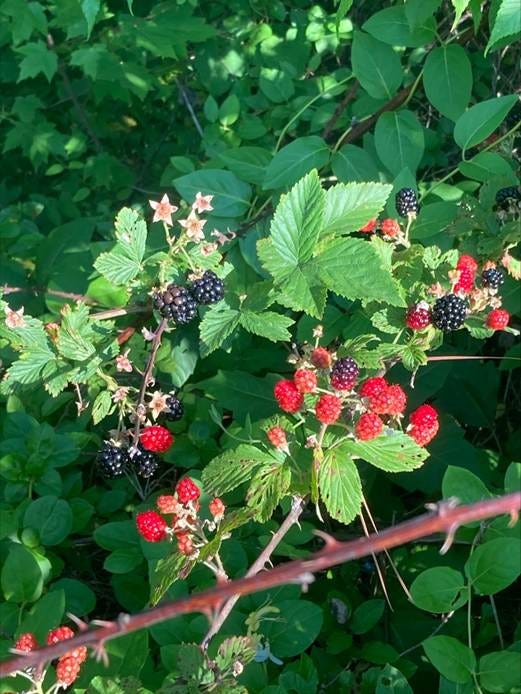
When my children were young, we purchased the property where I now live. For nearly two decades, it was our family’s private campground. Every summer, we spent hours braving the thorns of blackberry bushes for our annual 4th of July cobbler.
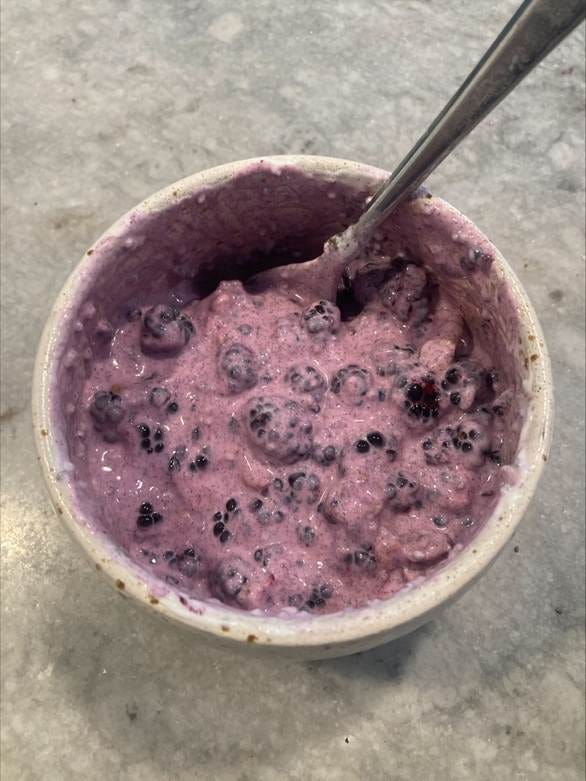
Now that I live here, I have discovered many more tasty delights and have adopted a new morning ritual. From early spring to late fall, I forage for my breakfast. This practice begins when the redbud trees bloom in late March. Their blossoms make a nutty-flavored addition to my morning yogurt. Then the wild strawberries, which grow in abundance in my front yard, add sweetness and fill the bellies of my dogs, who forage alongside me. Then the black raspberries, the first of the brambles to ripen, call me to venture out along our gravel driveway and into my forest trails where they grow along the edges. It is now blackberry season, the most abundant of wild fruits in my forest. I will end my foraging with paw paws and persimmons in the fall. If I am lucky, I might even get some American or Beaked Hazelnuts or elderberries if I can beat the wildlife to them.
The late freeze on April 21st this year means we will have no blueberries, peaches, plums, or apples from our garden. But my wild native neighbors will ensure my morning yogurt is full of flavor, nutrition, and color.
Foraging as a Spiritual Practice
As I walk slowly along the road, my eyes searching for ripe berries, I realize that this morning ritual has become a type of spiritual practice. The idea that the universe has been preparing a banquet for me over the past 24 hours fills me with gratitude. As I gather the berries, I am serenaded by a Mourning Dove, a Pine Warbler, and a Red-eyed Vireo. I greet the Fritillary butterflies whose orange color always grabs my attention in hopes that they may be the occasional Monarch. I admire the grace and beauty of a Red-Headed Woodpecker as she swoops through the trees and the brilliant crimson color of the Cardinals. Even the smell of my archrival, Japanese Honeysuckle, is a gift to my senses this time of year. I tread mindfully into the thickets, careful not to step on a copperhead or brush up against poison ivy or the sharp thorns of the brambles.
At each bush, I examine it slowly and carefully from all angles. The best berries are often hidden and only visible from a particular vantage point. I think about all my more-than-human neighbors who will be visiting this same bush over the next 24 hours. The black bear, raccoon, bird, fox, and countless other creatures that feed themselves in this wild, abundant garden. There is no human manager, no outside fertilizer, no sprinkler system, no insecticides, just Mother Nature providing at no cost a rich assortment of delights for me and my diverse array of more-than-human kin.
Most people would see this practice as a waste of energy. Why not go to the grocery store and pay $5 for bigger, juicier, sweeter berries? I suppose if my goal were simply food, this critique would make sense. But berries are not the sweetest fruit of this practice. The reminder that we humans are held within a cosmic web of life, and that we are simply one species among many, orients my whole day. Realizing how much life is all around me, enlivens me and fuels my curiosity.
If we think the goal of our engagement with the wild is about what we can get from it, we miss the greater gifts of peace, patience, joy, awe, and wonder. I can never fully repay this forest for all she has given me – not just food for my body, but of greater value is the nourishment for my soul. She and I have an ever-growing and deepening relationship of mutual respect, and I do all I can to show her the affection she offers others.
Foraging in Human Communities
This summer, I am engaged in another type of foraging that is equally spiritually nourishing. I am shepherding a group of youth and adults through an asset-mapping process in Appomattox, near where I live. Instead of berries and nuts, we are harvesting gifts and dreams. This process requires the same kind of attentiveness and mindfulness. It evokes the same kind of gratitude for the abundance and desire to give back in a way that benefits the common good.
There is also the occasional snake lurking in the underbrush, ready to strike if you step on its tail. These slithering creatures are the kind to hiss at you with comments like, “Nothing will ever change.” “You are wasting your time.” “No one cares.” They can also take the form of those who focus solely on the cost of the venture or who need to know the deliverables in the form of measurable outcomes before they will engage in the process as they demand evidence-based best practices be verified before simply talking to their neighbors. The only solution is to tread lightly and steer clear of these toxic conversations that poison the soil of a venture like this.
We have reached the midway point of this summer project. We have conducted enough learning conversations to begin to name the types of gifts and dreams that are emerging. A deep love of the outdoors has emerged as the top gift alongside a unanimous desire to include all members of the community, from turtles to the elderly, from youth to oak trees. This radical inclusivity is reflected in the dream of spaces that promote belonging and value all. Our shared dream is that the human part of this ecosystem mirrors the radical diversity and generosity exhibited by our more-than-human neighbors.
At this point, all we have done is make the invisible visible. We can see the gifts, and we can name the hopes and dreams. I know that if we tap into the heartbeat of the community, we can release these gifts in a way that can fuel these dreams. I will be sharing more next week about this project in my Field Notes from Appomattox article.
Restoring the Gift Economy
Our culture has been invaded by consumerism that discounts the value of the gift economy. Consumerism fosters a mindset that judges my wild blackberries as inferior to those purchased in the store, trucked hundreds of miles, and treated with all sorts of fertilizers and insecticides.
That same culture discounts the gifts of humans given to one another in the context of a relationship. As Robin Wall Kimmer notes in her book Braiding Sweetgrass, “But in the gift economy, gifts are not free. The essence of the gift is that it creates a set of relationships. The currency of a gift economy is, at its root, reciprocity.” In a society that confuses transactions with relationships, this distinction is hard for some to appreciate.
If I were to purchase my blackberries in the grocery store like a normal person. I would have no relationship with the bush, land, farmer, pollinator, or the rain clouds that helped grow it.
In my forest, something different emerges. I am not a consumer; I am a member of the ecosystem, and I see how all these parts must cooperate to produce each berry. I am a neighbor, protector, admirer, and friend. As John McKnight might say, I am a citizen of this cooperative community, not a consumer of its products. I feel an obligation to protect it and to cherish it.
In our harvesting of human gifts, we are finding a rich array of creative gifts - artists, writers, musicians, and storytellers. We are discovering care-giving gifts of companionship and hospitality. We have discovered a significant number of hikers, bikers, kayakers, gardeners, and other nature lovers.
As I shared in my post Join or Die, it is well documented that citizens are participating less in civic life, and our democracy is weaker as a result. A decline in civic life also erodes the functioning of the gift economy that is rooted in relationships of trust and reciprocity. Like the pine forest that used to stand across the road, gifts of care, creativity, recreation, and story are increasingly being converted into commodities. Those who have not succumbed to the cash economy and continue to give their gifts, like my wild blackberries freely, are seen as having little or no value. While Western society has forgotten the importance of the gift economy, Mother Nature has not and continues to call us back to this life-giving practice through her generosity.
The free flow of gifts through human communities is its lifeblood. Neighbors helping one another, the care of the vulnerable, the love of the land, and the nurturing of the next generation are functions of community life that are rapidly vanishing or converted into goods and services.
Sadly, the heartbeat of many of our communities is weak. It is being strangled by consumerism. The goal of a listening project like the one I am guiding in Appomattox functions like CPR. It simply stimulates what is already there, getting the blood moving again.
Every community is rich in gifts, and every community cares about something. Discovering that shared motivation, which we call the CommUnity Dream can unleash the abundance of gifts that would otherwise rot on the vine.
I hope you will join me next week as I share more about our gleanings in Appomattox.
Walking with Wildflowers is a free publication exploring the intersection of land, spirit, and community, the three recurring themes of my personal and professional life as a pastorally trained community cultivator whose spiritual journey has led me along a wild and untamed pathway.
Other Resources
If you enjoyed this essay at the intersection of land, spirit, and community. I recommend you check out Leah Rampy ’s work over at REWEAVING EARTH & SOUL. Her latest article Ecological Spirituality and her focus on the Gift Economy helped inspire portions of this post. I appreciated Rampy’s definitions:
Spirituality, as I use the term, is not tied to a religious tradition. It certainly is not intertwined with a view of a dominating male creator who rules with harsh punishment. I think of it as Holy Mystery that moves within, among, and around us all, a wholeness that unifies; a unity that makes whole. Or, as has been written, “Spirituality is about Spirit connecting with spirit.”4 (Upper and lower case letters matter here!)
Placing “ecological” in front of “spirituality” affirms that this is not only about an interior journey, or even a “transcendent” one. It is at once personal, ecological, and cosmic. Our souls are deeply intertwined with the souls of trees and rocks, rain and wind, humans and more than humans. Ecospirituality is a declaration that there is no “other.”
Camilla Sanderson ‘s article this week, What Story Does the Earth Need Us to Remember? Explores a related topic. I resonated deeply with her question:
The question that remains with me now is whether the human species can cultivate a relationship with the Earth that sees forests not merely as resources or investments, but as kin. And whether that remembering can happen before too much has been lost.
If you enjoyed this post and appreciate articles rooted in ecospirituality, you might enjoy these previous articles Facing the Dawn, Standing in the Darkness, An Invitation to Be a Cow, Cultivating Courage With the Help of a Lumpy Old Chestnut Oak, and Meet George a Rule Breaking Non-Conformist with a Message.
If you are a community cultivator who is interested in how natural patterns can inform our work in human communities, you might enjoy Convergence of Mountain Moving Streams, Reconnecting Land, Spirit and Community, The Place Our Nation Reunites and Evolve or Parish.
Thank you for sticking with me to the end. If you appreciated this post, please like, share, and comment. Your feedback is what keeps me going and informs my writing.
I loved reading about you foraging breakfast! And it was a happy surprise to see your shout out at the end! To say that I inspired even a bit of your writing is a high compliment indeed. I'm glad that we're here for each other.
Foraging is another form of rebellion against the tyranny of efficiency.