

“I feel like the LGBTQIA+ community is being used as bait to galvanize opposition against the library. The real issue is freedom to read without restriction and the attempts to censor books,” I said to my son the morning after a contentious local library board meeting.
“No, the real issue is freedom to exist. They would like us to disappear,” he responded.
I have not been able to stop thinking about his words.
The day before, when the reporter asked me to go on the record and speak to her as the parent of an LGBTQ+ child, I had refused.
When my son moved to Appomattox in 2022, I feared for his safety, and I still do.
I am a coward when courage endangers my children.
I want him to be invisible to those who might harm him.
When I saw my son talking to that same reporter hours later at the library board meeting, I wanted to grab him and lock him away.
I whispered to him, “Be careful what you say.”
When I saw the two men with holstered guns standing at the door, my fear intensified. I prayed they did not see him.
As I reflect back on these events, my son’s words shed a whole new light on that experience.
What I did not understand at the time was that his very presence was an act of resistance to erasure.
My son is teaching me how to be brave.
As I write this post, I feel I am entering the cave I most fear, to borrow Joseph Campbell’s metaphor.
It is not grizzlies that scare me. It is people who claim to speak in the name of Jesus while behaving in ways that seem profoundly unlike the Jesus I know.
In today’s article, I am putting into words the fears that have taken hold of me and the hope that is giving me courage.
Finding Acceptance
When we moved to Appomattox, VA in 2020, I suffered from severe culture shock after spending more than 20 years in the Metro Richmond area, the last ten living in a historically black community in the city.
Driving past Confederate flags and along Confederate Boulevard, listening to African American community members describe the discrimination they had experienced, and hearing longtime residents warn me that I had good reason to be cautious, I came to believe my family would never belong here.
For the first five years after we moved to Appomattox County, I managed to avoid going to the town of Appomattox. Instead, I drove the extra five minutes to shop and build relationships in nearby Farmville, a small college town that offered a much more welcoming culture.
Then in 2025, my son did something completely unexpected. He asked me to go to church with him as he was discerning his own spiritual path. He insisted we do so in Appomattox. For several months, we visited St. Anne’s Episcopal Church. The same church where I was moved to tears by this sign a year earlier.
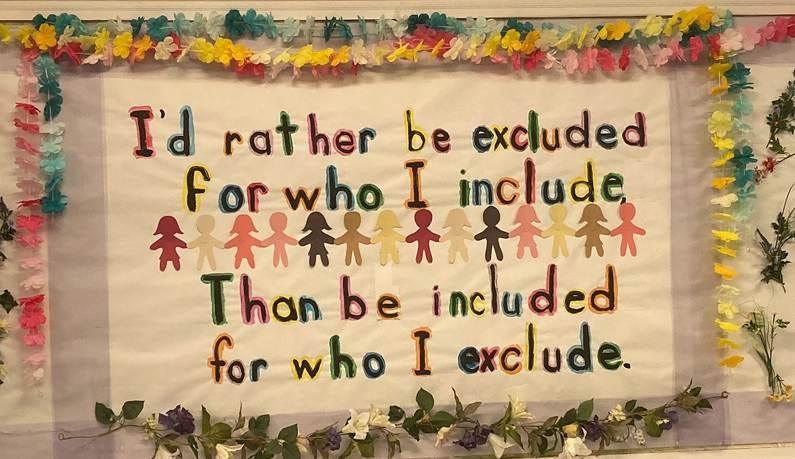
St. Anne’s helped me see that my family was not alone in our beliefs.
I soon discovered Pam Robinson and the community members at Appomattox UMC who have endured tremendous pain and suffering as a result of their decision to create an open and affirming church where all are welcomed. Like many UMC churches across the South, the majority of their church members chose to disaffiliate from the United Methodist denomination, resulting in a painful church split in 2023.
Their suffering awakened me to a reality: some people are willing to endure exclusion themselves rather than exclude others.
Through Pastor Kay Ryu of the Appomattox UMC Church, I met Pastor Carlos Malave, who introduced me to members of his church at Appomattox Court House Presbyterian, which was likewise a church that would rather be excluded for who they include than included for who they exclude.
Before I knew it, I had discovered a community within the wider community of people who wanted to create places where people like my son were welcomed.
Many of them experienced painful rejection from more theologically conservative Christians.
Told they were not “true” Christians.
Treated with disrespect and bullied in countless ways.
And yet, there they were.
Standing firm.
Speaking the words of Jesus.
Refusing to judge.
Loving ALL their neighbors.
When Advocacy Comes Home
My entire career as a community cultivator has been focused on strengthening communities that have historically been excluded.
But I was always the ally.
I was never the oppressed community member.
I used my power to support the excluded, but at night I went home.
My privilege to join in or step away protected me.
It emboldened me.
You can spend your career advocating for marginalized people, but it is a very different experience when someone you love is a member of the targeted group.
Now as I approach my 60th birthday, after standing up for others for over 30 years, I find myself cowering at the possibility that my son could be made to feel that he does not belong here.
I also do not know what to do with the fear that makes me want to hide him from those who are trying to erase his existence in this community.
The saddest part of this experience for me is hearing the Bible invoked in a way that those wielding it feel they have a right to erase others in the name of Jesus.
When the Methodist Church was going through the debates over the LGBTQIA+ community, I could not stay connected to the institutional church.
It was simply too painful to listen to people quoting everyone from the Old Testament prophets to the Apostle Paul to justify judging my child.
In those debates, I rarely heard Jesus quoted. They seemed to have used that mighty eraser to remove his words, “Do not judge” and “Love your neighbor.”
I find the tossing of Bible verses back and forth at people to be such an arrogant and violent act. It inflicts such spiritual harm on those pummeled by the hateful attacks. It also harms the Christian message. Those outside the faith see only judgment and cruelty, not the core message of grace and acceptance.
Many like me have had enough. We have left the institutional church, many of us clinging to the words of Jesus as we forge spiritual pathways that allow us to embody the essence of his message free from a distorted form of Christianity that is ripping our nation apart.
These encounters with those who use scripture as justification for their judgment remind me of the exchanges Jesus had in the desert when the devil quotes the Bible and later in the Gospels when Jesus is challenged by the Pharisees who are trying to trap him with Bible verses. What I see in Jesus’ responses is a grace that points toward the bigger message I find in the biblical witness: love, acceptance, and forgiveness.
So, I stepped out of institutional church life, but I continue to pray for and support those who are still inside the walls of those establishments that would rather be excluded for who they include than included for who they exclude.
When I left the pews, I leaned more deeply into contemplative forms of the Christian Tradition. I found healing and comfort in the arms of a loving God that meets me in the forest, on mountain tops, in ocean waves, sunrises, and beauty in all its forms.
Recently, I have discovered others who are tired of the business-as-usual ways of the institutional church with the “go along to get along” mantra.
The kind of faith community that pretends the waters are all smooth sailing while people are drowning all around them.
The type that throws you overboard if you rock the boat and puts a life jacket on you and asks you to sign a liability waiver if you say you want to walk on the waves with Jesus.
The message I heard beneath the recent debates over who should control the library was that the personal comfort of a few mattered more than the belonging of a vulnerable group who is simply trying to exist here.
While those in power assume that the majority believe their interpretations of scripture, my experience is that the majority of the residents of Appomattox County lean more toward creating a community where all are allowed to exist without religious persecution.
Most residents want our library to remain a public establishment that follows the non-discrimination policies of the State of Virginia.
Many residents of our county are sick of seeing our community ripped apart over culture wars.
Most residents simply want to live and let live.
While Appomattox has a lot of conservative churches, even conservative Christians believe in the separation of church and state.
Even conservative Christians believe in the First Amendment and the right to read and support intellectual freedom.
Even conservative Christians can insist that my son has the same right to belong here as anyone else.
An Oasis of Welcome
The Appomattox Library is a sea of welcome for all community members.
When the staff learns who my son is, they always smile and say, “We love your son!”
The head librarian, Cindy Schue, and her staff welcome my son just as they welcome all community members, regardless of religious beliefs, race, sexual orientation, or any other factor.
They made him feel seen.
They gave him a sense of belonging.
They let him be himself, and as a result, he has come alive.
And that is why he found the courage to be in the room with those trying to erase his existence. He was there to support the library.
He knows they would, and have, done the same for his community.
That is why, when the Board of Supervisors demanded Cindy remove a Pride Month sign, she refused to be bullied into erasing a community representing a significant part of the population simply to accommodate the religious views of a few vocal opponents.
Those men justify their religious bigotry based on a few complaints from those in their churches claiming that acknowledging the LGBTQ+ community is somehow dangerous to children.
Cindy knows that LGBTQ+ people are members of this community, including its young people, and that acknowledging their existence does not endanger children.
She understands that the harm inflicted by rejection and exclusion is real, while a single sheet of paper acknowledging that LGBTQ+ people exist is not a threat to anyone.
Even as they were sending her emails that quoted scriptures interpreted through their narrow theological lenses and saying the most hideous things about the Queer community, she stood firm.
While many in our “don’t rock the boat” culture think she should have simply ignored Pride Month, Cindy knows that this kind of censorship only emboldens bullies.
They believe and claim they speak for the majority of our community members. They use the Bible as a tool to bully those who disagree with them into remaining silent. This lack of visible support further reinforces this idea that their beliefs represent the majority.
People feel bullied into silence.
I felt bullied into silence.
But something is stirring in our small rural community. A spirit of boldness is starting to rise. This courageous spirit to stand up for those who are being oppressed is finding a voice.
Those voices became visible through the dozens of letters of support the library received when these censorship efforts became public.
The voices of opposition rose loudly in the last two library board meetings even though those in charge refused to listen.
As more reject this kind of narrow religious interpretation of scripture and seek refuge from culture wars of erasure, libraries are increasingly a safe haven.
This is not only true of Appomattox, Virginia. It is a reality across our nation.
In 2023, the U.S. Surgeon General issued an advisory warning of an epidemic of loneliness and isolation.
Our libraries are on the front lines. They play a huge role in cultivating communities of acceptance and belonging.
They may not be doing so in the name of Jesus, but the fruit of their labor is evidence of their heart. In their acts of hospitality, I have seen love, joy, peace, patience, kindness, goodness, faithfulness, gentleness, and self-control. The only measures those who wear the Christian label have been given through which to judge the faith of another.
My family is not perfect. My faith journey is not for everyone.
But my God does not sit idly by while people are told they should not exist.
That is what my son taught me through his courage.
That is what the library staff demonstrated to me through their resistance to efforts to erase some community members and privilege the comfort of others.
The library board voted 3–1 to adopt the new bylaws, expanding its own authority despite the strong opposition expressed by members of the public at the last two board meetings.
While this was not a surprise, what was surprising was the spirit of unity that is emerging among those of us in the room who would rather be excluded for who we include than included for who we exclude.
It is in that spirit of unity that those like my son, who have the most to lose, are finding the courage to exist.
We lost the battle.
But I left with something I didn’t have when I walked in.
The courage to exist in this place.
My son reminded me that sometimes the most courageous act is simply refusing to disappear.
I am still afraid.
But I am learning that protecting someone I love does not always mean helping them hide.
Sometimes it means standing beside them with your heart racing and hands trembling.
This article is my one small stone, and Substack is my slingshot.
I don’t know where it will land.
I only know that letting it fly feels like liberation.
I pray the giants of religious bigotry fall.
I hope others who feel small and alone read these words and find the courage to stand.
Perhaps they will even put their own stories into words and give them wings.
I welcome comments, encourage you to share and would be honored if you would consister subscribing.
While I generally welcome a spirited debate, if you are the type of person who likes to drop Bible Bombs on people, be forewarned: I will not hesitate to delete any comments that I find insulting or harmful.
I have a lot of thoughts in support here, so if I pick one and jump in the middle, it's not meant to be harsh. It's just cutting out a section of many thoughts and that can feel abrupt.
"Freedom to read" is a shorthand phrase that does a disservice to the real issue. Few want to take away a person's right to read. Rather, they want to take away the right to read whatever a person wants. In other words, they want to remove intellectual freedom. When a person has intellectual freedom, they can read any idea with curiosity. Curiosity leads to learning. Learning leads to independence. Independence makes people harder to control. Challenges to intellectual freedom, the right to read anything, is about control and power. I would encourage people not to use the phrase "freedom to read," but rather "intellectual freedom" or "freedom to learn/read without restriction."
In a micro-society that accepts that no person or group of people can decide which ideas are worth existing, even if an idea is generally accepted as reprehensible, the people represented by those ideas are also treated with respect, even if there are personal disagreements on which ideas are worth surviving.* There is more equal power between people.
"Freedom to read" is easily dismissed and gives censors a sense of intellectual superiority because few argue that there should be absolutely no books or other reading material. A censor can think to themself, "Those silly protestors. I'm not taking away their freedom to read. I want books in the library! Just books that are good for people. They're too stupid to understand what's happening." Using "intellectual freedom" or "freedom to read without restriction" forces us to face the real issues, along with the cascade effects.
___________________
*I don't know that you'll find an advocate for intellectual freedom asking the library to add Mein Kampf, but you also won't find them asking that novels showing Nazis as sympathetic characters be removed. Advocating for intellectual freedom doesn't mean advocating for chaos and no morals. It just means the person has enough humility to know that when one person or group decides for everyone, society becomes a miserable place to live for anyone who is different. And what happens when your sincerely held beliefs or identity are the ones not approved? You've already said that someone has the right to tell you what to think and be, so you better comply and give up your beliefs and identity. No one wants that. That's why people advocate for intellectual freedom.
Love wins! And that is not a trite statement, but a deeply spiritual and theological hope. God is love and anyone who loves knows God; they that love not, know not God.