

This post is the third installment in my series: Field Notes from Appomattox. In my Field Notes articles, I am attempting to take you on a community-cultivating journey in a variety of contexts as the development efforts unfold a little at a time.
This post captures the outcome of the first process in cultivating community – community listening.
If you missed the earlier installments of this series, I have captured some of the key moments in this post, so you don’t have to read all three to understand the story, but if you wish to see the earlier posts, you will find #1 here and #2 here.
The sorted data sheets were stacked neatly in front of the four teens and four adults seated in folding chairs around the white circular table in the fellowship hall of one of our Appomattox partner churches.
Fifteen-year-old Jackson was the first to share, “What surprised me is the fact that adults ‘say’ they care about young people.” He adjusted his cap over his curly red hair.
Though I had only known those around the table for a few months, I had learned not to be caught off guard by Jackson’s candor. He always gave us the juiciest insights.
We had gathered to reflect on our summer community listening project. Jackson was responding to Ruth’s opening question about what surprised him about the experience.
“It breaks my heart to hear you say that,” Pam said. Of all those gathered around the table, Pam was the only person I had known before we began this project. We were a circle of strangers in many ways, but I hoped that this meeting would be the turning point that changed that.
I asked him, “Can you say more?”
He added, “All my generation hears is, ‘The young people today …’ and then fill in the blank. You’re lazy. On your phone too much. Don’t understand the value of work. And on and on.”
I instantly understood his comment and skepticism. The night before, my mother had called to tell me about a book that probes why the younger generation is not thriving – at least not in the way the older generation describes success. One of many books aiming to answer what is “wrong” with the younger generation.
Then Amy, Jackson’s classmate, shared, “What surprised me is how many people care about things I care about.”
I asked Amy what she cares most deeply about, it was the environment. Amy not only cares but has changed her lifestyle to reduce plastics and shared the name of a bulk store in nearby Lynchburg, something I had been hoping to find for years.
Amy had missed the first part of our summer adventure. I had just met her a few weeks earlier. She had arrived at our event at the library, her little brother in tow. They had walked quite a distance from their home in the heat to participate. When I asked for a volunteer to greet library guests and explain the project, Amy stepped up. I watched her balance caring for her brother, socializing with her friends, and greeting library guests with warmth and enthusiasm. She instantly won my respect.
The equally wise and reflective sixteen-year-old Chloe was the next to respond, “For me, it’s how much people were willing to talk about hopes and dreams for the community and seemed to enjoy being a part of these conversations.”
While Chloe had been in the room all summer and was one of our most faithful team members, her voice had often disappeared in a sea of louder, more dramatic students. She was a bit of a mystery to me. When I asked Ruth, who knew her better, what gift she thought Chloe would bring to this steering team, she responded, “Heart. Chloe cares deeply about others.”
The adults in the room added their insights, which largely echoed those of our young people.
I had invited this group to come together to reflect on our summer journey, but more importantly to guide the effort forward.
We had spent eight weeks together, hosted conversations with over 100 community members, and facilitated four public events. We had learned a lot. We had reached the most crucial part of our journey together – figuring out what it all meant and moving from listening to action.
I walked out of that meeting wondering:
What’ll become possible as more adults listen to these students?
To answer that question, I need to tell you how we got here.
The Moment that Changed Everything
The primary goal of this summer listening project was to discover what the community members who came to the events cared about most.
For nearly nine months before these larger summer public events, I had been hosting informal listening conversations and had heard four topics come up repeatedly – improving social connections, physical health, opportunities for growth, and protecting the environment.
During our first public event, many of the adults who participated shared that they wanted to hear more from the teens about what they cared about. So, we made our second event entirely teen-focused.
For me, the moment that changed the trajectory of this project happened during that second conversation.
We all knew we could not go in four directions, so our goal was to eliminate one of these themes. Up until the teen-focused conversation, the theme with the lowest energy was protecting the environment, and thus I assumed it would be the one to get cut.
The teens came into the room and sat randomly around four tables for dinner.
We had designed a playful “time machine” exercise that invited participants to imagine a future where our community’s deepest hopes had become reality. To power this time machine, they had to close their eyes, turn in a circle three times, touch the ground, and hop forward.
As the students traveled through time, the room filled with laughter, giggles, and the occasional off-balance stumble. While their eyes were closed, the adult hosts quietly put up signs to represent four possible futures on four different tables.
Venus, our 16-year-old MC for the evening, reminded us why naming our dreams was the most critical part of this listening process: “Our dreams tap into our motivation for action.”
They were then invited to join the table that best captured their hopes for the future.
The futures included these options:
People feel more accepted and valued
People have meaningful opportunities to grow and be engaged
People are physically healthier
The natural environment is healthier
I was stunned when the most popular table among the teens was “the natural environment is healthier.”
I had never, in nearly thirty years of doing this work, had this theme rise to the top among any group.
When asked why this was important to them personally, Jack, a tall, soft-spoken young man, stated, “If we don’t address this, none of the others matter. We won’t be alive to enjoy them.”
They weren’t choosing between community and ecology. They instinctively understood them as intertwined.
In my work as a community cultivator, I never know where a community listening project will lead us and am always surprised, but this one was a blessing to me in so many ways.
A Reluctant Cultivator
As I shared in my first Field Note from Appomattox, my community listening journey began roughly 18 months prior to our summer listening project when this church bulletin board brought tears to my eyes,
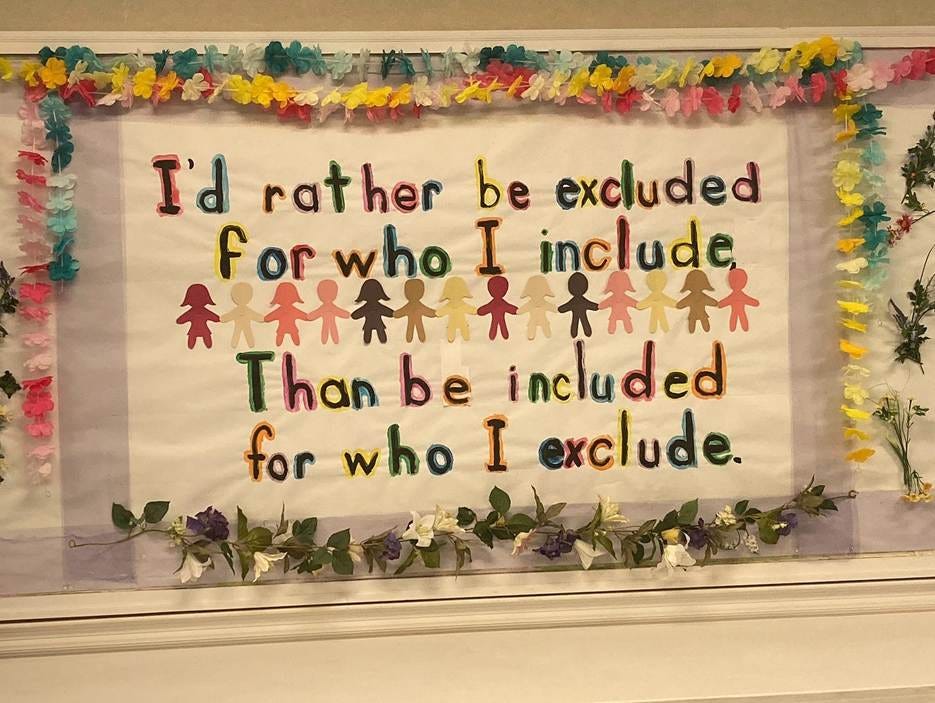
I had no intention of doing any community cultivation work here; I was simply moved by realizing I was not alone in my belief that everyone belongs and should feel loved, valued, and treasured.
The table that had the second most students gathered around it during our youth-focused gathering was labeled, “People feel more accepted and valued.”
The students were unknowingly pointing to the whole reason I had initiated this project in the first place.
That day, eighteen months earlier, as I stood in St. Anne’s Episcopal Church in front of that bulletin board, I never could have imagined where that fateful encounter would lead me.
I had been greeted in that fellowship hall by Evelyn Ford.
“I love your bulletin board,” I said.
Before this experience, I thought I would never feel at home in my new hometown with its abundance of Confederate flags and the many stories of religious and political division.
Evelyn shared that she not only believed the words, but she had personally been excluded and harassed because of her commitment to be inclusive. She was instantly my hero!
That same day, I found myself in another church across town because Evelyn had suggested that her church was not the only place that had faced persecution for embracing everyone. I wanted to see for myself.
This time it was Pam Robinson who so warmly welcomed me. She and I agreed to meet up for coffee the next week, and that is when I learned her story of feeling ostracized because of her commitment to including everyone.
I realized how widespread this feeling of being “othered” was. Even among those who had spent their whole life in this town, who were straight, white, educated, and middle class. Their othering was exclusively based on their embrace of all, especially those who were condemned by more conservative religious traditions.
Dozens of coffee conversations with others like Pam and Evelyn revealed something I did not expect – a silent but strong group of like-minded individuals who would rather be excluded for who they include than included for who they exclude.
What I discovered was that while there were many more than I expected, they also felt alone.
This culture of othering, while felt strongly among adults, was experienced even more intensely by the young people we interviewed.
Community listening doesn’t create community.
It simply makes the invisible possibilities visible.
The courage and commitment I heard in Evelyn and Pam’s stories moved me. It shifted me from simply wanting to find friends to wanting to change the culture to one that welcomed everyone.
At the time I met Pam and Evelyn, I did not realize that the young people of our town were experiencing a similar longing, and that they would be the ones who would bring us all together.
The Most Important Connection
Soon thereafter, I met Ruth, another community member who was also dreaming of greater community unity. She and her daughter had joined with a few volunteers from a local church in a service project at the state park where I volunteer. I instantly loved Ruth’s light-hearted spirit and “why not” attitude.
I decided to bring Pam, Ruth, and Evelyn together over lunch at the local Pizza Hut to thank them for helping with the project and get their thoughts on how we might all work together going forward.
Sitting in that booth, that fateful day in mid-May, something I never could have orchestrated happened.
Pam said to Ruth, “I just loved meeting your daughter and the other young people at the park. That’s my favorite part, seeing younger and older people working together.”
I added, “That’s my favorite way of doing community listening, engaging young people in interviewing adults. It is so much fun.”
“We don’t have any teens in our church, and I don’t really know young people that age,” Evelyn sighed.
Ruth offered, “I know lots of ’em. I volunteer with the local drama club. Want me to ask if they’d be interested in doing something like that over the summer? They’re looking for a way to stay connected, and they like serving in the community.”
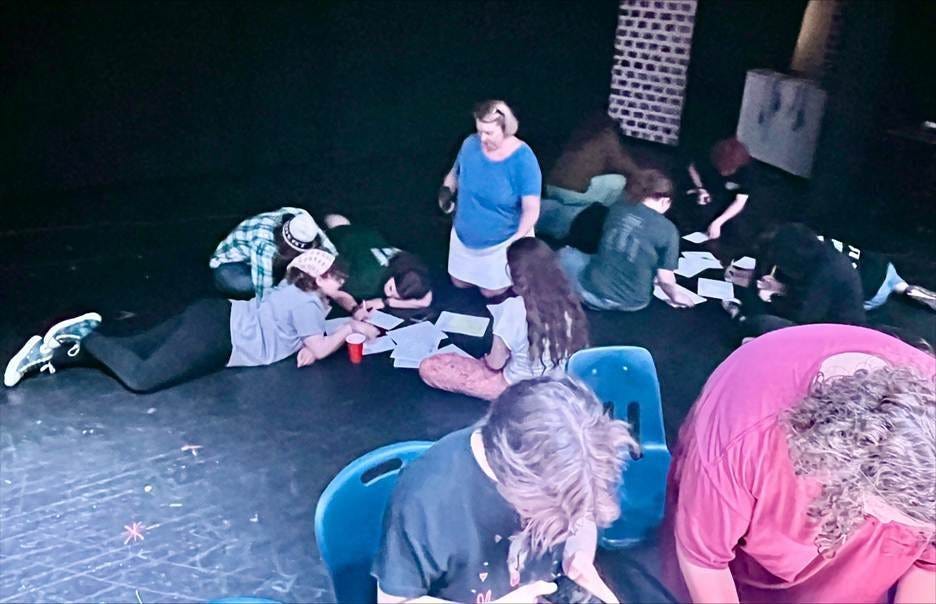
Ruth arranged for me to meet this very lively group of students, and I reached out to a few community partners about sponsoring the summer listening project as a fundraiser for the drama club. In less than two weeks, we had a team, $1,000, and a goal of learning the gifts and dreams of one hundred of our fellow community members.
Over the next two months, we engaged the students in a variety of events hosted by different partners from across our small town. In addition to the roughly dozen high schoolers who participated, our listening team included nine adults from eight different organizations – each joining our team through what felt like random encounters throughout the summer.
By the end of the summer, we discovered the gifts and dreams of 107 community members!
Every conversation helped guide the next step, offering new insights or deepening our understanding of what this community cared most deeply about.
These insights emerged little by little as participants offered an unexpected idea, invited another person into the conversation, or helped us see a new possibility.
Our Journey of Discovery
While I have been following the same process in my community cultivation work for decades, the outcome of this process is always unique. It is a journey of discovery!
Our process included two elements – gifts and dreams.
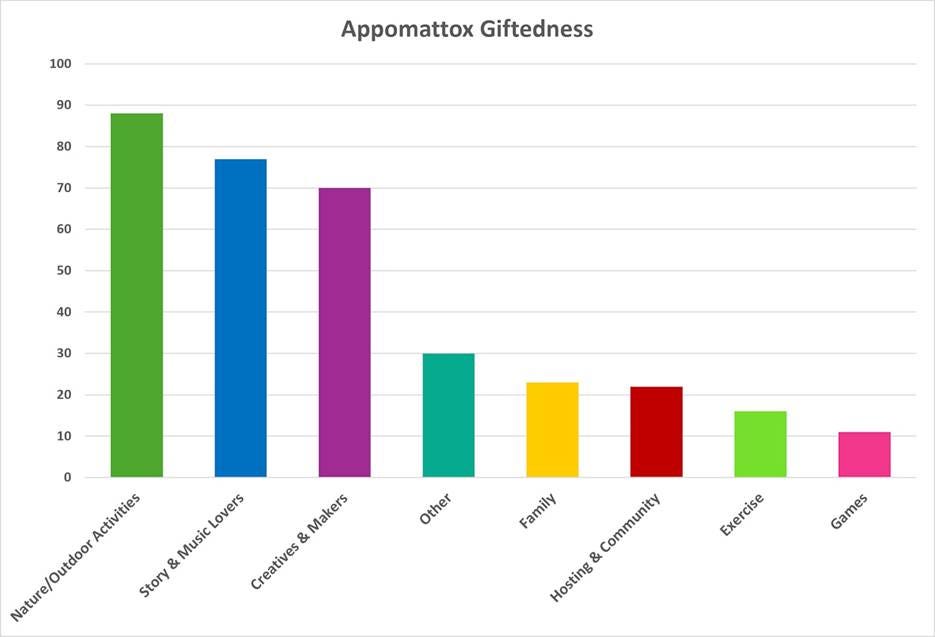
To discover the gifts, we focused on what we call gateway gifts – those things people already enjoy doing and would likely enjoy doing with others.
To learn these gifts, we asked this question:
“What do you like to do in your spare time?”
Below is a graph that captures what we learned.
To discover the dreams of the community, we asked this question,
“What would you do to strengthen Appomattox?”
The top community dream when we combined teen and adult responses was to nurture community connections. This included creating a sense of belonging, acceptance, and inclusion of all by cultivating meaningful relationships across social divides - especially age.
We expected adults and teenagers to have different answers.
They didn’t.
The following insights were captured through our facilitated conversations from various participants.
“My heart breaks to see students judging each other – they could be a force if they built each other up!” a local teacher shared.
“School should do more to help kids not feel left out and alone,” one teen shared.
“Too many divisions and conflicts in our community. People are unwilling to accept anyone who is different,” one of the adult participants shared.
“Different opinions should not equal hate. We need to learn to accept difference,” a wise teen wrote.
“Being able to be yourself without fear of being rejected and harmed,” was the dream of one mother.
“A lot of us don’t feel wanted, don’t feel included or welcome,” another teen shared.
Different ages.
Different life experiences.
The same longing.
The differences between age groups only appeared in how we might foster that belonging.
Adults named creating opportunities for young people to grow as the second theme they cared most deeply about. This included creating opportunities for students to gain skills and become more engaged in the community.
Teens were more interested in how they might help protect the natural world. As we dove into this subject, we heard deep concerns over the loss of wildlife habitat, the overreliance on plastic, the impact deforestation is having on climate, and the impending data center slated for our county.
These were not spur-of-the-moment responses – these young people had given these topics considerable thought.
I think this level of heartfelt concern moved all of us.
Following the Young Wise Guides
Community listening is the hardest part of cultivating organic community connections.
These students earned our respect.
They showed up.
They kept listening when the novelty wore off.
They interviewed strangers.
They stayed curious.
They returned to make sense of what they had heard.
The adults who are supporting this project are committed to following the students’ lead as we move from listening to action.
We have reached the fun part. Taking all the insights we have learned and answering this question:
What might be possible if we support high school students who cultivate a sense of belonging through outdoor adventures and creative expression while caring for the earth?
Like the original listening project, we don’t know exactly where this will lead us, but what we learned this summer will serve as a compass.
We are trusting that our young leaders will show us the path, one small step at a time.
It was Ruth’s fifteen-year-old daughter Abi who suggested we begin by hosting an event in the Fall featuring eco-friendly artists and crafters. All summer long, Abi had shared her artistic gifts as a graphic harvester, capturing our table conversations through her drawings. Now she could use her artistic gift to support what she cared most deeply about – protecting the environment.
“What if we did a trash pick-up – perhaps make it some kind of contest?” one of our young steering team members asked.
“The park next to the library has a stage, perhaps a talent show?” another young leader suggested.
I was writing down all the ideas as quickly as I could. The creative energy among these teenagers was incredibly life-giving.
I think all the adults left feeling more hopeful, not only about our Appomattox community but about the future of our planet.
If you live in Appomattox and would like to get involved, send me a private message, and I will add you to our mailing list.
If you are interested in learning more about community cultivation, I am facilitating two trainings this Fall and also hosting a book study of my own book Power Shift. Send me a private message, and I will share more about these opportunities.
A Few Parting Thoughts
I’ve spent nearly thirty years helping communities listen to one another.
I’ve learned that living communities, like living ecosystems, cannot be engineered.
They can only be listened into becoming.
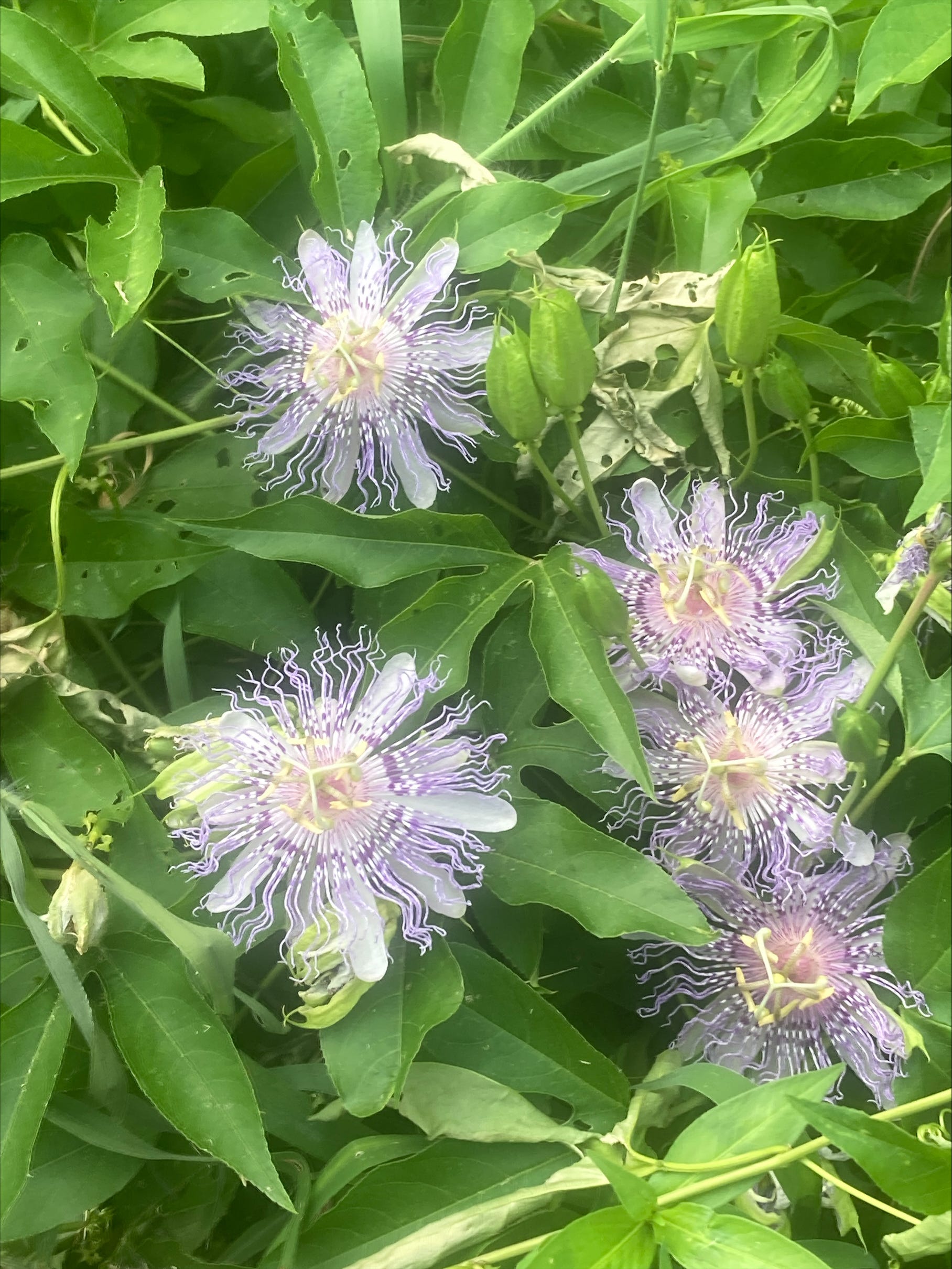
The passion vine that started this spring as a single sprout now covers my side yard.
It is an ocean of beauty, literally buzzing with life.
It mirrors what I have experienced in Appomattox.
Like these beautiful blossoms, the dreams of the young people are becoming visible.
They have captured the hearts and imaginations of all – young and old.
I can’t wait to see what fruit forms as we step toward our desired future.
Both in the life of our community and in the lives of these young people.
This whole generative process begins with the courage to ask meaningful questions.
It grows when we are willing to be vulnerable and answer honestly and thoughtfully.
Like the passion vine, community emerges long before anyone notices the blossoms.
Looking back, I realize almost nothing important happened according to my original plan.
Every significant turning point emerged from paying attention to what life itself seemed to be inviting next.
What becomes possible when adults truly listen to young people?
I still don’t know the full answer.
However, I believe the passion of these young people will enliven new growth.
Listening doesn’t create community.
Listening reveals the invisible possibilities,
and invites us to join the community that is trying to emerge.
What wonderful passion fruits your community cultivating is bringing forth! It’s very inspiring to hear! Having worked with teenagers in my past, I’m not surprised by the wisdom of the teenagers and their leadership. Very hopeful!
The work you have been doing is inspiring and so needed! Thank you so much for sharing this journey; I love the process, so straightforward, thoughtful, and open-hearted. Gratitude. 🙏