

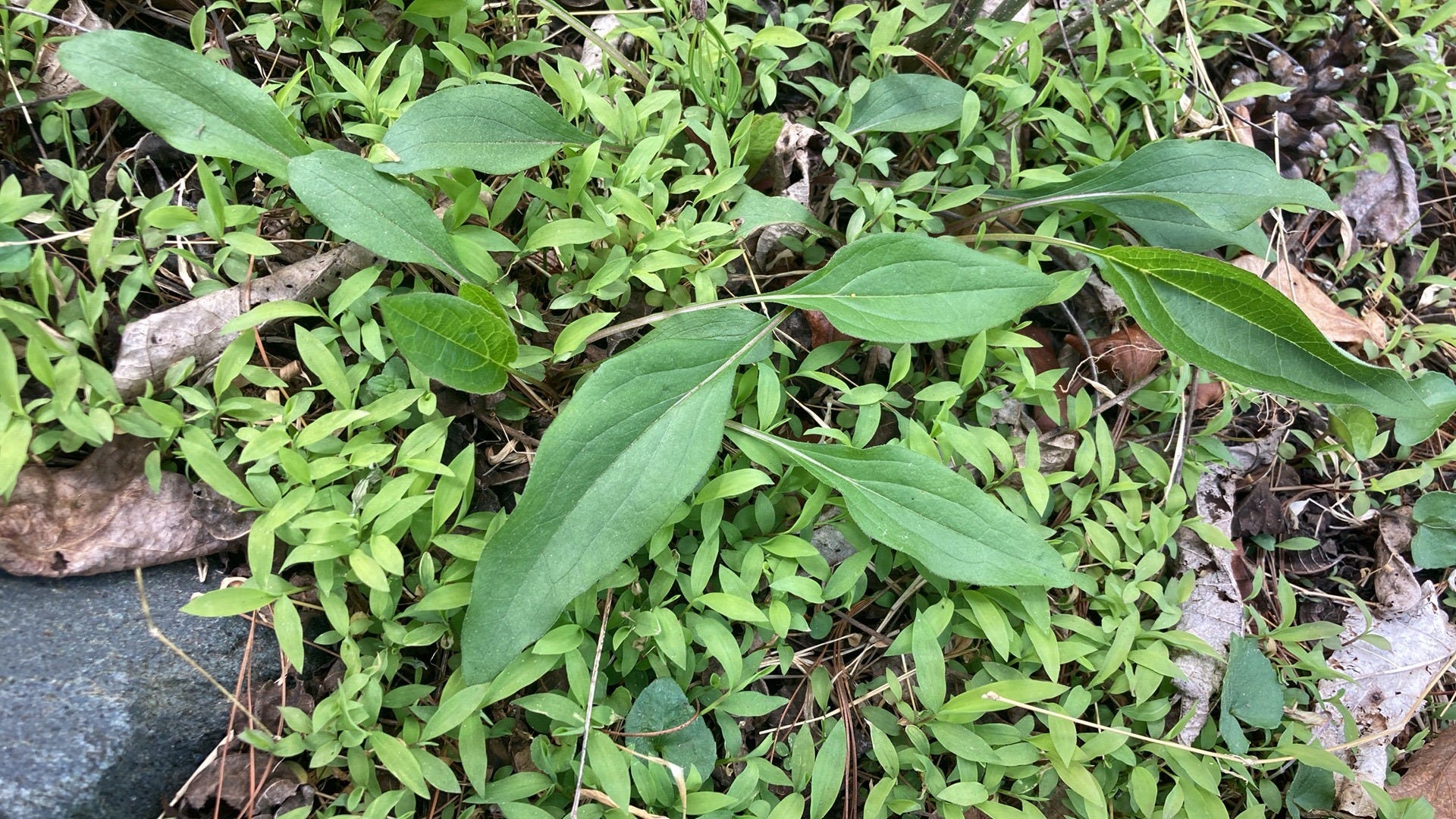
The first time I visited the neglected pollinator garden at Holliday Lake State Park in Appomattox County, Virginia, all I could see was stilt grass, a highly invasive plant. It was late fall, and it had already gone to seed. My advice was to cover it with cardboard and wood chips for a year. It felt beyond redemption.
When I returned in March with a few friends to rake out the dead stilt grass, we filled six very large bags with it. As the dead grasses were removed, we discovered a variety of native plants growing alongside this year’s stilt grass seedlings - bee balm, mountain mint, and purple coneflower.
I did not have the heart to smother the good plants in my effort to eradicate the bad. The park interpreter suggested doing a service day as a part of the park’s Earth Day celebration. I had my doubts about the success of hand-pulling such a large amount of stilt grass, but we decided to try.
This experience of discovering beautiful native wildflowers alongside destructive invasive plants reminded me of my experience here in our new home in Appomattox County, Virginia.
Native Wild Flowers in Human Form
My husband and I moved to Appomattox County in 2020. It was a huge culture shock for me after spending decades in Richmond. The number of confederate flags and Trump signs the size of billboards, in addition to the pandemic and a rejection of face masks, made me feel very isolated, unsafe, and alone. I stumbled upon a group of fellow transplants through activities in nearby Pamplin who made me feel welcome. Though many had lived in the county for decades, they were not native to this place. I assumed that was what made them so welcoming to a transplant like me.
This surface-level exposure to my new community and native residents caused me to make assumptions - assumptions that led me to believe I did not belong here. For the first four years, I avoided going to the town of Appomattox, opting to cultivate relationships in Pamplin and Farmville, where I felt more welcome.
In 2024, a friend, Father John Maher, was guest preaching at an Episcopal Church in Appomattox. I was stunned that there was an Episcopal church in this ultra-conservative part of rural Virginia. His visit was during the absolute darkest days of two years of trials and tribulations that rocked my world. John had been one of the few individuals I had confided in. I was not in a good place emotionally the day of his sermon, but I figured I could hold it together for one hour to support John and thank him for supporting me.
When the Old Testament passage was read from the book of Job, I felt tears rolling down my face. It was the first time in my life that I had felt drawn to this disturbing book of the Bible, but I found it strangely comforting. That day in the pew at St. Anne’s Episcopal church, I felt seen, not by John or the congregation, but by a loving, holy parent. I heard in the depths of my soul the words whispered gently, “You are not alone.”
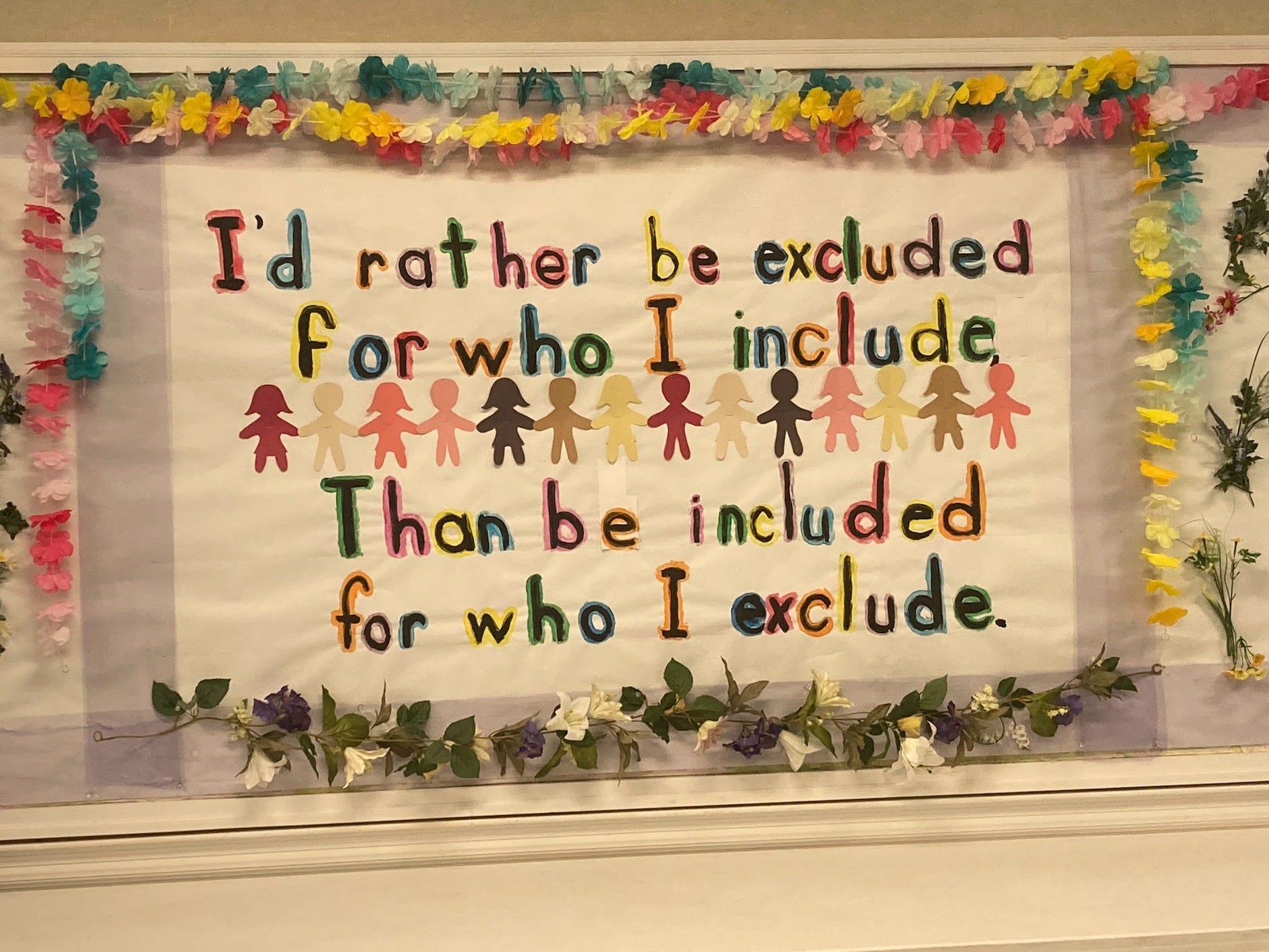
I pulled myself together and walked into the fellowship hall after the service to greet John. There, on the wall, was a bulletin board with the words “I’d rather be excluded for who I include, than included for who I exclude.” I burst into tears again. This time, tears of gratitude at having found kindred spirits here in a community I believed to be inhospitable.
A lovely woman named Evelyn Ford welcomed me to the church. She kindly ignored the tears and snot running down my face. I blubbered a hello and then shared how meaningful the bulletin board was to me as the parent of a transgender child. She introduced me to Mary White, who had created it. I explained how fearful I had become of the town of Appomattox. I had heard horror stories of how the library board had been summarily dismissed because of a Pride month display. I expressed how heartwarming it was to find people who lived the message on that board and the words of Jesus to love one another.
Evelyn assured me that her church was not the only one in town. She reminded me that the Appomattox United Methodist Church was also open and affirming. I had heard about the heated disaffiliation fight the prior year. The debate that tore Memorial United Methodist Church in two and left those who were LGBTQIA+ affirming without a church building, when the majority of the church chose to disaffiliate from the United Methodist Church and take the building with them. The remnant that remained became Appomattox United Methodist Church. Again, it was a story of hostility, and another reason I had steered clear.
But that day, with my tear-stained face and red nose, something prompted me to drive from the Episcopal church directly over to the Methodist church, whose services were about to begin in the rented space in a strip mall. I don’t remember anything from the service, the message, or the music. I had arrived a little late, sat in the back, and waited for some kind of sign from above. Would the message be about Job or some other private message meant just for me? Nope. Would there be a bulletin board that jumped off the wall and gave me hope? Nope. Instead, a woman in front of me had a terrible cough. I kept holding my breath, feeling certain that COVID germs were the only gift I would receive from this church. I was convinced by the end of the service that the whole venture was a waste of time.
After the service, the woman with the hacking cough greeted me and thanked me for visiting. Her kind eyes and genuine welcome made me forget about the risk of contamination. We talked until the last person was ready to leave and lock the door.
The woman’s name was Pam Robinson. She gave me her number, and we met for coffee the following week. We began walking regularly around the town, and I got to see Appomattox through her eyes. Her friendship and those evening strolls helped me feel less alone in my new home community. I gained an appreciation for community members like Pam, who were fighting against the invasive species of hate that had gained a foothold in her hometown, causing so much pain.
Dreams of commUNITY
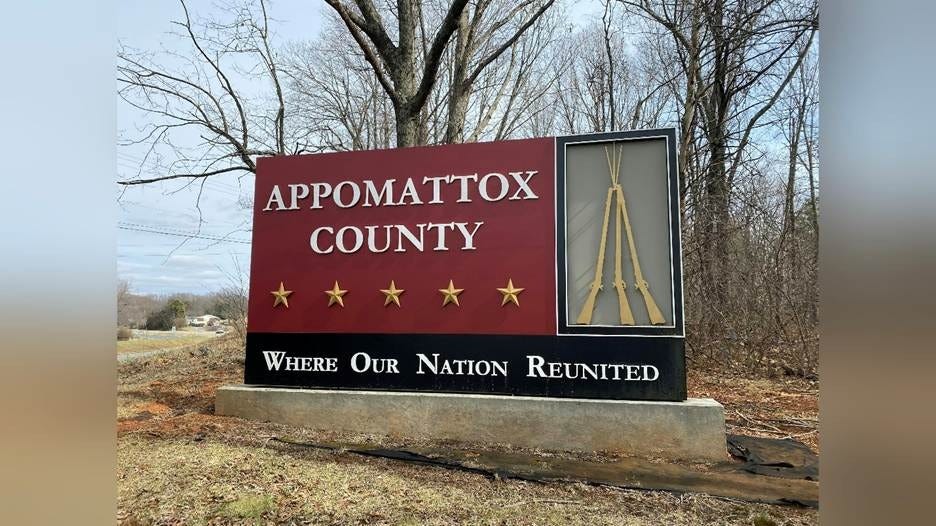
One of my walks with Pam was on the grounds of the Appomattox Court House National Historical Park, where the Civil War ended, just a few miles from my home. I met Pam at this historic location to learn more about her hopes and dreams for her community. As we walked this once blood-soaked terrain, we pondered these questions:
What if Appomattox truly became the place our nation reunited and not just a slogan on a billboard?
What would it look like for all citizens of Appomattox to feel they belonged here and were valued for the unique gifts they bring?
What would it look like to tap into a shared love of the natural world as a bridge across the current social divides?
What would it look like to unearth the strengths of past generations and weave them together to ensure a bright future for generations to come?
As the cars rushed past us, those gazing out the windows would see two middle-aged women on a walk through the fields of wildflowers, but I think the butterflies fluttering about could see the possibility of yet another cultural revolution in the making.
Pam’s dream of community unity was full of question marks, but I was convinced she and I were not alone. She sparked in me a commitment to discover others who shared the dream of greater community unity.
Discovering the Dreams
I have been a community cultivator for close to 30 years. I have found that every community has dreams, and every community member has gifts. When we discover our shared dreams and invest our individual gifts, we can bring those dreams to life. I have developed a process for discovering gifts and dreams based on the principles of Asset-Based Community Development, and I began using this process in Appomattox.
Pam’s dream of community unity led me to facilitate a series of conversations with community members and groups over the next nine months. Like all gift discovery processes, I never know what will emerge. The goal of this initial listening was to discover what a community cared enough about that they would get involved. This is what I call the commUnity dream in my Power Shift training.
Our key organizing question is, “If you could do anything to strengthen Appomattox, what would you do?”
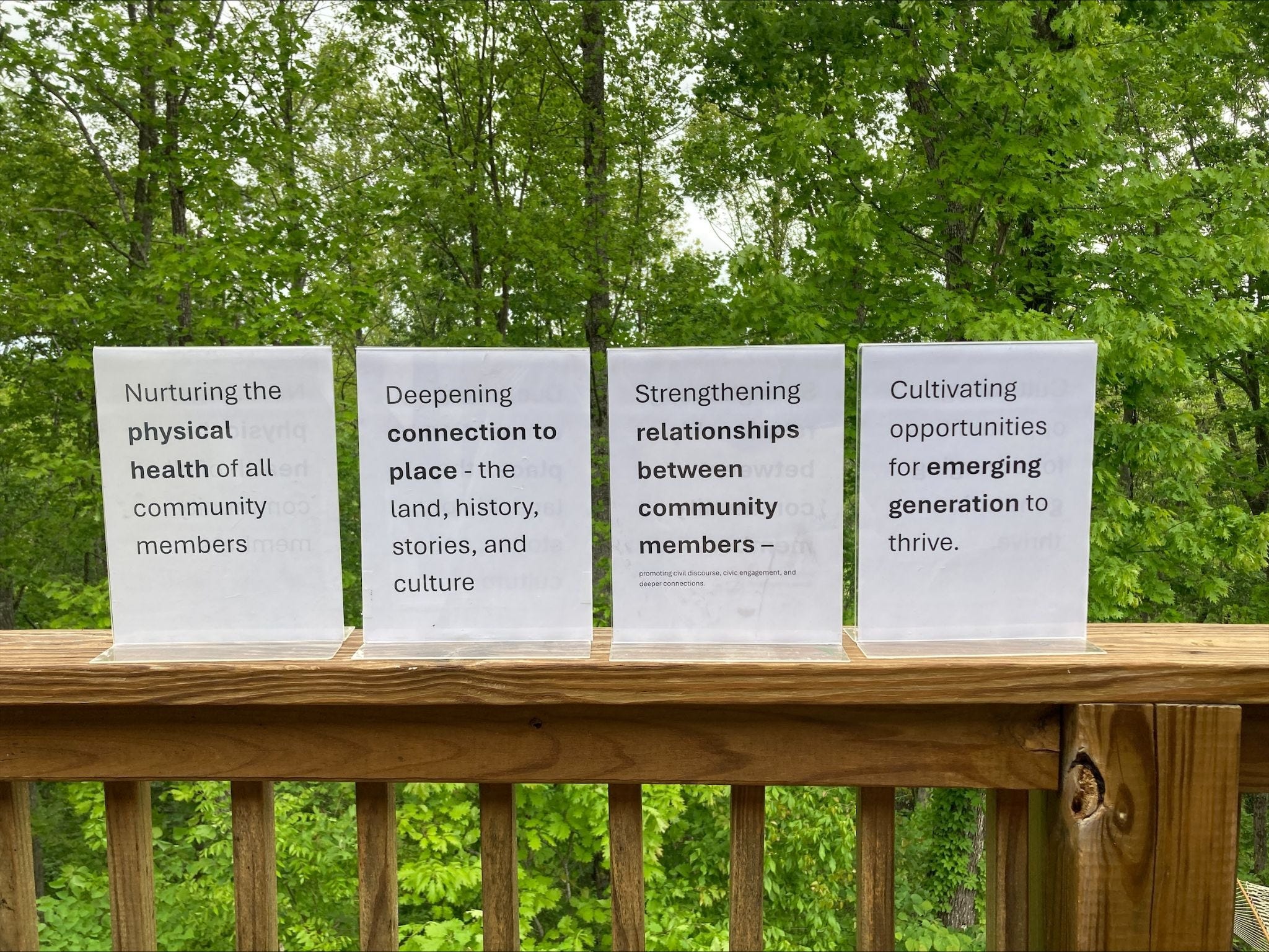
I met one-on-one with community members and facilitated several small group discussions around this question. We identified four themes:
Strengthening relationships between community members of all ages - promoting civil discourse, civic engagement, and deeper relationships of mutual respect
Nurturing the physical health and well-being of all community members
Cultivating opportunities for the next generation to thrive
Deepening connection to place - the land, history, stories, and culture
Pam and I worked with her church leadership to conduct a large group event at her church. During this event, the greatest energy was around the theme of strengthening relationships, with more than half of those who shared their dreams falling into that category. As the participants each shared their dream, the strongest motivation for action was around healing divisions within the community, around growing understanding that melts away the divisions, cultivating peace among leaders and the community, and a desire to work together to serve in the community.
Discovering the Gifts
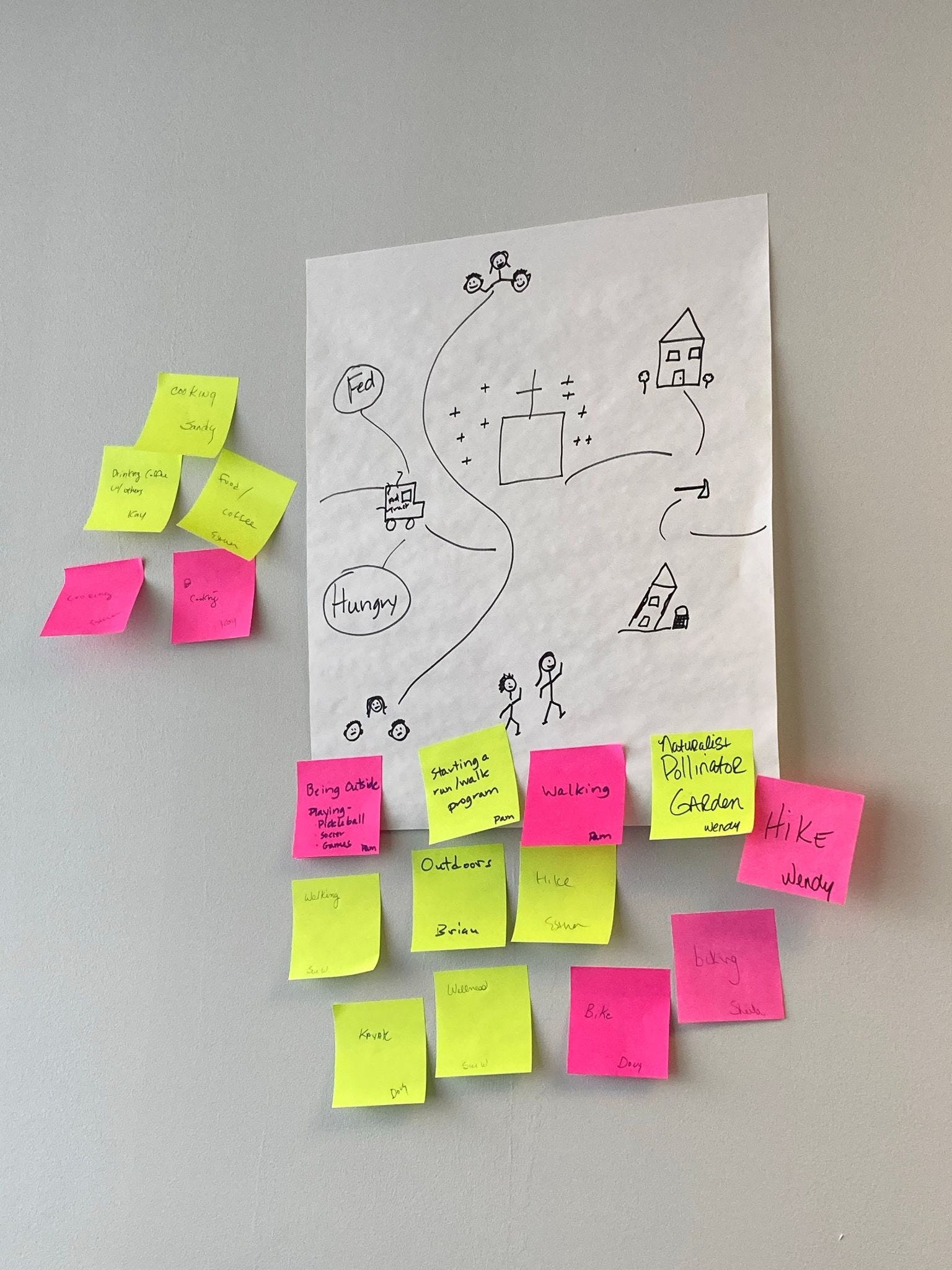
The next part of the process is to discover what we have to work with - the gifts of those who are interested in engaging and those of the broader community. One of the questions I always lead with is, “What do you like best about your community?”
I think the response that best sums up what I heard that day is, “It is home.” The vast majority of Pam’s church members are long-time residents of the community. Their commitment to this place is deeply rooted, and the rich cultural knowledge is a tremendous asset. If they were flowers in the pollinator garden, they would be the closest thing to a native species you will find in the community, with many tracing their family’s connection to the area back generations.
This fact blew apart my assumption that all who were native to the community, the been heres, were unwelcoming to transplants like me, the come heres. My self-constructed narrative about rural Virginia inhabitants was rapidly unraveling.
The second gift discovery question I asked was, “What do you like to do in your spare time?” Three themes emerged. The number one answer was “spend time with my grandchildren.” Followed by staying active through outdoor activities like hiking, biking, kayaking, golfing, fishing, gardening, and building things. The third theme that emerged was around civic engagement, such as volunteering through local non-profits and engaging in local civic groups and politics. This line of inquiry captures the gifts of the group that are the building blocks of any shared effort to bring the community together.
As we explored what the group cared most deeply about, two populations of beneficiaries emerged, youth/families and seniors/elderly, with a strong desire that activities be designed to foster intergenerational connections.
After discussing all these hopes, dreams, and gifts, the group arrived at three action items that they were interested in exploring - hosting outdoor activities that celebrate the region’s vast natural spaces, coordinating acts of service in partnership with other values-aligned community groups, and practicing hospitality that invites connection through storytelling, food, and culture.
Through two follow-up conversations, a core team of six community members emerged. We began looking for projects that allowed us to serve together with others in an outdoor setting, on projects that would foster intergenerational connections and that could engage people with a variety of physical ability levels.
I proposed partnering with the State Park to help save the pollinator garden, and they graciously accepted the project as the first effort in their attempt to WEave commUNITY.
Lessons from the Pollinator Garden
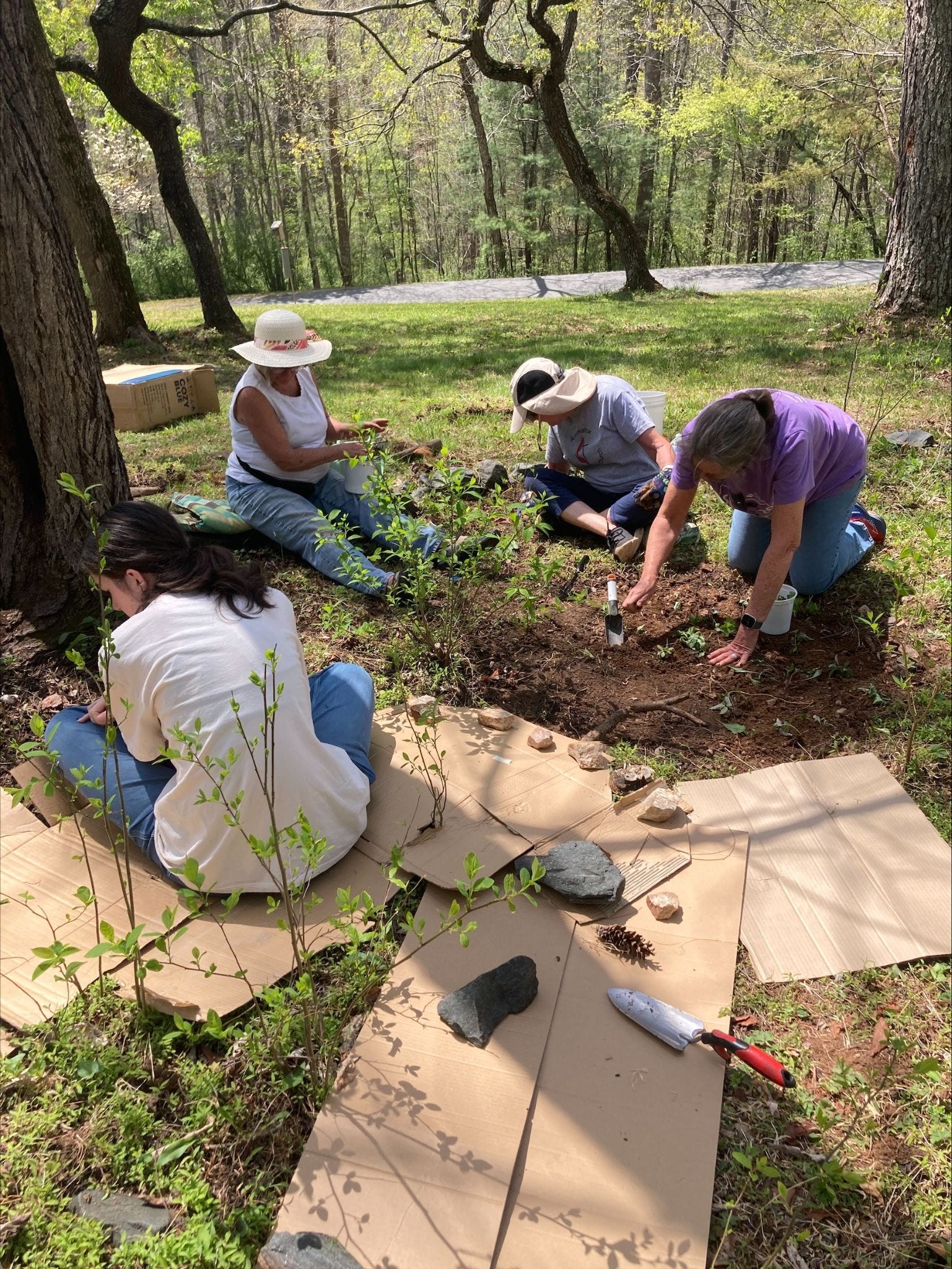
As we worked together to remove the invasive plants to save the native ones, I felt a sense of gratitude. It was the same kind of gratitude I experienced the day I met Pam and Evelyn. It was the realization that my new community was full of beautiful humans – those native to the community and those like me who were new. What brought us together is our willingness to cultivate spaces of belonging and purpose for all who call this place home, not just humans but flowers, pollinators, and birds as well. This place is beginning to feel like home for my family and me. I hope our new found family can help foster the feeling of “It is home” for others who are struggling to find their place here.
As we pulled out the stilt grass seedlings one by one, I imagined this invasive plant as the seeds of hate that have been sewn across our county - seeds that have harmed my family, ripped apart faith communities, terrorized communities of color for generations, threatened immigrant families, and caused those with political views that differ from the majority to remain silent.
I believe all people, when invited to build authentic relationships, will reject false narratives about their neighbors when their own experience runs counter to their unfounded assumptions. These harmful “othering” narratives have shaped our community much the way my false narrative about my native neighbors shaped my engagement with my neighbors. This faulty narrative shifted as I entered into meaningful conversations and discovered common values and a shared dream.
As I looked around, I saw a dozen fellow community members who, through both word and deed, are living their commitment to the statement, “We would rather be excluded for who we include than included for who we exclude.” I believe with my whole heart, we are called not only to cultivate a literal pollinator garden but sacred spaces that bloom and spread seeds of love, belonging, and acceptance for all. As those seeds are spread, the invasive seeds of hate, fueled by divisive narratives, will be choked out, and we will become the place our nation reunites.
While many would simply see a bunch of volunteers pulling weeds, I believe the monarch butterflies who visited us in the garden as we worked saw plants and humans working together to cultivate a connection that I pray extends beyond a single event. Our goal in this fledgling venture is simple- to see everyone for the gift they bring, regardless of their race, age, religion, political views, sexual orientation, or gender identity.
It will be a long process of hand-pulling the harmful narratives and cultivating relationships that forge new ones. It feels totally overwhelming at this moment in a political climate where narratives of distrust seem to rule the day. However, seeing the natives thrive in the midst of these harsh conditions gives me hope.
I loved that the event included individuals of all ages, from high school youth to great-grandparents. As I think about our first event I am celebrating these gifts: Sue’s get-it-done attitude, Donna’s gift of digging in the dirt, Amy’s gift of welcome, Pam’s gift of invitation, Brian’s gift of rock hauling, Lilly’s plant knowledge, Abby’s love of living things, Ruth’s outgoing personality, Nakia’s gift of youthful curiosity, Kyrian’s gift of quiet reflection, Chance’s coordination of the activity and Chris’s continual support from behind the scenes. Each gave a gift, but it remains to be seen if the connections forged to land, spirit, and community will grow and deepen.
Living these Questions
As I shared in my previous article, I prefer the edge spaces- spaces where institutional versions of spiritual traditions meet the wild, organic sacred spaces. I find these kinds of organic, emergent communities, where you discover the path as you walk it, to be life-giving and spiritually rich. Our journey together began with the questions Pam and I pondered as we walked the land where the Civil War ended. There are still many questions yet to be explored. Questions that will open up the path we are to walk together. Here are a few questions we are currently pondering:
Can active, deeply rooted grandparents be the catalyst for a multi-generational effort that transforms the culture of our rural community into one where diversity is celebrated, not simply tolerated?
Could we bring families together to enjoy the beauty of the natural world in a way that reconnects us to the land and each other?
What role will young people play in this emergent community cultivation effort? Could they be the healers and connectors we have been waiting for?
As I sit dreaming of where this development effort could go, I have to remind myself that I am simply a pollinator in someone else’s garden. My job is summed up best in Mary Oliver’s Instructions for Living a Life: “Pay attention, be astonished, tell about it.” This development effort has captured my imagination, and I hope it will do the same for others in our community.
My initial impression of the Appomattox community, like that of the pollinator garden, was false. I am so thankful for Pam, Evelyn, and all the beautiful native wildflowers they have introduced me to. I can’t wait to see what blooms in our garden this summer!
If you live in the Appomattox area and would like to join this community cultivation effort, please let Pam, Evelyn, or me know.
If you enjoyed this article and would like to read more like it, please like, comment, and share with others.
Other Resources
This post is part of the Field Notes Series. Through this series, I am following several community cultivation efforts, including our Richmond Regional Network and Youth-development in Farmville, Virginia. My goal is to profile one development effort per quarter and provide regular updates on these stories as they unfold.
In addition to writing here on Substack, I am a consultant and trainer in a form of community cultivation called Asset-Based Community Development through Embrace Communities. You can learn more about ABCD Here and our Network of Community Cultivators Here.
Unlike most of the stories I will be profiling, this development effort is in my backyard, making me personally one of the assets to the effort. In the post, Are you a Daffodil, Day Lily, or Goldenrod? I look at the different roles those who are native, transplants, or institutionally rooted play in a community cultivation effort.
If you enjoyed this post, I hope you will consider subscribing, commenting below, and sharing this post with others. All materials on my site are free, and 100% of any paid subscriptions are donated directly to Embrace Communities, a public charity.
Love this: I believe all people, when invited to build authentic relationships, will reject false narratives about their neighbors when their own experience runs counter to their unfounded assumptions.
Reading this, two words kept surfacing in my mind: risk and efficiency.
So many people, simply by their existence, are at risk of experiencing hate from others. To find community among people who accept you, you have to take the risk of being in situations where you'll experience this hate. I'm using "hate" here to cover all forms of dismissal: scorn, condescension, intentional ignoring, etc.
Taking that risk isn't efficient. In your story, you went to two services in one morning. That's not an efficient use of time when you could have just asked the leader of the Methodist church to coffee. But if you had taken the efficient route, you would have missed out on meeting someone who became a life-altering friend.
Hand-pulling stilt grass isn't efficient. But the efficient removal method would have killed what you wanted to thrive. Being in a relationship isn't efficient; the person always wants your attention at the most inconvenient time. Travel isn't efficient, but the experiences of travel often create a more satisfying life than making the efficient choice to stay home.
I wonder if the Western focus on efficiency is how we build our own hell. Perhaps in the 21st century US, the Sabbath of the Bible could be seen as a rebellion against the tyranny of efficiency. Perhaps taking the slower, more relational way is a Sabbath rest. Perhaps taking the time to slow down and notice and assign value to cone flowers among stilt grass is a practice of Sabbath.