

We arrived at Breaks Interstate Park just as the Worm Moon was rising on the horizon. Like the earthworms awakening from their winter nap that give this March moon its name, Chris and I emerged from frozen ground eager to resume our RV travels. I was surprised we were the only humans to choose to do so; the campground was empty on this second day of March despite the beautiful 70-degree weather that followed weeks of freezing temperatures, snow, and ice.
Roughly 30 minutes after dark, as we were watching a movie on our tiny travel DVD player, whose volume button was stuck on low, a sudden, loud, high-pitched screeching, whistling, woman-screaming type of sound pierced the night. We heard the sound three or four times and then silence.
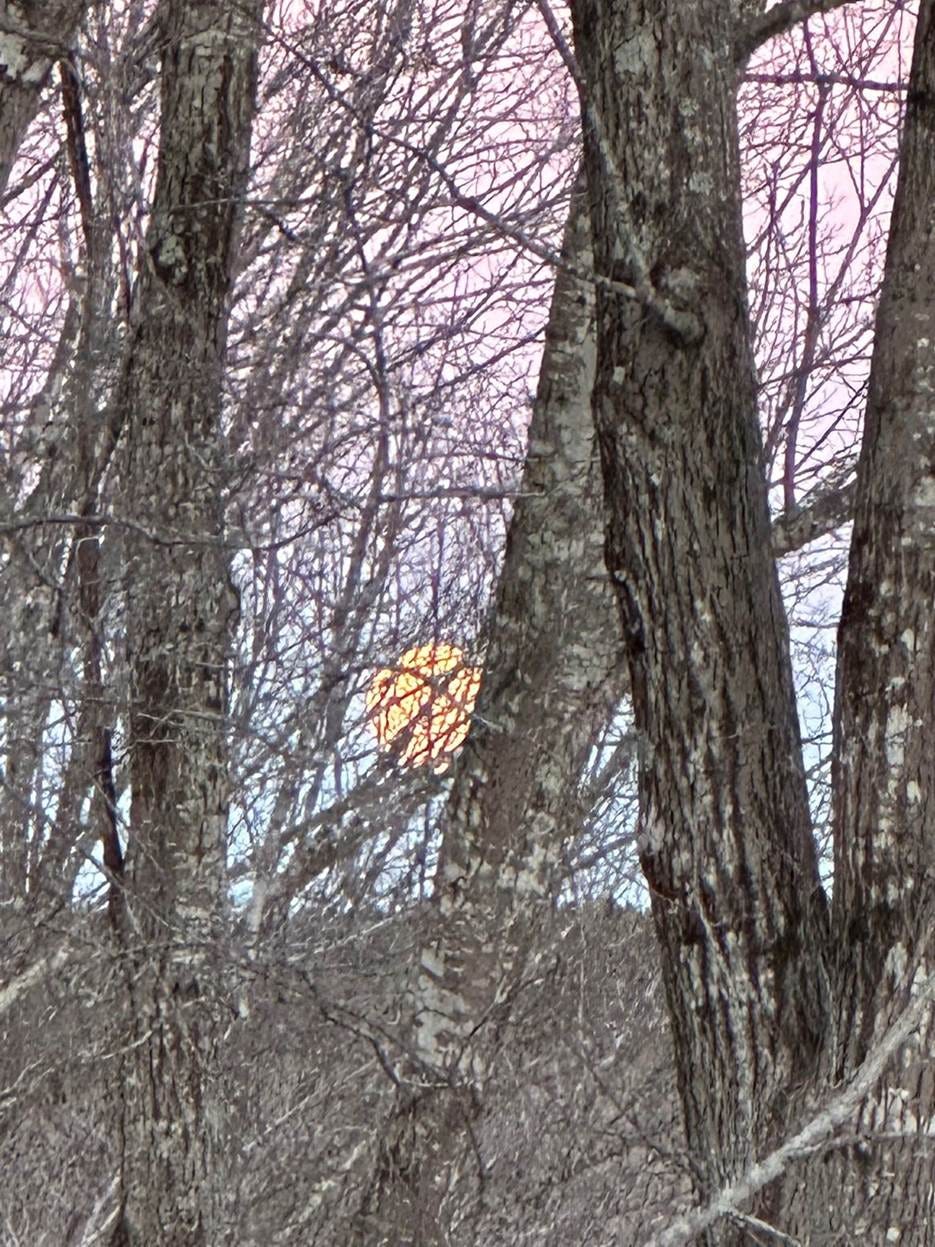
It sounded like it was in the field just beyond the campground. As I peered out the door, all I could see was the silhouettes of trees lit by the bright yellow moon. Later that night, long after I was asleep, there would be a lunar eclipse; perhaps the creature was preparing for the event and inviting her friends to join her for a watch party.
I had been told that bobcats make sounds resembling a woman screaming. I assumed that was what I heard. We returned to the DVD, eager to see if Indiana Jones would once again save civilization as we know it.
While at the visitor center the next day, I saw a display about the reintroduced elk and learned that they spend the winter months in the park. When I asked the ranger where we might see them, she said they like the field just beyond our campground. I watched several elk videos and recognized the sound as similar to what I had heard the night before. According to the ranger, the elk generally bugle in the fall during rutting season. Perhaps they made an exception in celebration of the worm moon, or perhaps they were welcoming me to their park. Either way, they had my attention. This launched me on a mission. A mission to see the elk.
Stalking Elk
These magnificent creatures went extinct in this region in the 1800’s as a result of colonization. They were reintroduced to Southwest Virginia in 2012. An old mining site had been rehabilitated, and the original 75 individuals had grown to a community of over 250. The park had recently turned an old field into a winter grazing site for the elk.
Chris and I hiked to the site the next evening and found a wonderful brand-new viewing tower that was high enough to see the entire field. That evening, we sat and stared out over the field for over two hours. Our only visitor was a lone deer. I was deeply disappointed but not defeated.
The next day, I learned of another public viewing area at an ATV park recently acquired by Breaks Interstate Park. Just before dusk, my accommodating husband agreed to drive the 30 minutes to the park where we sat and stared for two hours on a hard bench in the cold. No elk. Only a gaggle of teenagers on ATVs sped across the field.
As we left the park, I snapped this picture, convinced that it would be the only elk I got to see on this trip.
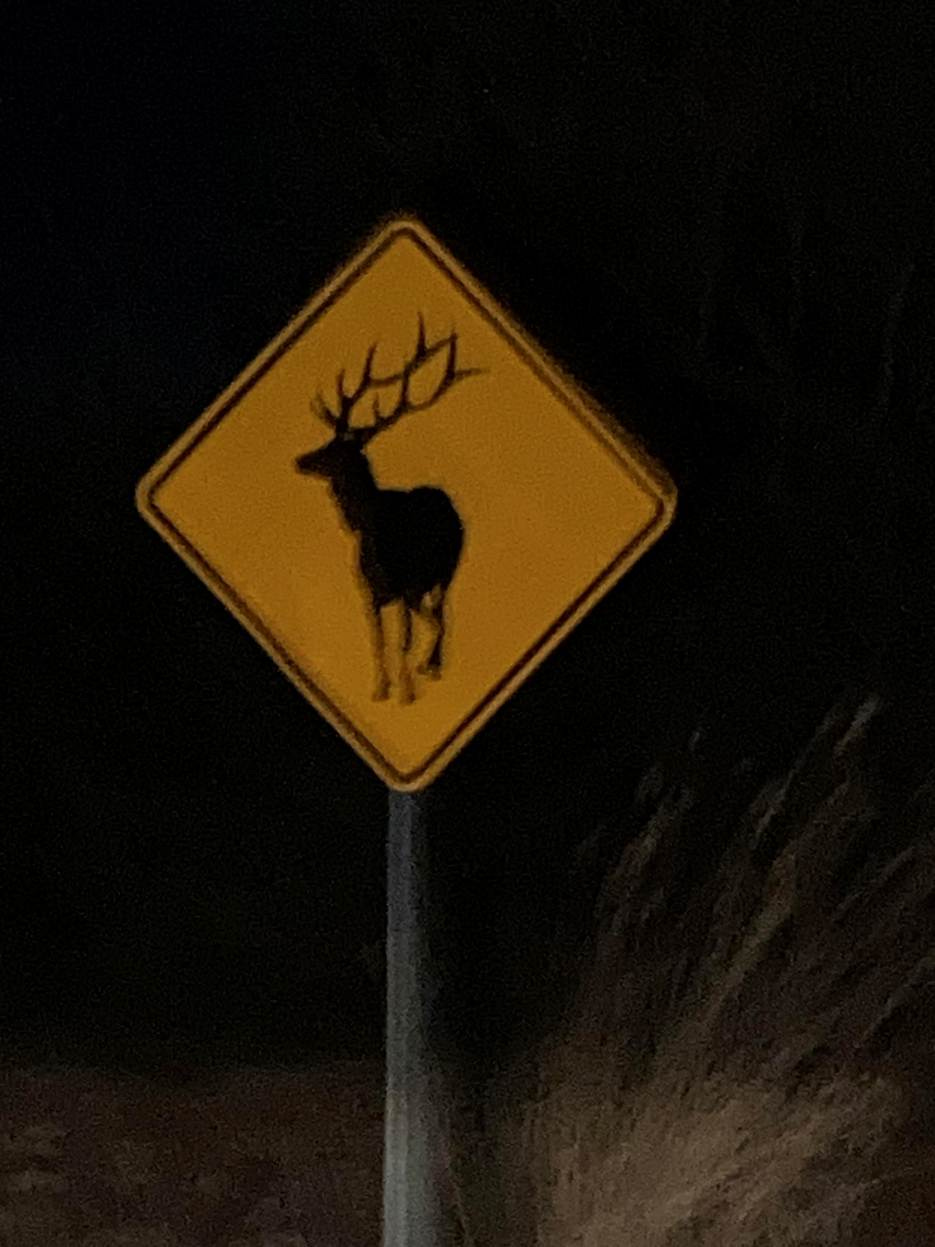
As we were driving back to the campground in the dark, I remembered the ranger saying that she most often saw them on her drive home along the newly constructed portion of Highway 460, called the Coalfield Expressway. I scooted up toward the front of the seat, rolled down my window, and began looking for evidence of these stately creatures. I was just about to give up when I saw roughly a dozen blobs just off the side of the highway. We were cruising 60 miles an hour on a major road, so I only caught a quick glimpse of these shadowy figures in the moonlight.
I asked Chris to turn around so I could see if it was really them. He refused. I begged. He refused. I begged some more. He finally gave in and did an exasperated U-Turn in the middle of a 4-lane highway. Thankfully, this road is not heavily traveled.
Chris was going well below the speed limit as an 18-wheeler approached us from the rear, and I screamed, “STOP! I think I see them.” Instead of stopping, Chris sped up to avoid being rear-ended. I squinted and tried as hard as I could to make out their features. Again, all I saw were blobs. It was too dark to know for sure, but it certainly looked like large elk-shaped figures in the field.
I knew better than to ask for a third look. The next day, we drove past the same patch of highway where I saw the blobs. I expected to see another explanation for what I saw, perhaps barrels from the recent construction or large shrubs spaced to look like grazing animals. Instead, we saw an empty field.
I Could Be Wrong
For now we see in a mirror dimly, but then face to face. Now I know in part; then I shall understand fully, even as I have been fully understood. – 1 Corinthians 13:12
I chose to believe that what I saw was the elusive elk. All the evidence points to that being the most likely explanation. I will never know with 100% certainty if I saw elk or imagined I saw elk. Nonetheless, I choose to believe that I achieved my mission. However, simply believing it to be true does not make it so. This willingness to admit that I could be wrong does not negate the fact that I believe it.
Our faith journey is a lot like this elk adventure. We listen to those wiser than us, those who have had their own personal sightings. We follow the evidence. We look for spaces where the spirit is known to appear. Yet, no matter how hard we try, we are always looking through a dark glass dimly, as the Apostle Paul writes. Or in my case, the light of the worm moon on a cloudy night. The wise among us recognize that “truth” is open to interpretation.
This embrace of mystery, of uncertainty, of honesty about the dimly lit spiritual world, was not a barrier to early spiritual seekers but the core driver behind the continued pursuit of the sacred mystery.
Like the elk, the Christian faith has been impacted by colonization, and the element of mystery, of unknowability, of uncertainty was slaughtered and branded as “unchristian.”
This faulty narrative of certainty is one of the impurities that has soured the original wine, to recall my metaphor from my previous post. In this colonized version of Christianity, a true believer is not allowed to question or admit interpretive choices have been made in the construction of the narrative memorialized in creeds and statements of faith. These litmus tests for “true” believers create “them and us”, “in or out” binaries. Those who dare to think differently are quickly dismissed as “other” and cast out. This kind of black-and-white narrative is incapable of acknowledging that what it holds as pure truth might not be the full story. It ignores even the Apostle Paul’s statement, “now I know in part.”
The result of this black or white, in or out, right or wrong binary world is the formation of rigid, fundamentalist movements like Christian Nationalism, the Crusades, the KKK, and the Nazi party. All were convinced their narrative was “The Truth” and thus their superiority was absolute.
A Non-Binary Holy Other
Recently, James Talarico upset those who ascribe to this black-and-white faith when he suggested that God was non-binary. I think those who got into an uproar over it do not really understand what the word “non-binary” even means. According to the Cambridge Dictionary, non-binary means “not simply one thing or the other.”
For me, a non-binary label is about more than God’s gender identity, which, for the record, I do not think God is gendered. We apply genders to God because of our limited human language. Limiting the sacred mystery to a male human image diminishes the Holy Other nature, which is far beyond our human ability to comprehend. It turns the sacred into our own image, which is a very small understanding of the divine.
For me, embracing a non-binary lens for the sacred is more about a mindset. It is about the ability to hold multiple possibilities at the same time. It is the ability to stand in the grey, to admit your way may not be everyone’s way of experiencing the sacred mystery. This posture requires maturity and a solid sense of self. It is a refusal to be limited by an outside belief system that judges non-adherents.
Jesus is the way for Christians, but that does not mean that the sacred mystery does not speak to non-Christians in another form. There is also a vast array of ways Christians define and experience Christ.
I know that last paragraph will separate me from many who read this. For those unable to accept that their experience is not everyone’s experience, this feels threatening. Those who believe their interpretation of scripture is the “right” interpretation will likely double down on this certainty. This is especially true for those who were shaped by high-control or fear-based religion.
What if We Choose Humility Over Certainty?
What if we lived in a world where we all admitted, like the Apostle Paul, that we are looking through a glass dimly?
What if we admit that we think we see hard evidence, that we choose to believe that evidence, but still hold space that our way may not be how the spirit is moving in the lives of others?
Imagine, no more holy wars.
No more faith-rooted judgment.
No more othering in the name of Jesus.
No more hiding our own unique experiences that run counter to the party line.
Imagine a world marked more by humility than by certainty.
A world where we could all admit that we honestly don’t know all the answers.
A society where we boldly proclaim, as did the Apostle Paul, “For now, I see in part.”
Other Resources:
Ruth Perry’s interview with Bishop Sue Haupert-Johnson, over on The Beautiful Kingdom Builders Podcast this week, touches on this topic. Here are a few quotes that resonated. However, the whole interview is well worth a listen.
“I think it’s having a little more openness to mystery and that God does work in weird ways. It’s time to let everybody be faithful.”
“I may be wrong. Anytime I talk to somebody and they can’t say “I may be wrong,” I am eternally frustrated….So let’s just acknowledge we’re seeing through a glass darkly.”
“And at the end of the day, I think Jesus wants us just to love one another and to respect each other and to defend each other.”
“Because we’ve held onto the past far too long. We’re way too rigid. And we need to follow where Christ is leading.”
Additionally, Ruth’s podcast with Jenai Auman, author of the book ‘Othered: Finding Belonging with the God who Pursues the Hurt, Harmed, and Marginalized.’
kathy escobar ’s posts titled Dismantling Binaries, Practicing Paradox, and Expanding Faith are all inviting us into a more expansive view of faith.
This was lovely to read! Thank you for mentioning the podcast with Ruth!