

We think of Thanksgiving as food, family, and hospitality, but I think that first Thanksgiving was more a celebration of the gifts of a place.
I wish I had a time machine and could see the place I call home on that first Thanksgiving and meet the original inhabitants.
If I were to travel through time and land right here in the autumn of 1621, who would be around the table on that first Thanksgiving?
The Mountains and Waters
If my imaginary portal through time spit me out where I am writing this, a few guests at my Thanksgiving celebration would be the same as they were then.
The ridge upon which my house sits, which I named Whispering Ridge, and the creek that lies at its base, likely predate all other inhabitants of this place. We are less than 50 miles from the Blue Ridge Mountains, among the oldest mountain ranges in the world, and my little mountain is likely a distant cousin.
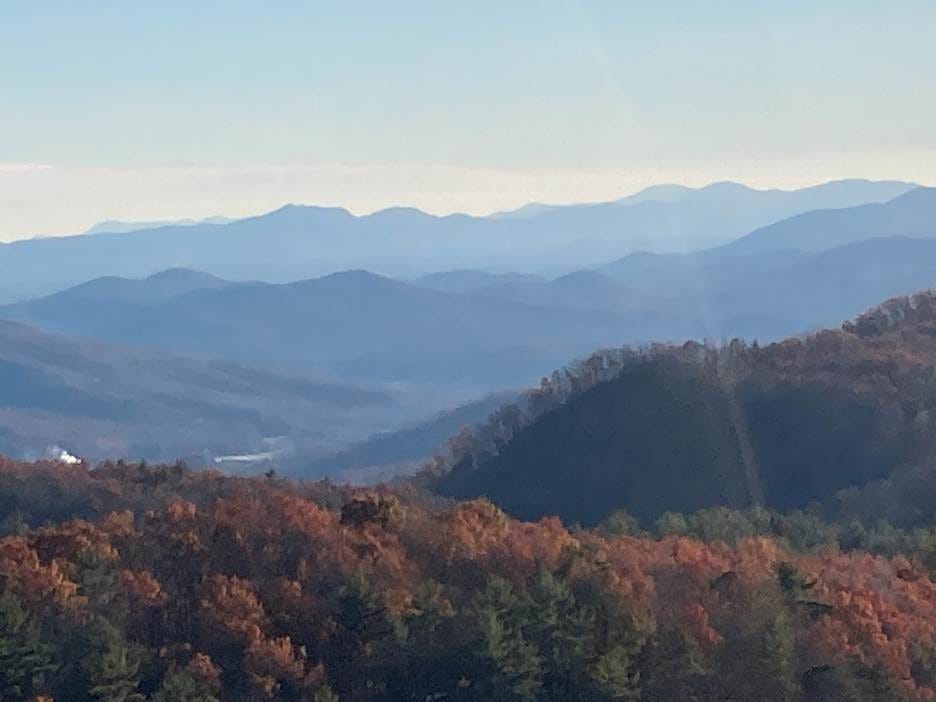
While Whispering Ridge is a mere few hundred feet above sea level compared to the 6,000-foot peaks along the Blue Ridge Parkway, I suspect its bedrock was formed in a similarly ancient time.
While the views pale in comparison to the Blue Ridge Mountains, this ancient, weather-beaten ridge delivers endless gifts of beauty to my family and will be here long after we are gone. It is the elder of my forest community and deserves a place of honor at my Thanksgiving table.
There is no way of knowing when Fish Pond Creek, the northern boundary of our property, first appeared, but she is likely our second oldest neighbor. Her headwaters are formed by three springs just over 5 miles from my home, and she joins the Appomattox River just over 1300 feet to the east of our property line.
On her way to the Appomattox River, she provides a home to fish, salamanders and beavers, and drinking water to all the animals of the forest.
As I write today, the clouds are rolling in, and I am praying for rain. Our county is experiencing one of the driest years on record. But Fish Pond continues to flow even as wells across the region run dry. I give thanks for Fish Pond Creek and her faithful springs that have not failed to give life to the forest inhabitants.
I hope she is protected from the multitude of data centers proposed in all the surrounding counties, including our own. I wish those choosing profit over her protection could see her as a source of life and not simply a resource to be exploited in the name of progress.
This Thanksgiving, I remember that Fish Pond Creek has been a source of life since her earliest days and will invite her to sit beside Whispering Ridge as the matriarch of our celebration.
The Returning Community
While these two community members remain, many others have vanished.
If I were to land here in 1621, I would be surrounded by giant chestnut, oak, and hickory trees. The forest would have likely had a closed canopy, with towering trunks. The forest floor would have been blanketed with thick leaf litter that crunched underfoot.
Like the rest of the Piedmont region of Virginia, all the old-growth trees were cut during colonization. Sadly, any of the chestnut trees that survived the axe were killed by chestnut blight. The only evidence of the mighty chestnut trees is found in the bones of old houses and tobacco barns that litter the landscape, some of which are still standing.
The final leaves of the red oak trees around my house make a rustling sound as, one by one, they float to the ground in the gentle breeze. The oaks and hickories have returned to reclaim what was taken from them by the early settlers.
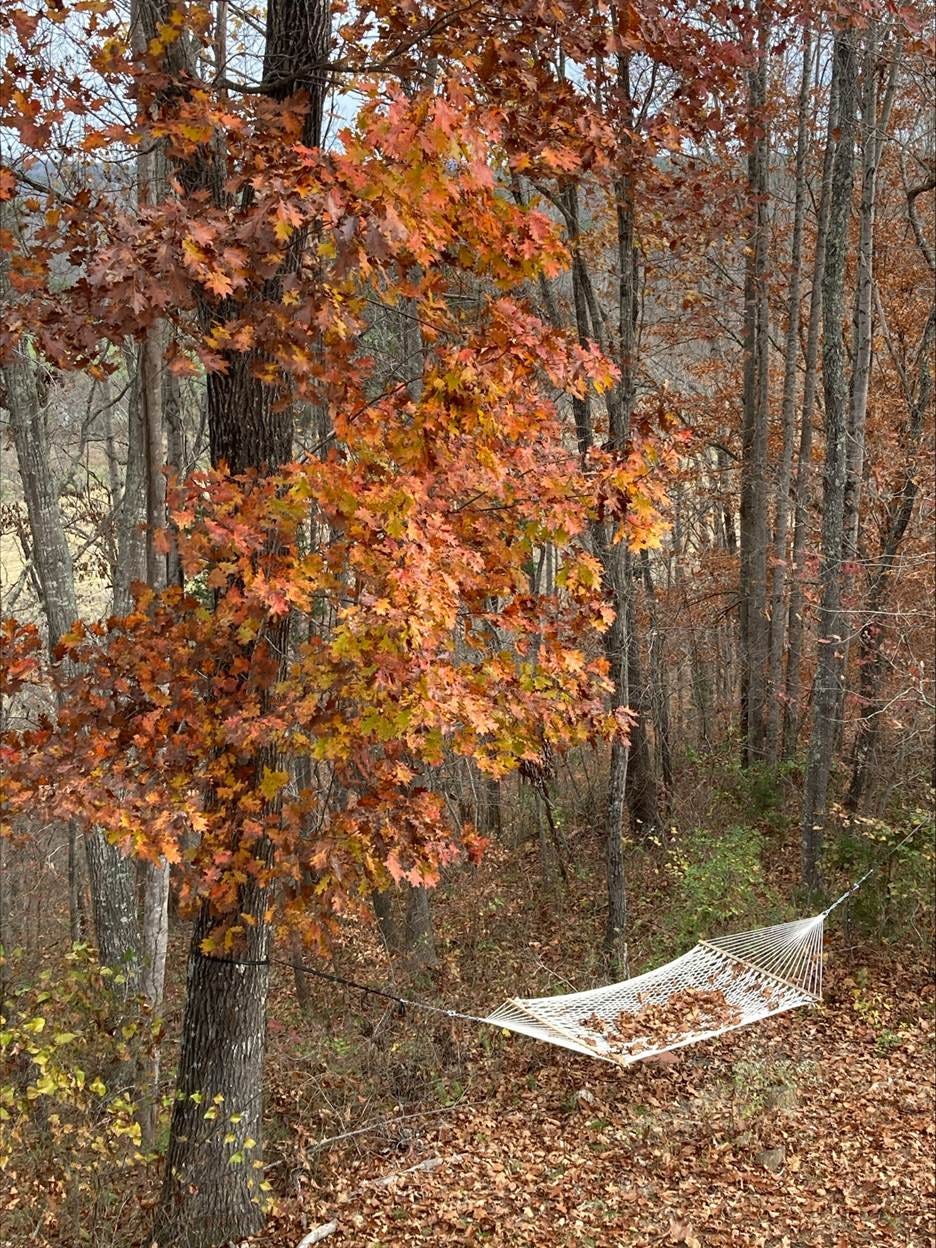
My home sits at an intersection of four different types of land. To the north, mature oaks and hickories have reclaimed the ridge slopes overlooking the creek which were too steep for industrial logging operations to navigate. This roughly 80-year-old portion of the forest is the closest representation of what the forest might look like if I were to travel back in time.
To the west, the pines on the upper portion of the ridge are slowly dying, and younger oak, hickory, and other native species are emerging. This part of the forest is showing me the healing power of natural systems and teaching me to trust the earth’s ability to return to what is genuine to a place.
The land is not returning to some untouched past. It is becoming something more like itself again.
To the south is my neighbor’s land, which was clear-cut in 2018 and replanted with loblolly pines, which are now 20 feet tall and densely packed. My neighbor allows us to cut the pines directly in front of our house to maintain our view of the southern horizon and the sunlight we need to grow vegetables.
To the east are cleared areas for our garden, storage buildings, and septic drain fields.
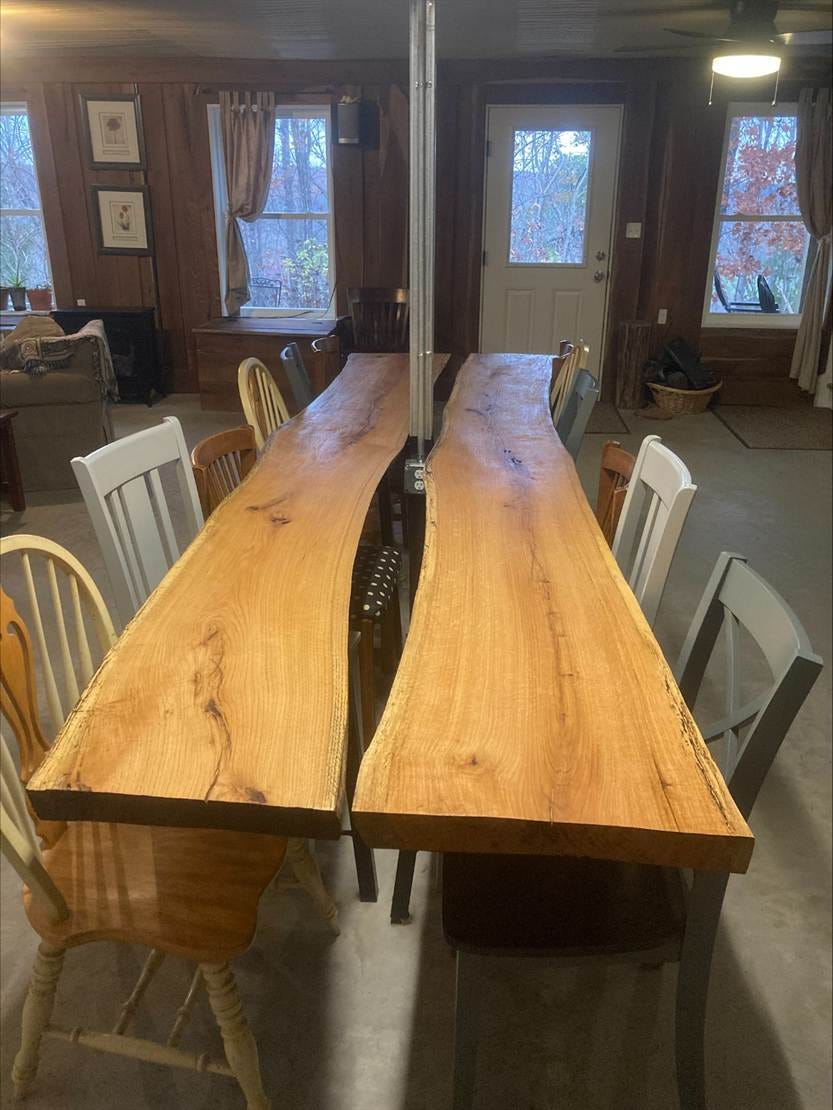
When we cleared our land for our home, I could not let all the trees that had to be cut go to waste. We had a local sawmill cut the large red oaks and black walnut trees into paneling which now lines our basement walls. The largest of the trees we had cut into long slabs, one made of walnut, is in our dining room, and a much larger red oak table, which can seat 16 guests, is in our basement for larger gatherings.
So, rather than inviting my forest neighbors to the table, I acknowledge that they literally are the table.
My Colorful Volunteers
I have been attempting to restore the areas that were disturbed during the construction phase into native pollinator gardens. Unfortunately, the non-native lespedeza planted by the logger who harvested my neighbor’s trees has invaded my property and is choking out our native grasses and plants.
Thankfully, some natives have prevailed, like a variety of asters and bee balm. Others, like the goldenrods and purple violets, volunteered to help me out when the species I planted died.
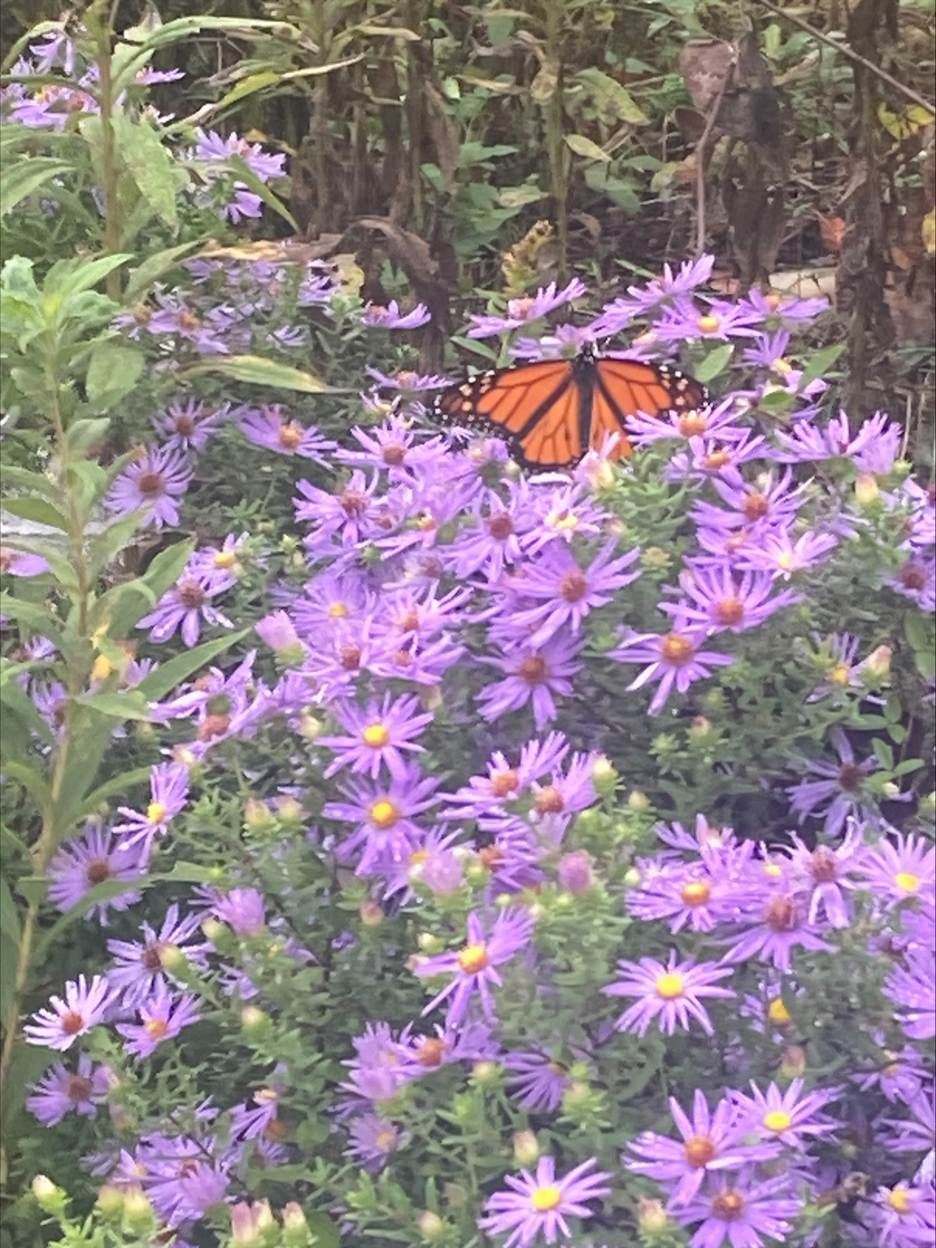
Together, these planted and volunteer plants keep my yard in continual bloom from spring to late fall, providing nectar for the pollinators and eventually seeds for the birds.
What I have discovered is that what I plant has little to do with what grows.
This may be one of the greatest lessons this land has taught me.
I am learning to trust the plants to know where to go and letting things I used to call weeds become my greatest contributors.
I can make a plan, but the land knows what it needs and uses what it has to meet that need. I can plant a flower, but I cannot make it thrive. I have pulled “weeds” only to discover that same species blooming in the wild when my garden most needs a source of nectar.
Perhaps belonging to a place requires learning to listen to what the place is already trying to become.
This year, I will invite these often overlooked little plants to join us in our celebration of the first Thanksgiving, remembering their contribution to that abundant feast.
Perhaps some dried flowers will serve as this year’s centerpiece. Though the brilliant colors of spring, summer, and early fall are all faded, these neighbors still bring interest and charm to my now sleeping gardens.
The Neighbors Who Don’t Respect Property Lines
Being at the intersection of four different types of land means I am visited by a large variety of bird species. Some like the bushy, dense cutover area, some the open grassy areas, others prefer the dying pines and emerging young trees, while others choose the mature oak and hickory forest. The diversity of this place is one of its gifts.
I am delighted by all these feathered visitors, from our year-round Northern Cardinals to our warm-season Ruby-Throated Hummingbirds to those who simply pass through during yearly migrations. The haunting melody of the Meadowlark makes my walks on Coleman Mountain even more enchanting, and the Carolina Wren never fails to be the first to announce the arrival of a new day. The Tufted Titmouse that hops around the dogwood tree in search of its red berries reminds me that I am never alone in this place.
I hope they discover the unwanted squash bugs overwintering in my garden and pray that no matter where they call home in the winter months, they arrive safely and return next year the way they have done since long before that first Thanksgiving feast.
Mammals are the smallest group of species in my community.
I have a deer I named Lily because she ate all my lilies. Lily is unafraid of my dogs and chases them. Lily had a baby this year, and I pray her unwillingness to run from dogs helps her survive hunting season in Virginia, which relies heavily on hunting dogs. I have planted extra lilies just for her and baby Lillian.
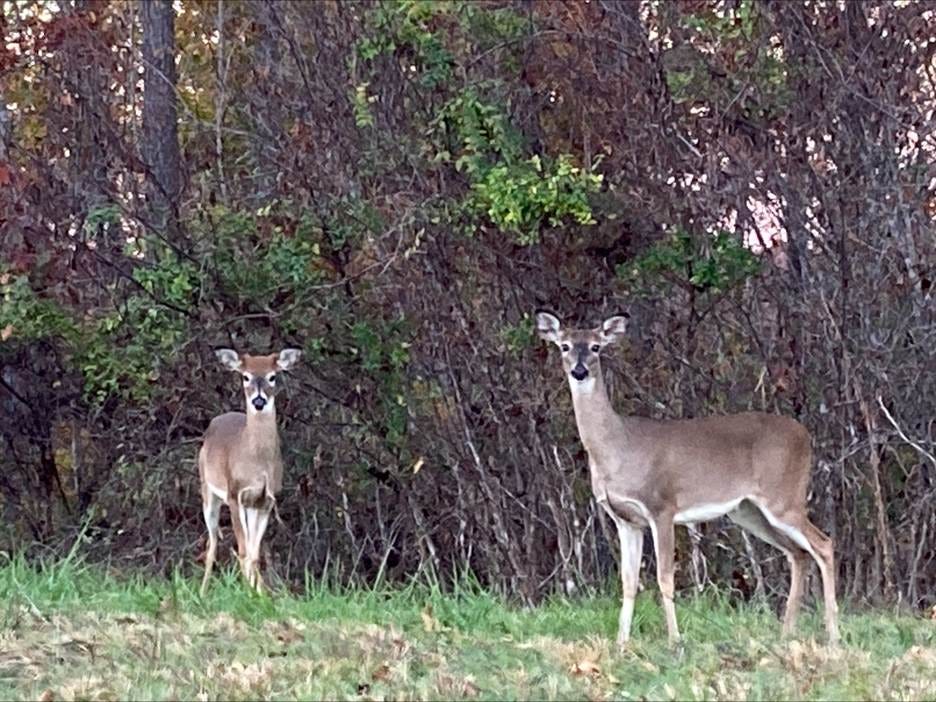
Other than the occasional live sightings of squirrels and rabbits, I only see evidence of most of my furry neighbors on my game camera and through the scat they leave on my trails. The fox, raccoon, bobcat, groundhog, beaver, and possum are rarely seen by human eyes.
Of course, we do have a few that like to show up unexpectedly just to entertain us, like the mischievous coyote that decided to join our Wilderness Way gathering a few weeks ago and became the star of the show.
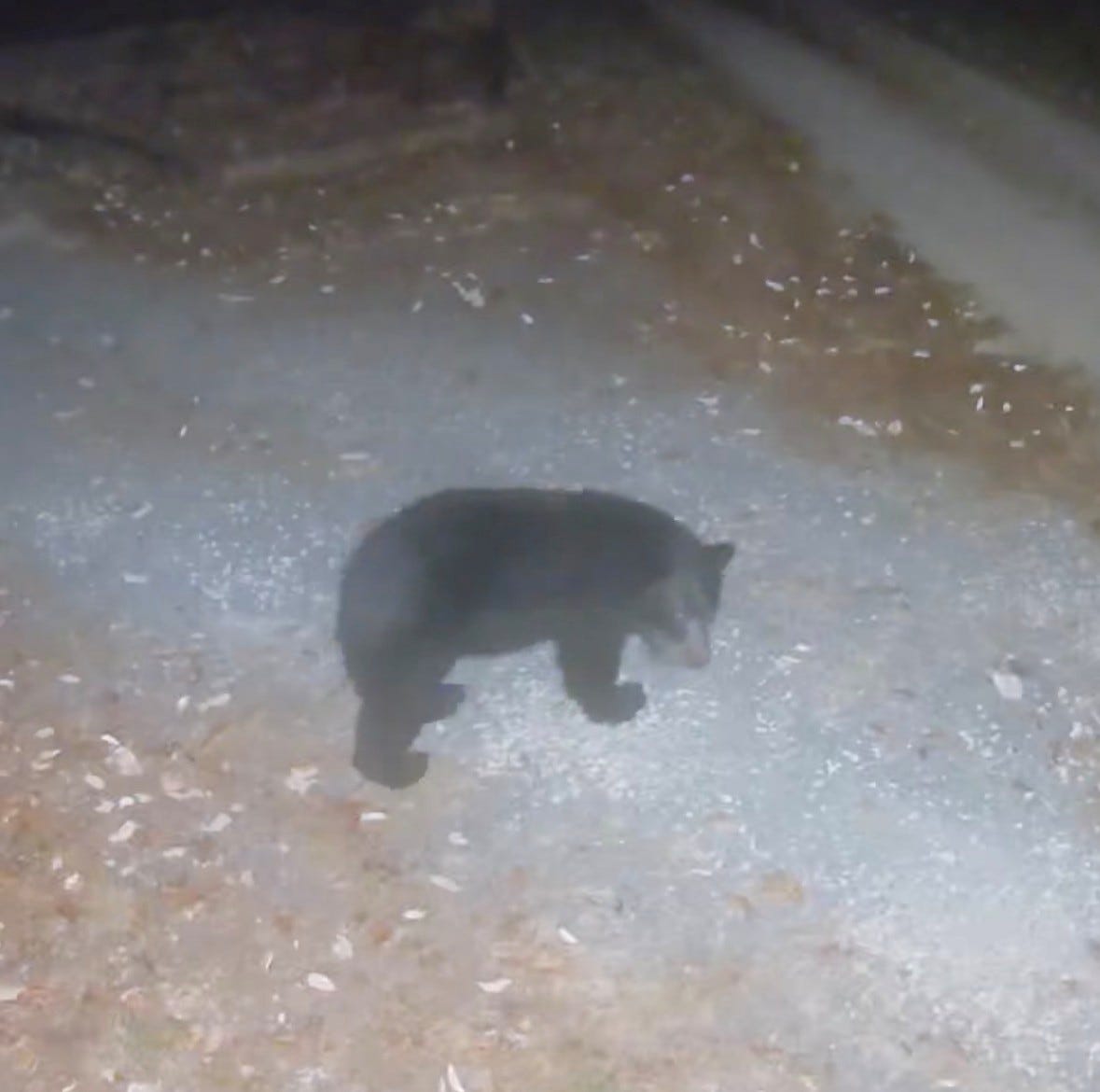
My favorite mammal is the black bear that makes an appearance a few times a year, most often on our game camera during blackberry and persimmon season. But this year, we have a less cautious adolescent prowling around. My neighbor Mary and I followed him down Coleman Mountain Road one day, and he even showed up on my game camera cruising through my front yard last week! I named him Grogu.
Two years ago, a bear I suspect was Grogu’s Big Brother was killed by deer hunters. His body, strapped to the tailgate of a truck loaded with hunting dogs, was hauled away.
I pray Grogu does not experience the same fate.
I know that Grogu does not know his name. He does not know that I watch for him on the game camera or that I worry about him. He certainly does not know that I have come to think of him as one of my neighbors.
He has no idea where my property ends and someone else’s begins. He knows only the forest, the creek, the places where he can find food, water, and shelter. He has no idea which humans are safe and which would kill him for sport.
This place is more his than mine. His ancestors, along with those of the birds, fox, coyote, fish, and turtle, would most certainly have lived here during that first Thanksgiving and would be the most lively of guests at my imaginary First Thanksgiving gathering of neighbors.
This land is their mother, and she is shrinking. She has been carved up, cleared, planted, cut, and our tiny 23 acres is nowhere near enough to contain a curious and hungry growing bear who has no idea where the property lines are and which of the human stewards are friends and which are foes.
They deserve a place at the table during our Thanksgiving gathering. I wonder if perhaps Grogu and Lily might dance for us to the tune of Wren and Sparrow?
A Few Unwanted Visitors
A gunshot rings through the valley below my home. The hunters who line our roads this time of year come largely from other communities. They leave their beer cans along the road, kill our bear, and run their dogs through our property.
But I know that at least as it relates to the deer population, they too are performing an ecosystem service. They are performing the role of an apex predator that our ecosystem needs to maintain balance. Without them, our deer population, if left to its own devices, would destroy the health of the forest through overbrowsing.
These temporary community members perform the function of extirpated wolves who would have roamed these lands during that first Thanksgiving.
And so, I remind myself to be thankful for the deer hunters and the service they provide for my forest.
The thought of them killing Grogu makes being thankful for their presence incredibly difficult.
And, I simply cannot bring myself to offer them a place at my Thanksgiving table.
The First Humans
The Monacan Indian Nation and Virginia’s Powhatan-descended tribes, such as the Pamunkey, still reside in communities to the east and west of our forest. While our land lies much closer to the Monacan ancestral lands, the official map of the Monacan Nation found in the Monacan Ancestral Museum does not include Coleman Mountain. However, there is mention of seasonal movement into boundary areas in the tribe’s historical account.
If my time machine brought me to this place in the early 1600s, I likely would have met Native hunters. Perhaps a young girl collecting the same fruits I like to forage. I can imagine a grandfather teaching his granddaughter how to catch fish in Fish Pond Creek. I suspect they knew Whispering Ridge, Fish Pond Creek, the forest and her inhabitants far more intimately than I ever will.
It would be arrogant of me to invite them to the table they first hosted.
The Settlers
During colonization, the land was cleared, initially for family farms, then converted into tobacco fields. When the land became unproductive, much of it was converted into a loblolly pine forest between the 1920s and 1960s.
All the land as far as my eyes can see was owned by one family who named our main road – Coleman Mountain Road. Generation by generation, the Coleman land was divided among the heirs, sold off, and cleared for homes, horses, hay, and cattle grazing.
The landscape I see today has many different stories and a multitude of inhabitants who have come and gone from this place, but echoes of all these ancestors remain.
Those Who Steward
I have gotten to know those who live off Coleman Mountain Road through their more-than-human family members. Most live far off the main road, and other than their mailboxes and livestock, you would have no idea humans occupy this land.
There is the horse farmer who takes in rescues, the sheep and goat farmer who saved me from a rabid skunk, the cattle farmers whose big-eyed beasts make me smile as they graze in the pastures all around me. One of the cows likes to sing, but she is not very talented. I named her Moaning Myrtle. Her calf, little Houdini, likes to escape and stand in the road, daring me to drive past him.
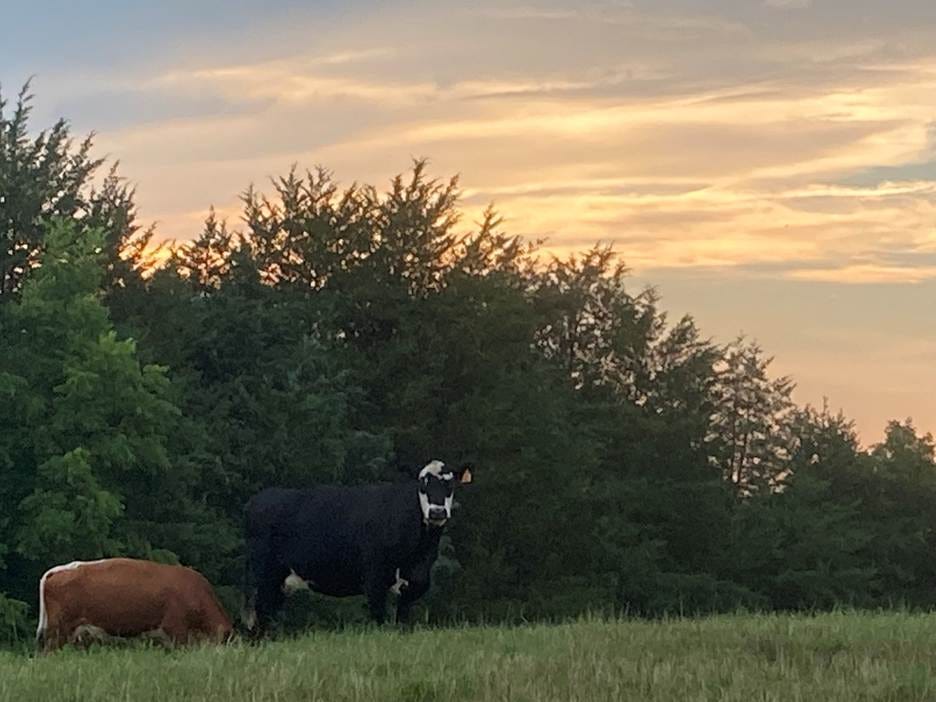
My immediate neighbors, weekenders who live in Richmond, lovingly tend their land on either side of me and share access to their sunset chapel with all who desire to appreciate its beauty up here on Coleman Mountain Road.
Then there is my closest neighbor Mary, whose companionship makes living in the middle of nowhere a bit less lonely. She helps me clean up the roadway at the end of hunting season and shares her vast knowledge of bird species, gardening, and even her chicken eggs with me. This year, she allowed me to borrow her chickens for an experiment. I wanted to see if they would eat all those dadgum squash bugs at the end of the growing season. Sadly, they were too freaked out by the change of location to focus on the task at hand and spent most of their time trying to find their way home.
But it is my family that makes this place a home. All of us have grown more deeply connected to this place and all its inhabitants the more time we spend here.
The human members of my forest community are few and far between. We don’t own these lands; we simply steward them for those whose ownership interest predates all of us and who, God willing, will be here long after we are gone.
To steward a place is to receive it as a gift, care for it while it is in your hands, and leave room for those who will come after you.
A Late Arrival
While only the ridge and the creek were likely here during that first Thanksgiving, the ancestors of my forest trees, the ancient oaks and hickories, along with ancestors of Grogu and the other forest animals, remind me that my time here, my presence in this place, is but a blip on a timeline.
I am a late arrival.
The ridge was already here.
The creek was already here.
The trees had already grown and fallen and grown again.
The animals were already making their homes here.
The Monacan and Powhatan had already traveled these woods and known these waters.
And generations of settlers had already altered the landscape in ways that still shape what I see from my front porch today.
I imagined myself as the host of this expanded Thanksgiving table but am instead a guest who has just arrived.
I am simply one more temporary member of a community that began long before me.
May those who inherit this place see what I am only beginning to see: that its beauty is not ours to possess, but ours to receive.
May they know Whispering Ridge as an elder, Fish Pond Creek as a giver of life, the trees as neighbors, the animals as companions, and the land itself as a gift that was here before us and I hope long after us.
And may I never forget that I arrived late to this party.
This year, as we gather around the table, I hope we pause and invite all who enrich our lives, both the human and the more-than-human neighbors, to join us at the table.
Perhaps Grogu and Lily’s dance might be one played out in our imagination as Whispering Ridge and Fish Pond tap to the beat.
I can imagine Sparrow teaching Moaning Myrtle to sing, and the oaks and hickories swaying alongside the goldenrods and violets.
This Thanksgiving, I am deeply grateful for all of them.
The post above was inspired by the Haudenosaunee Thanksgiving Address, which I first read in Robin Wall Kimmerer’s book Braiding Sweetgrass.
I hope you and your family have a happy Thanksgiving, filled with gratitude and surrounded by a loving community of both human and more-than-human friends.