

The future can exist only when we understand the universe is composed of subjects to be communed with, not objects to be exploited. The Earth is a single community that lives or dies together. - Thomas Berry
Arriving at the Intersection of Land and Spirit
Something is shifting for me both in the way I think about the sacred and how I think about community. It has not been a sudden shift, but something that has been evolving for decades. What began as a seed, planted by my Celtic Christianity class in seminary, has taken root and has been growing silently and secretly for decades.
It was watered by the wisdom of Joanna Macy, Thomas Berry, Matthew Fox, Robin Wall Kimmerer, Patty Krawec, Leah Rampy, and many others. Sustaining life on planet Earth is the crisis they are all trying to address from their respective fields and faith traditions. Surprisingly, they all arrived at the same root cause for this crisis - a growing disconnection between humans and the rest of the natural world. This disconnection is also at the root of what ails humans – from physical health to mental health.
The only lasting solution to this problem, as Leah Rampy puts it, “is to reestablish our soul connections to the Earth so that kinship may flourish into the future.” Every one of the climate activists, indigenous leaders, and eco-theologians I have read has ended up at the same solution – reconnecting Spirit/soul with land/earth.
Thus far, my journey to this intersection of Earth and soul has been largely a solo journey, but I am hoping this post will help me connect with others who have been silently and secretly finding their way to the same intersection, but who are longing to find others who have arrived here.
A New Way of Seeing our Community
When I read Joanna Macy’s book Active Hope, what surprised me was how much of what Macy calls “the work that reconnects” sounded like Asset-based Community Development, but simply with a larger lens. Instead of “human thriving” being the end goal, which is what we largely think of in ABCD circles, Macy centered the earth. She was proposing a shift from anthropocentrism, which means human-centered, to ecocentrism, which means nature-centered, with humans being just one element among many. This image captures it well[1]:
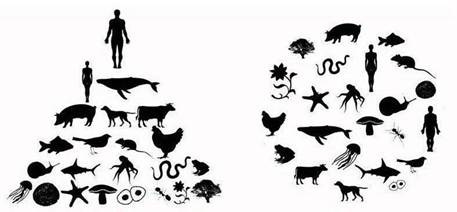
The deep connection that is needed to reconnect soul and earth comes only through direct experience of oneness with the sacredness of all life. We will not think our way, invent our way, or work our way out of this mess. Seeing the earth as a living whole and humans as one species among many, not as dictators but as family members, requires a new way of seeing.
An Old Way of Experiencing the Sacred
Throughout the ages, mystics have sought to understand this communion in sacred oneness through direct experience of the Holy. - Leah Rampy
While many of the voices calling us back to this idea of the sacred earth community have emerged from indigenous cultures, this understanding is not foreign to the Christian tradition. The mystics of all faiths were simply eco-theologians long before that term was coined. They managed to maintain this connection, which was largely erased by Western versions of Christianity.
Eco-theologian Thomas Berry claims, “The divine communicates to us primarily through the language of the natural world. Not to hear the natural world is not to hear the divine.” This is not what I hear in most churches. However, this practice of listening to the natural world was the core of what I learned during my Celtic spirituality course in seminary. It is the practice that has most deeply shaped my own spiritual journey. You see it in the life of Jesus and all mystics who came before and after across all faith traditions.
Community Cultivating at the Intersection of Land and Spirit
This intersection of land and spirit sprouted in my community cultivation work through John McKnight, founder of the asset-based community development movement, whom I interviewed in 2023. I asked John, “What were your key learnings related to your inquiry into the role of culture across the globe?” He said, “The central importance of Spirit and land to the work.” In a follow-up email, I asked him to elaborate, and here is his response:
In most traditional societies, a common understanding of their local culture begins by recognizing how culture started. These societies tend to believe that the starting point is the context within which they live. That context has two elements. The first is recognition that they are in a place that was created by a spiritual force that pervades the community at this time. The second is that the spirit created the land for us to occupy and enjoy.
It seems to me that in general most reform efforts, including ABCD, do not explicitly identify either the Spirit or the land as the primary assets from which communities emerge. Traditional societies usually find it impossible to even think about community without first explicitly identifying and celebrating the Spirit and the land. Therefore, what we call assets excludes the most important resources.
I think discussions of these two assets can enlighten our reform and ABCD work.
Decolonizing From all Directions
While I agree with John that ABCD generally does not acknowledge the role of Spirit and land, it does teach us to embrace new perspectives, especially those rooted in ancient practices that lead to deeper connections.
After my interview with John McKnight, I hosted a series of conversations about this topic with community cultivators from across the globe. Indigenous ABCD Practitioner, Karri-Lynn Paul, shared that one of her mentors defined decolonization this way: “If our kids are closer to the land, then we are decolonizing.”
I realized that what I loved most about the natural world is how it helped me dismantle contemporary cultural norms. The trees that I encounter in the forest, the insights I gain from simply paying attention, ground me in what is real.
For those deeply steeped in Western culture and contemporary Christianity, rediscovering this source of community and connection at the intersection of land and Spirit requires deconstructing much of what we have been taught by society and by religion. There are many working to decolonize the Christian faith and others doing the same work around how we function in community and as societies, but few who see them as inextricably linked.
What would it mean to decolonize the way we think about land, spirit, and community?
Anyone Else at This Intersection?
I never really fit in with the pastoral crowd because I don’t feel called to work inside the religious establishment. I never fit into the non-profit sector with its outcome measures that often cause us to focus on symptoms and ignore the root of the problem. I don’t feel at home in climate activist circles because I agree with Macy that the path forward is a shift in consciousness, not a well-crafted campaign. What I have learned from these wise guides is that the root is spiritual and must be addressed at the soul level.
It is far bigger than those inside the religious structures can address alone, though I know many who are following in the footsteps of Berry and Fox and are awaking this sleeping giant. We need a convergence of streams – climate activists, theologians, and community organizers working together to reweave the connection of earth, soul, and community.
Thomas Berry, Joanna Macy, John McKnight, and others all arrived at this same intersection after spending a lifetime in their fields – Berry as a Christian Theologian, Macy as a Buddhist climate activist, and McKnight as a Christian community organizer and researcher.
I am curious, are there others who have arrived at this same intersection?
Attempting to Weave Land, Spirit and Community
Since that interview with John, I have been attempting to weave threads from wise guides, like those named above, into my community cultivation work. Last spring, I partnered with Suzanne Bonefas from the Association for Regenerative Culture to explore the intersection of ABCD and permaculture through a co-sponsored training.
During my sabbatical last summer, I read multiple books about this intersection, including Leah Rampy’s marvelous book Earth and Soul: Reconnecting Amid Climate Crisis.
Last year, Embrace awarded Corey Turnpenny, a Wild Church Pastor, a CommUnity Cultivator grant to conduct a listening project with Wild Church Pastors across the globe. The passion and energy of these leaders fueled my interest in the wild church movement.
Over the Christmas break last year, I read Victoria Loorz’s book Church of the Wild and found that she had brilliantly woven all these threads together with more skill than I ever could. Loorz spoke to my spiritual roots as a pastor, my passion for the natural world, and my life’s work of cultivating communities of belonging and purpose outside the walls of the inherited church.
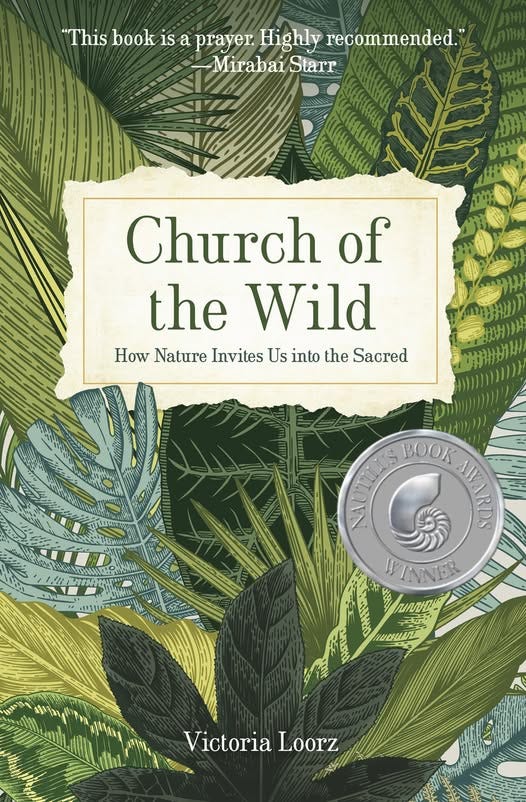
Loorz’s book had been on my reading list for years, but I had assumed that it was a very church-focused book, all about how to save the church from its steep decline, with nature as a kind of gimmick. I suppose I am a bit jaded after spending over a decade in church growth circles. I came to realize decades ago that as long as the church focuses on its own survival and ignores the health and well-being of the community beyond its walls, it is not worth investing my energy in. So, the book remained on the shelf until multiple people encouraged me to crack it open. Once I did, I could not put it down. It is not that the ideas were new to me; it was that Loorz had woven her own story and the wisdom of those who came before her in a way that was very accessible, concise, and relatable.
For this reason, I felt that Church of the Wild: How Nature Invites us into the Wild would make an ideal book study for others who have arrived at this intersection and who would like conversation partners as they discern what it means for them personally or perhaps for their community.
Would you be interested in going on this journey with me?
I plan to launch the book study on May 3rd. More details here.
We will combine asynchronous reading and responding here on Substack for 9 weeks, working our way through the 9 chapters with three facilitated conversations - once at the beginning, once midway, and then at the conclusion of the book. I will be hosting both in-person and a virtual group.
Please let me know in the comments or send me a private message if you would like to join the conversation.
If you enjoyed this post, I hope you will consider subscribing, sharing your thoughts in the comment section, and sharing this post with others. All materials on my site are free, and 100% of any paid subscriptions are donated directly to Embrace Communities, a public charity.
Other Resources
If you are interested in Spiritual Ecology but this book is not really speaking to you, you might want to check out Amrita Bhohi at The Mustard Seed. She hosts monthly Spiritual Ecology-focused book studies.
Leah Rampy has a Substack publication called REWEAVING EARTH & SOUL. I encourage you to subscribe if this is a topic of interest to you.
I have a few other Eco-spirituality-leaning posts here. I would recommend An Invitation to be a Cow , Standing in the Darkness and Facing the Dawn.
[1] (Bilheimer, 2023)
Earth, our holy home,
essence beats embedded here.
Heart, our ‘kind-led’ hearth?
...
Hail, hallowed hollows...
forests, oysters, cocoons, caves.
Templum, temenos.
...
In resonance: https://marisolmunozkiehne.substack.com/p/holy-humus-holding-hands
Did I suggest Teilhard De Chardin to you? The scientist, biologist, theologian, priest, whose theology of integration starts with the integration of spirit and matter — from the beginning (the big band). There is no matter without spirit and no spirit without its manifestation as matter. He talks about matter-spirit, or spirit-matter. They are not polar opposites, but complimentary and necessary for one another. Like yin and yang.
All of creation is moving toward the Omega Point, the highest level of consciousness, and the full and ultimate integration (oneness) of all things.