

“Church is the tax we pay to find fellowship,” my friend Jill said during our final discussion of Victoria Loorz’s book Church of the Wild.
I stifled my laugh. I can’t believe she just said that out loud in a room full of pastors!
Jill’s comment struck a nerve. For weeks I had worried I had chosen the wrong book. Several people had declined to join because it felt “too churchy.” I avoided reading the book for years out of concern it was simply a book about doing church outside.
To close our discussion, I shared the line that, for me, captures the heart of the book — “You only protect what you love. You only love what you know. You only know what you are in deep relationship with.”
Then we closed our books and stepped outside.
“You can join me for a guided wander, or you can head off on your own,” I explained. Esther and her husband Kay, who grew up in Seoul, South Korea, with little exposure to wild spaces, chose the guided option.
Standing on the gravel road, I pointed to our neighbor’s land so densely packed with young pine you could not see into the forest. “This section was clear-cut about ten years ago. I cried when it happened,” I shared. “I felt like I was living in Dr. Seuss’s book, The Lorax, but did not know how to speak for the trees.”
We continued along a path on our side of the road. I grabbed a honeysuckle vine that was climbing a Red Oak Sapling and said, “The worst part was all the invasives that took off once the forest was removed.”
Jill plucked a few ripe berries off one of the thorny brambles and ate them. I added, “The upside is we have more blackberries!”
“I used to think it was all the same. Trees are a forest. I never thought about the types of trees or the ages,” Esther admitted.
I loved Esther’s honesty and her genuine curiosity. I felt the same way when we first purchased the land. Every hike was filled with exciting discoveries, and they still are. Seeing Esther’s face light up made me grateful for the opportunity to introduce her to the forest.
As we left the gravel road and turned onto a mown path, a staghorn sumac caught my attention. I licked my finger, ran it down the ripe berries, and touched my finger to my tongue. “Tastes like lemons,” I said. “Give it a try.”
Esther punched Kay. “You do it.”
Kay looked skeptical but followed my example. “It does!” His eyes widened in surprise when the bitter residue hit his taste buds.
Esther gave it a try and smiled. “Oh wow, that is interesting.”
Further down the mown path, we came to an intersection with a foot trail that led down the ridge into a stand of mature Loblolly pines.
“See that black walnut?” Chris asked, pointing to a tree just off the path. “It releases a toxin into the soil that kills the Loblolly pines.”
As we passed through an area where fallen pines lay scattered across the forest floor like giant matchsticks, I remembered how sad the sight had once made me. Now I saw something entirely different. Mother Nature was patiently restoring the forest, making room for native hardwoods to reclaim their place.
As the path narrowed and became much steeper, we paused. “This is the line between the pine stand and the more mature native hardwoods. Can you feel the difference?” I asked.
Jill looked down at the trail. “The forest floor has completely changed from pine needles to leaves.”
Chris added, “The trees are bigger and more spread out. It is more spacious, and you can see through the understory. We also have a lot more species of trees in this part of the forest.”
As we continued down the steep trail, Chris and I pointed out the various species of oak, hickory, maple, dogwood, and cedar.
Lying across the path was a large decaying tree trunk. As I stepped over it, I pointed out the rusty metal cable that protruded from under it. “This tree always reminds me that this part of the forest was spared from the most recent logging because it is too steep for the loggers to haul the trees up.”
We moved deeper into the forest. Dark clouds rolled in along with echoes of thunder in the distance.
I paused at one of my favorite spots, a rich green moss-covered mound that was formed when a huge old tree decayed.
I turned to face the group. “There is a feeling I get in this section of the forest that is hard to describe. It feels wiser, more connected, more like an interdependent community. There is an intelligence here I don’t feel in the other parts of the forest.”
We stood in silence. Then we heard a clap of thunder. The storm was approaching fast.
I had hoped to stay longer. To allow our guests to feel the embrace of this mature hardwood forest. To absorb some of her wisdom.
However, Chris was watching the radar on his phone, and the storm had other plans. “We better get back. The storm will be here in five minutes.”
I reluctantly agreed. We raced up the ridge with the sky growing darker by the minute. The smell of rain arrived on the wind gusts. The pines on the upper ridge swayed back and forth. It felt a bit ominous, and I was thankful Chris made the call to return.
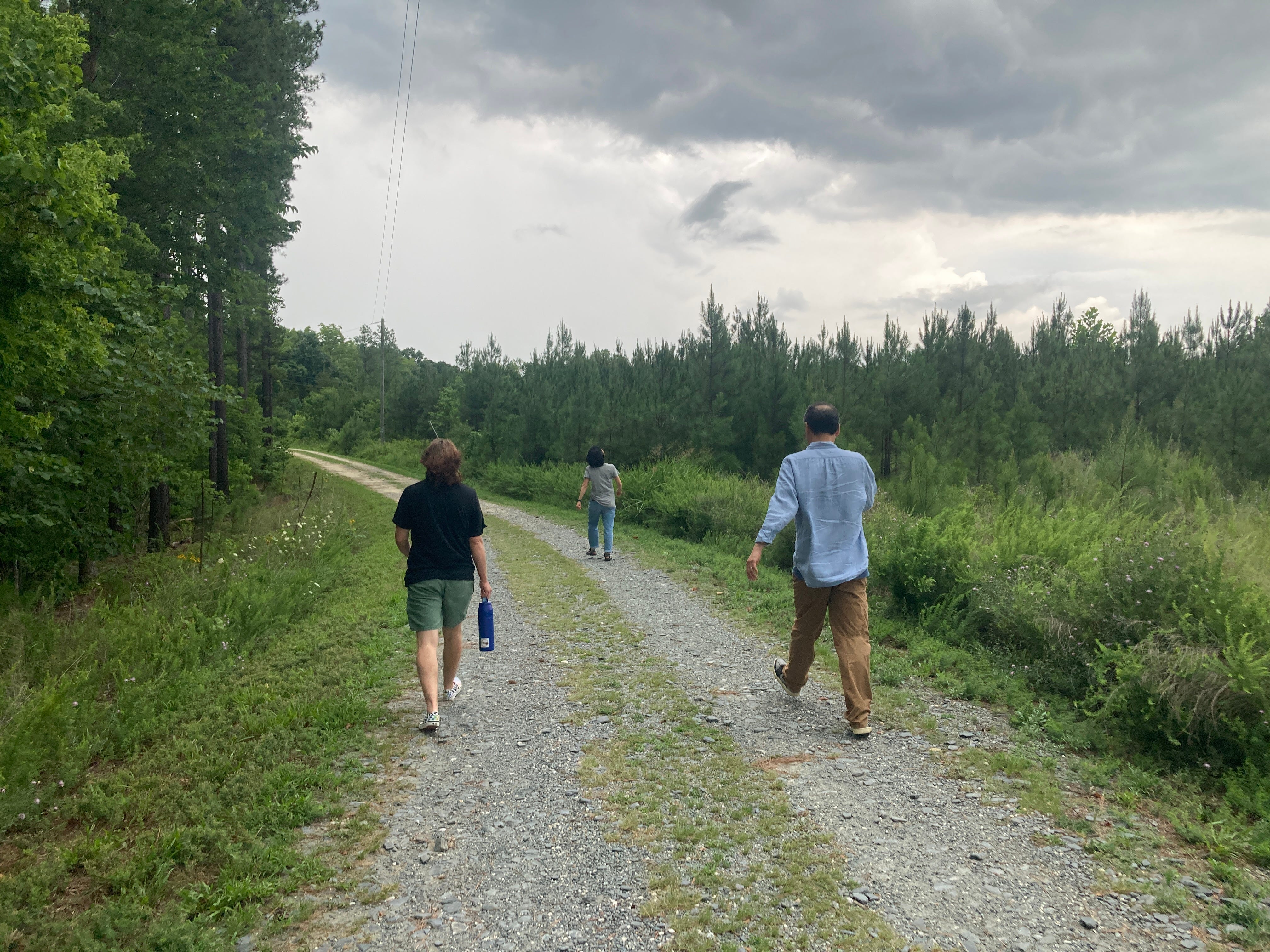
Esther was leading the group. As it began to sprinkle, she appeared to be dancing with the raindrops. She was so light and free, able to find joy in the moment. I may know more facts about the forest, but I suspect she knows more about surrendering to its wildness.
The rest of the participants were already back at the house when we arrived. We gathered in a circle on the covered back deck just as the sky opened up and released a gentle and steady rain.
The air turned cooler, and the sound of the rain settled over us as we stared out at the curtain of water now falling from the sky. No one said anything. We were mesmerized by the rhythmic sight and sound.
For several minutes, no one reached for a phone or searched for words. The rain was enough.
I broke the silence. “What stood out to you from your time in the wild?”
Some appreciated the stillness; others appreciated the opportunity to revisit parts of the forest that had caught their attention during previous visits.
Jill’s response seemed to resonate with everyone in the group. “I really enjoyed doing this with other people.” Heads nodded in agreement around the circle.
I closed our time together with my favorite question. “What gift have you received by participating in this group?”
The answer was unanimous – fellowship.
Jill shocked me when she said, “We should keep doing this.” I was even more surprised when others echoed that sentiment.
“The leaves are beautiful in mid-October. What if we gather once every season?” I asked.
There was overwhelming agreement.
As I waved goodbye, I realized something had quietly shifted. Eight more people now knew this forest—not as a patch of trees, but as a place with a story. They had tasted its fruits, walked beneath its branches, stood among its elders, and listened to rain fall through its canopy.
If the quote is true—that we only protect what we love and only love what we know—then perhaps this simple experiment accomplished far more than reading a book together ever could.
What emerged from our time together is not a church that meets outside, not a book study, but an opportunity for fellowship with others and the wild—fully tax-exempt.
If that kind of gathering speaks to you, we’d love to have you join us in the fall or connect you to others in your area.
As the cars disappeared down the road, I looked back toward the woods. The leaves stirred gently in the breeze.
I couldn’t help wondering if the trees were waving goodbye too.
What a gift to walk in the woods together. And to receive the rain!
I’m feeling love for your forest as well!
And, you are speaking for the trees here and now, you Lorax!
Thank you for your beautiful, experiential writing !