

My husband and I recently visited our daughter Caroline in Philadelphia. While there, we toured The Museum of the American Revolution and the Benjamin Franklin Museum. I encountered this image repeatedly. This snake has been slithering alongside me for months! This post is an attempt to understand its significance.
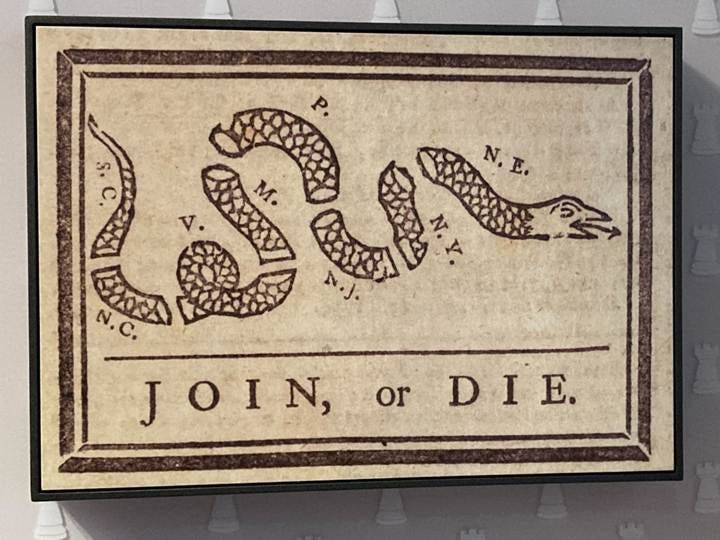
Ben Franklin’s 1754 Invitation
In 1754, Benjamin Franklin published this image with the objective of uniting the colonies during the French and Indian War. It is one of the most famous political cartoons in history and is considered an early masterpiece of political messaging. It has resurfaced throughout our nation’s history, most notably in the years leading up to, and during the American Revolution.
I first learned of Franklin’s influential comic through the Ken Burns American Revolution documentary on PBS a few months ago. Growing up, I thought of the American Revolution as a battle between the English and the Americans. I never considered that it began as a campaign for the unification of our nation – a battle between American patriots seeking liberation and American loyalists who wanted to remain under British rule.
I always imagined that the hero of the American Revolution was George Washington, triumphantly defeating the enemy on the battlefield. I never understood that his success was made possible by men like Ben Franklin, who spent hours building consensus and unifying different factions around a common cause. More importantly, it was the sacrifice of families who were torn apart as the men and boys left home to fight for the cause, many willingly giving their lives, that made the revolution a success.
It is easy to forget the sacrifices made by past generations.
It is easy to think someone will ride in on a white horse and defeat the enemy.
It is easy to withdraw from what feels like a dysfunctional, increasingly divisive culture.
Franklin’s Invitation Echoed in Robert Putnam’s Research
I will be honest; I have given a lot of thought to simply giving up on trying to bring people together around their shared vision for their communities. Vanishing into my forest and waiting till this season of insanity ends sounds far more enticing. I consistently take for granted that the good guys will win. An honest account of our history makes it clear what a miracle our nation is and how easily it could have gone the other way.
The miracle is not simply that the revolution liberated America but that the thoughtful words, “All men are created equal,” have taken our nation and our global society further than even the founding fathers could have imagined. Those words were the rock upon which Abraham Lincoln stood as he brought an end to slavery. That vision was the same foundation that allowed women to achieve equal rights. The founding fathers were far from perfect; it is not the men but the spirit of equality contained in their words that has liberated countless people both in our own nation and across the world.
I recently watched a documentary about social scientist Robert Putnam, author of the book Bowling Alone: The Collapse and Revival of American Community. The documentary was titled Join or Die, drawing on Franklin’s legacy. Putnam concludes that there is a direct link between the health of the community and the strength of our democracy.
A healthy human ecosystem consists of the formal and informal groups of individuals that gather for a variety of purposes, from civic groups like PTAs, neighborhood associations, and friends of various parks’ groups that work toward the common good, to affinity groups like sports groups, book clubs, and faith communities that gather around a shared interest. Putnam’s research shows a sharp decline in all forms of community life.
The documentary reminded me just how much is at stake and why I have dedicated 30 years of my life to cultivating community in all its forms.
Franklin’s Invitation Echoed in the ABCD Movement
John McKight, the co-founder of the Asset-Based Community Development Institute, studied communities for more than 60 years. McKnight defines community as
“Small groups of common citizens coming together to form organizations that solve problems.”
He refers to this kind of voluntary participation in various forms of community life as the associational life of a community. McKnight’s research illustrates that a community’s care-giving capacity is directly tied to the health of its associational life. He explored this loss of care-giving capacity in his book, The Careless Society: Community and Its Counterfeits. Below is a short synopsis.
Basic Premise: “Care is the only thing a system cannot produce. Every institutional effort to replace the real thing is a counterfeit.”
Core Problem: “Competent communities [have been] invaded, captured, and colonized by professional services. Through propagation of belief in authoritative enterprise, professionals cut through the social fabric of community and sow clienthood where citizenship once grew.” In short, “the enemy is a set of institutions and interests that are advantaged by clienthood and dependency—dependency masked as service.”
The Solution: “The two foundation stones of reform are economy and community…the central reform is the conversion of clients to citizens.” He defines the starting place for community building as a “focus upon efforts to define the competence, the skills, and the capacities.”
McKnight calls this process of defining the competencies, skills, and capacities of a community asset-mapping. He calls the process of strengthening a community by building on these strengths, asset-based community development, or ABCD.
I have been using this strengths-focused approach to strengthening communities for roughly 30 years, and while the term has become more widely recognized, the actual practice has become increasingly difficult as civic life continues to decline.
Indicators of a Thriving Community
Few would argue with Putnam’s assessment that community life is declining. Most agree with McKnight that the solution is to invest in the associational life of a community by focusing on strengths. Sadly, few are willing to make the kinds of investment in associational life that are needed.
Traditional funders want canned programs with evidence-based best practices that address community needs through professionalized services with guaranteed outcomes. The exact cause of our decline in civic life, according to McKnight and Putnam’s research. Funders get the importance of community life in theory, but many don’t know how to support it in practice.
Years ago, the United Way in Richmond hosted a series of conversations to help formulate a way of measuring the success of community-building efforts. The conversations included leaders from foundations across the region who took community-building efforts done across Richmond and tried to find measures of success that would be consistent across all different types of communities, and at the same time did not turn the work into a professional service delivery model.
We came across the Conjoint Community Resilience Assessment Measure (CCRAM), which identified 6 indicators of community resilience. We recognized those same indicators as key indicators in our own grassroots community building work and have been using them as measures of success for decades.
Social Relationship
Authentic relationships are the key ingredient of a healthy society. I love the ending of John McKnight’s book Careless Society, which draws on the words of Jesus who in John 15:15 says, “No longer do I call you servants…I have called you friends.” The shift from cultivating clienthood where one group “serves” another group to cultivating circles of friends is the primary goal of an ABCD effort.
Social Trust
Associational life builds trust, empathy, and acceptance across social divides. When we don’t know one another, it is easy to ascribe harmful stereotypes that erode trust. Associational life is how we learn to relate to one another. As Americans disengage from the public square, we weaken our democracy in a multitude of ways. As the saying goes, “Community grows at the speed of trust.” Trust is grown through consistent meaningful engagement. Time spent together is a key driver for growing trust. Are community members coming together as groups, and having conversations about things that they care about?
Civic Investment
Associational life also builds civic investment. People invest in what they co-create. If we assume the government or the non-profit sector will meet the needs of our community and don’t personally engage, our communities are harmed by this disinvestment and the transfer of power from the community to the institution. Civic investment can also be measured. How are community members contributing their labor, skills and resources to the community building effort?
Collective Efficacy
Associational life also builds collective efficacy. Efficacy is the belief that we can make a difference in the world. The small wins of a group of ordinary citizens working together are the lifeblood of democracy. When we don’t experience our own power to bring about change by working together, we become cynical and assume, “nothing will ever change” and “no one else cares.” This leads to further disengagement and the belief that individuals have no power in an increasingly global society controlled by a handful of powerful elites. Do community members believe they have power? What decision-making power have they exercised?
Community Leaders
The single most important indicator is civically minded leaders who act based on moral responsibility and not personal gain. Leaders who start at the grassroots level out of a motivation for building a stronger community versus those who enter the public square motivated by political aspirations are the kinds of leaders our nation needs. As associational life declines, so do these grassroots leaders, leaving us with elected officials who enter the public square with motives and experiences that are not shaped by community life but instead by corporate and personal interests.
Shared Vision and Plan of Action
The final indicator of a healthy community is clarity about what the community collectively cares about and agreement about how it can achieve its shared objective. This is achieved through countless conversations aimed at discovering the gifts, hopes, and dreams of the community. If you don’t start with this kind of internal motivation for action, it is nearly impossible to cultivate an authentic community.
The vision of Embrace, the organization I founded in 2005, sums up what a thriving community looks like in our vision statement: “We envision communities where community members are connected, investing their gifts, and in control of their own well-being and future.”
I meet a lot of individuals who claim to be cultivating community. I love John McKnight’s response to such claims: “Tell me the story of how community members are making their community a better community.” Counterfeit community development efforts focus on service delivery; authentic community is born out of ordinary citizens working together for the common good – not for money, power, or prestige.
Ben’s Invitation to Us Today
As I walked through the Franklin Museum, I found myself asking, “What would Ben do if he were here now?”
The last display we viewed was a video about his early days and how he began cultivating community early in his career.
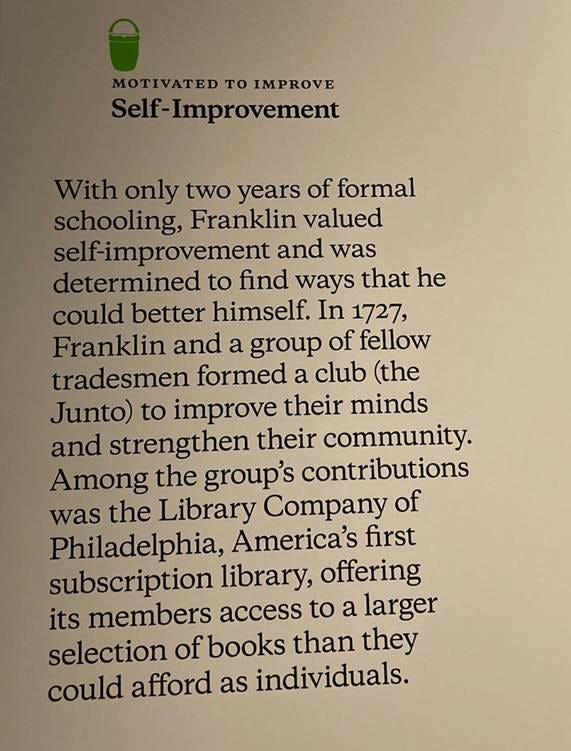
Ben Franklin started as a small group leader, cultivating a circle of friends who worked together to improve their local community. This made me smile. It’s the same place my own journey began. I always thought of Ben Franklin as an inventor, but his true gift was as a community cultivator.
As we approach the 250th anniversary of the Declaration of Independence, we are invited to remember…
We began as a nation divided and chose to unite.
Our shared creed that we the people can form a more perfect union, is still true.
That liberty and justice for all is worth the sacrifice.
The only way to protect our democracy is to reweave the social fabric that holds us together. We are not going to get there through some big saving act of a lone ranger riding in on a white horse. We will get there by forging one relationship at a time. As Ben would say, Join or Die!
If you enjoyed this post, I hope you will consider subscribing, sharing your thoughts in the comment section, and sharing this post with others. All materials on my site are free, and 100% of any paid subscriptions are donated directly to Embrace Communities, a public charity that seeks to strengthen communities from the inside out.
Other Resources
If you would like to learn more about some of the other development efforts I am following, check out Drama in Appomattox, which is the effort of youth to unite their rural community, Convergence of Mountain Moving Streams, which contains a snapshot of our network-weaving efforts in Richmond, Virginia. The Ups and Downs of Community Cultivating, which documents the journey of one of my favorite wildflowers, Torrie Patterson. As well as additional stories over in our Mighty Network Newsroom like this one. You can also learn more about some of the wildflowers I am journeying with here.
A most compelling post. Thank you for expanding my understanding of community and the connection to democracy.
I will go find that documentary right now. Maybe a screening at pHuel too? I appreciate your perspectives & vision, always❤️ even if I won't get my 'ass'et-mapping self together yet🤣✌🏼Thanks for being wonderful YOU!✨🪬🌱🪩