

Last week, I drove 12 hours from Virginia to Canada, hopped in the car with my friend Heather, who drove another hour, then hopped in the car with our friend Rishia, who drove us another hour into Toronto to meet our friend Rory, who had traveled all the way from Belgium.
We are an odd bunch. Rishia is the co-chair of the ABCD Institute, a global network of community cultivators. Heather just left her role at Tamarack Institute, where she helped build a vast network of cultivators across North America. Rory is in Toronto speaking at a conference for community musicians. Then there was me, the convener of this group of relative strangers. While each of us had taken a different path into community cultivation work and our work was rooted in different countries, we are all striving toward the same goal: communities that are connected and in control of their own future.
Three days later, I found myself doing the bunny hop in a church fellowship hall chanting “Teamwork makes the Dreamwork”. The teens looked confused; they had never heard of the bunny hop! But a fearless fifteen-year-old redhead named Jackson and Ruth, a United Methodist Pastor, led the charge as we sought to build connections among an incredibly eclectic group of community members, a dozen high school youth, and twenty primarily senior adult church members from a local Baptist church. My co-facilitators are seven adults who are supporting the project and are now scattered across four conversation circles. These groups of community members did not know one another but came together around the shared possibility of strengthening their hometown.
The following day, I drove an hour and a half to host yet another conversation. This time it was our Richmond Regional Community Cultivator network meet-up, which was an all-day series of conversations. The morning was made up of United Methodist Pastors from across the region who were cultivating communities in their local context. Katie, one of the most experienced Community Cultivators in our network, facilitated the first conversation. During lunch, we were joined by Community Health Workers in the area. They were invited by Stephanie, who has been seeking to bring community cultivator training to CHWs across her vast network. I watched as the more experienced cultivators encouraged those who were new to community cultivation, like Ruth, who began her journey just a few months ago.
Three gatherings.
Three very different circles of people.
All building connections.
All dreaming of stronger communities.
It wasn’t until I returned home and walked my own forest that I realized I was seeing a pattern that needed more attention.
Lessons from the Forest
It has taken me two decades to realize that the forest that surrounds my home is actually three distinct ecosystems, each with its own species and critical role.
Likewise, I am beginning to understand how the various kinds of community cultivation efforts are home to different types of cultivators who collectively offer unique gifts to the broader community.
Our 23-acre forest consists of three ecosystems: a dying pine forest that is giving way to young hardwoods, a mature oak and hickory forest, and the older yet ever-changing riparian area along the creek.
This past year, I traveled from Texas to Canada, learning from community connectors, regional network weavers, and global thought leaders. Some are launching new development efforts like those in Appomattox, others are experienced regional network weavers like those in Richmond, and yet others are helping fuel global movements like those I met in Toronto.
I have come to realize that these three distinct sections of our property mirror the three realms of community I find myself participating in. Listening to these human and more-than-human communities has revealed some insights that I am just beginning to understand and, more importantly, incorporate in my own community cultivation efforts.
Emerging Communities
The upper part of the ridgeline was most recently a mature loblolly pine forest, which was logged roughly 40 years ago. It is where our home is located and also the area that is the easiest to access along our gravel road and mown trails.
We attempted to select-cut diseased and mature pines. Unfortunately, we disturbed the soil and now have a serious issue with invasive species like Japanese Honeysuckle, Autumn Olive, and Japanese Stilt grass. After the more mature trees were removed, the younger trees have had to bear the brunt of stronger winds, and many otherwise healthy trees have snapped in half.
This is the part of our land that I manage most intensely, trying to get the invasives under control and encouraging the native plants and trees to take hold. This part of the forest has been managed for profit for hundreds of years. Shifting to a more organic purpose, one that honors nature’s intent for this land, is a lot of work and a very slow process.
My dream for this part of our land is that it will one day become a mature hardwood forest. It won’t happen in my lifetime, but it is a vision worth investing in.
Likewise, the communities where we live are where we first learn to cultivate community, specifically those that are close enough to return to day after day.
In these communities, we fight the invasives of racism, institutional takeover, and polarization. We seek to shift from profit-driven paradigms or program-defined outcomes to community-centered ways of being.
This is the soil out of which our own unique story of transformation takes root, is nurtured, and grows.
This is where all forests, communities, and community cultivators begin their journey – rooted in the soil of place.
Mature Communities
Between the upper ridge and the creek, there is a beautiful, mature, roughly eighty-year-old hardwood forest covering the steep-sloping ridge. It consists of amazing biodiversity, including oaks, hickory, maple, beech, and poplar trees. We have a trail running horizontally along the ridge that is of moderate difficulty but absolutely worth the effort. This is where I hike when I am seeking to take in the beauty of the healthy forest and receive the wisdom that a fully functioning native ecosystem can provide. I love walking under the canopy, sheltered from the scorching sun.
As I have gathered with community cultivators regionally, each sharing what they are learning in their home context, I feel the same kind of sheltering arms that I feel from the mature canopy. For a brief time, we are not alone in our efforts. We find each other; it is like finding your tribe you never knew existed. As one participant in our Richmond conversation shared, “I thought I was the only unicorn.”
The gift of this gathering of more mature and emerging community cultivators is a deep sense of camaraderie in a world that does not understand us.
This is where community cultivators are supported for the long haul.
Watershed Communities
At the bottom of the ridge is a spring-fed creek with water-loving species like sycamore and pawpaw trees. This area is the hardest to reach and thus contains the oldest and most mature trees. The creek is my favorite place, but I only visit when I have several hours to spend there, knowing the amount of energy it will take to climb back up.
The creek is rarely still. After heavy rains, it tears whole trees from the bank; by midsummer it whispers over stones. This is a place of energy, flow, and refreshment.
The creek always reminds me how connected we all are; rainwater from my ridge will flow all the way to the Chesapeake Bay and out into the Atlantic Ocean. The creek is the artery that connects us to this beautiful living earth.
When I gather with others from various parts of the globe or read ideas from thought leaders from other movements – something stirs in me. The ideas mix with my own, and what emerges is fuller and richer than what I would be able to imagine on my own.
While some of the social change efforts feel destructive as they knock down old systems and structures, others calm my soul and offer buoyancy in rising flood waters. I find refreshment from a multitude of thought leaders, some from within the field of community development, others from a more spiritual place, and increasingly from those working to foster a shift toward regenerative culture by reconnecting land, spirit, and community.
While the number of social change movements is mind-boggling, the end goal is often the same: cultivating ecosystems of humans and more-than-humans where both thrive.
This is where insight and inspiration for change often begin – where our imagination is invited to run free and to flow and mix with other creative energies.
Cultivating Connection across Ecosystems
At first glance, these communities and sections of my forest appear to be three separate ecosystems.
They aren’t.
Forests have taught me that what matters most is rarely visible.
Beneath them lies a single organism...
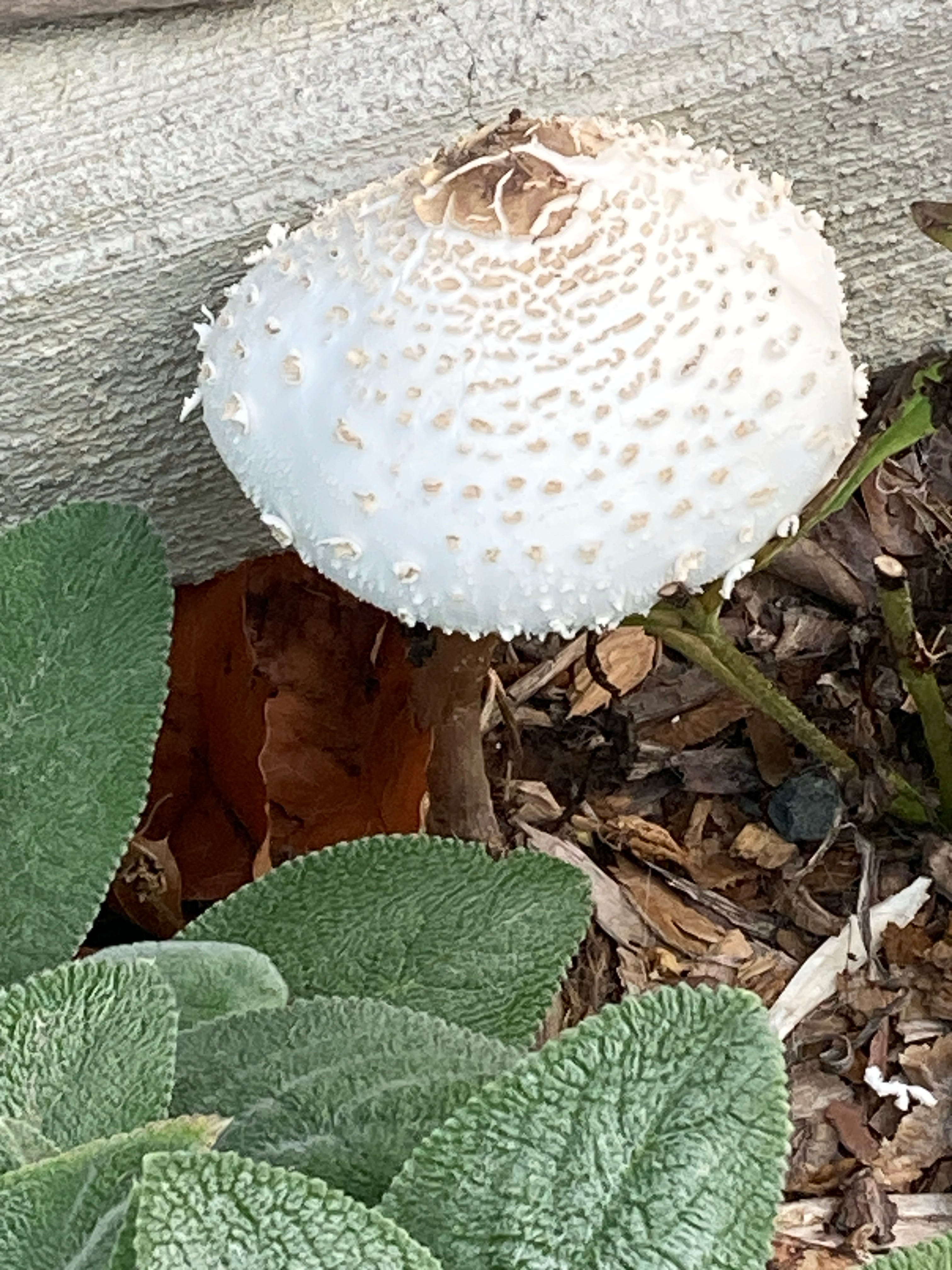
This morning when I walked out of my house, I was surprised to see this new resident in my yard. My yard consists of terrible clay soil that was heavily compacted when the house was built six years ago, but somehow the mycorrhizal network has made its way here. Though all I can see is the occasional mushroom, there is a massive hidden web of connections made possible by fungi. This is the only living organism that connects all three of the ecosystems of this forest.
Through this vast underground network, water, nutrients, and messages are transmitted, young saplings are strengthened, and species that never physically touch are connected.
This invisible network thrives on diversity.
Rather than trying to convince others that one movement or framework or social change model is the “right one,” those who understand the role of the mycorrhizal network are finding ways of flowing into each other, allowing the waters, nutrients, and messages to mix and flow without losing their distinct identities.
The health of a forest isn’t measured by its tallest trees but by the strength of the relationships beneath them.
Discovering my Place in the Ecosystem
In each of the three community conversations I participated in this past week, I found myself thinking like mycelium, looking for connections and opportunities for them to share their gifts.
I am not interested in my efforts being seen above the ground, in building organizations.
I am interested in what is happening in the unseen realms of human hearts and minds.
I am interested in how these invisible webs of connection will grow and thicken when I am no longer holding the space.
Perhaps I am becoming one of those old fallen trees.
The ones who served their purpose, whose canopy once offered shelter to dozens of species, but who now allows itself to decay, becoming one with the fungi – one with the forest – one with the source of all life. One final act of surrender.
I smile thinking about Stephanie and Heather welcoming new cultivators into the first collaborative learning cohort for public health professionals in the fall.
My heart leaps thinking about Jackson and Ruth touring Katie’s work at the Pace Center and seeing a mature youth-led community development effort.
I can see the youth in Appomattox, leading future community arts and music sessions, dancing to their own tunes with Rory’s encouragement.
For years I assumed maturity meant building a larger canopy.
The forest is teaching me something different.
Mature trees eventually become nurse logs that feed the mycelial network.
I wonder…
If I cease to host these conversations, will they continue to find each other?
The Challenge of Staying Rooted
I used to think we could nurture mycorrhizal networks virtually.
I no longer believe this is possible.
I believe virtual communities are wonderful places to share ideas and to plant seeds. However, for those seeds to germinate and grow, they need to land in the rich soil of real communities with opportunities for local and regional cultivators to connect in person and continue to learn from others from across the globe.
All these various types of communities are dynamic, living, breathing, ever-changing ecosystems that you discover by being a part of them – tasting their fruits, dancing in their fall leaves, swimming in their cool waters.
No one can do this through a computer screen.
Only experienced community cultivators whose own community efforts have reached a level of maturity allowing them to stand on their own, are able to move underground, horizontally, to connect the swirling waters of the various streams of thought and those planting seeds in harsh, barren soils.
The mycorrhizal network does not ask every tree to grow everywhere. Each tree remains rooted where it belongs. The fungi do the traveling. I have begun to wonder if some of us more mature community cultivators are called to play a similar role. To stop building upward and simply be the conduit that connects horizontally.
This past week, I watched invisible connections form between community members, community cultivators, and global thought leaders. I don’t know what will happen as a result. I only know that I am grateful to have been in the rooms.
Tomorrow morning I’ll walk among pines, then hardwoods, then down to the creek. As I walk, I will remember the unseen connections between them all and give thanks for the fungi.
I love this imagery, Wendy! This would resonate well among our nature-loving youth.
Wendy, WOW! This is so well done. Honestly, I think what you have here is a book proposal. A big YES to trees, woodlands, and forests as offering deep wisdom and guidance for community work. The ARE communities par excellence!
I love catching these glimpses of your community work in these posts. Thank you for doing this important work. ❤️ 🙏
I look forward to reading more!