

All around worlds are dying out, new worlds are being born; all around life is dying but life is being born. The fruit ripens on the trees, while the roots are silently at work in the darkness of the earth against a time when there shall be new leaves, fresh blossoms, green fruit. Such is the growing edge! It is the one more thing to try when all else has failed, the upward reach of life. It is the incentive to carry on. —Howard Thurman
As I sipped coffee during my recent visit to Virginia Beach with Jenny Grant, Manager for Faith and Community Engagement at Episcopal Relief & Development, and Stephanie Parker, Coordinator for Church Vitality from the Coastal Virginia District of the United Methodist Church, Jenny said something that struck a chord with me: “The church is not dying, it’s changing.”
Everything Evolves
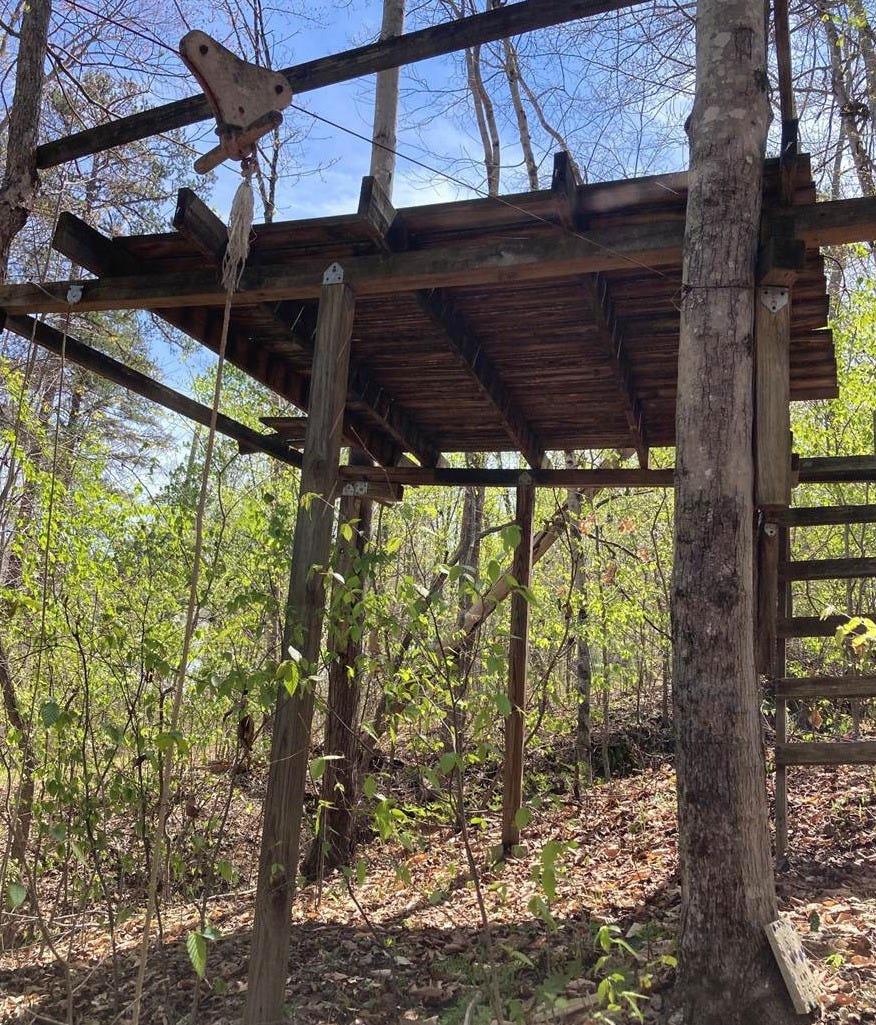
Years ago, next to our cabin in the woods, my husband and I built a treehouse for our children, who at the time were five, eight, and ten. Sitting in that tree house, high up on the tree-covered ridge, I not only see the forest from a new vantage point I also catch glimpses of the past: a long-abandoned tire swing, a rusty zip line, and parts of my daughter’s secret hideout. The children are all grown now, and this treehouse gives me the pleasure of being suspended in the air and the thrill of being able to see so many things all at the same time.
From my perch, I always feel a bit sad seeing the fallen trees. Some die as a result of disease or old age, but in recent years, it is violent winds that topple many otherwise healthy trees. I hate seeing things go to waste, so I ponder salvaging the lumber and using it for some future good. At one point, I even considered turning the bottom part of the treehouse into a woodshed.
When we built that treehouse, I never imagined it having a purpose other than the one for which we built it. But the rhythms of nature remind us that this world is forever changing. Everything evolves. As climate change intensifies, those species that evolve to meet the challenges will survive, and those that do not will perish. In response to the massive culture shifts we are experiencing, we likewise can either evolve or perish.
Wendy McCaig, Power Shift: A Field Guide for Community Cultivators Everywhere
The excerpt above from Power Shift opens a chapter about the need for the social sector to evolve. In this post, I want to explore how faith communities and people of faith are evolving.
Option 1: Stay the Same
I recently helped facilitate several conversations for a church that’s preparing for a pastoral change. It’s an older church with older members who are among some of the most loving and caring people I know in my small town. When asked what they desire most for their church during this season of change, the general sentiment was this: “We love it the way it is. All we need is younger people to keep it going.” There was no real desire to evolve, and I suspect this church will keep on doing what it has always done. They will keep loving their members and serving their community until the day the last leaves this earth, or until they run out of funding to keep the lights on. It is a common story that those of us who work with faith communities see regularly.
On my first visit to Norfolk last fall, Stephanie took me through what many would define as a “dead” church. I wrote a post titled, Hauntings and Hope on Halloween last year about that experience. That church existed without evolving for decades until the funding ran out, the members died off, and it closed its doors. However, this is not the end of the story. The building is being sold, and a new expression of the mission of the church will emerge. It could take the form of affordable housing, a hub for non-profits, a vocational training facility, or a daycare. These kinds of resurrection stories are happening across the nation. What some see as death, others see as a part of the evolutionary process.
If you are like the dear sweet friends at the church I mentioned above, who love the church just as it is, just as it was in the 1960’s, and who hope it will stay the same forever, I hope I am wrong. I hope by some miracle, the evolutionary process is not necessary for you to reclaim your glory days and that you find younger parishioners to carry your good works forward. The world would suffer a great loss if it were to lose your caring heart.
Option 2: Reform Movements that Create New Wineskins
Nor is new wine put into old wineskins [that have lost their elasticity]; otherwise the wineskins burst, and the [fermenting] wine spills and the wineskins are ruined. But new wine is put into fresh wineskins, so both are preserved. Matthew 9:17
The desire for a younger demographic voiced by the older members of the church mentioned above has been at the root of many church reform movements within the Christian Tradition aimed at attracting a younger audience.
My call to ministry was forged in the early 90’s through the small group movement. I entered the church revitalization conversation in the late 90’s during the purpose-driven and seeker movements. As a formerly unchurched young adult, I applauded its focus on making church more accessible to unchurched individuals through changes in the music, liturgy, the layout of church buildings, and programs for youth and children. I found my way into the missional church movement during seminary in the early 2000’s through my encounters serving individuals experiencing homelessness in Richmond, Virginia.
I added my own voice to these reform efforts when I published From the Sanctuary to the Streets in 2010. I felt certain books like Robert Lupton’s Toxic Charity, which I wrote about in 2012 in a post titled Is Our Charity Toxic?, would change how the church engages in the community forever. I was wrong.
When I started training pastoral and lay leaders in Asset-Based Community Development in 2012, I thought training and guiding the church was the missing piece. I have trained thousands of pastoral and lay leaders over the past decade, and there is one lesson I have learned: those who are willing to evolve thrive. Those who choose to stay the same do not.
All these movements, along with many of those that came before and after, focus on the wineskins - the structure and containers that carry the inherited Americanized version of the Christian tradition to new populations.
Even my own book and training efforts, while radically shifting how the church thinks about its role in community, fall into this category of reform efforts. Try as I may, it is impossible to evolve at the level of the mind; it must come from a deeper, more soulful place.
Option 3: Deconstruction of Contaminants that Change the Wine
Why is it that Christianity seems impotent to deal radically and therefore effectively with the issues of discrimination and injustice based on race, religion, and national origin? Is this impotency due to a betrayal of the genius of the religion, or is it due to a basic weakness in the religion itself? Howard Thurman
There is another movement happening alongside these church revitalization movements. It is not organized with slick marketing and conferences featuring big-name sages on stages who promise a three-step process to success. It is more of an underground movement of those who tried changing wineskins for decades and realized that what needed to change was the wine.
The Good News, which began as a life-giving message of freedom, acceptance, and blessing born out of love, has become so contaminated that it carries the exact opposite meaning for many outside religious institutions. This parallel movement is focused on deconstructing these elements of Americanized faith that have polluted the original message and thus have turned the wine into vinegar for many people.
Some people deconstruct to the point of abandoning all faith; some simply deconstruct the patriarchal lenses and retain the rest. Some are deconstructing through the lens of decolonization and discovering more ancient forms of faith. Some, like Thurman, look at the gospel through a liberation lens, reminding us of Jesus’ marginalized status and how far we have gotten from that truth. While others simply abandon high-control religion and find freedom in a different branch of the Christian tradition or another faith. Some leave institutionalized religion but retain a robust spiritual life. There is no “one way” to deconstruct and no “one way” to move forward after deconstruction.
I think that this deconstruction process is a natural and necessary part of evolution. Like a Caterpillar inside its chrysalis, whose body completely loses all form, deconstruction precedes metamorphosis. However, it is important not to remain in a state of dissolved goo!
My Own Deconstruction Journey
“The supposed achievements of the first half of life have to fall apart and show themselves to be wanting in some way, or we will not move further.” Richard Rohr
Since I did not grow up in the church, it was relatively easy for me to reject interpretive lenses of high-control religion overlaid on top of the original message, like not allowing women to be pastoral leaders. Early on in this deconstruction process, I lacked the words and agency to go deeper than the surface issues to the root of why the faith had become so toxic in many corners of the tradition. While I was in seminary, many of my fellow students were challenging inherited narratives, which gave me the courage to do the same.
I found myself drawn to Christian writers who were not afraid to ask hard questions and to dig deeper to find life-giving answers. Authors like Brian McLaren, Richard Rohr, and Rob Bell lined my bookshelves. But the brutal treatment of some of these insiders who dared to question the establishment soured me on the whole venture.
For a short time, I tried adding my own voice to the conversation through my blog, View from the Bridge. The most popular post I ever wrote was titled “ Religionless Christianity and featured the early insights of one of the most consistent voices in the deconstruction conversation, Jim Palmer. Palmer now writes a publication titled Deconstructionology with Jim Palmer .
During this time, I wrote a fair number of posts probing some of the deeper questions, primarily around how we define church. I was challenged on Twitter (this was pre-X) by a missional church megastar whose definition was far narrower than my own, and found that there did not seem to be much interest in evolving at that time.
For the past decade, I have retreated to the edges of the Christian tradition. I have focused on one core element that all faiths, and even those without a faith tradition, agree on - loving our neighbors. I have largely ignored the evolution of the religious establishment. Instead, I have focused on creating a parallel structure for those who were willing to evolve - a network for community cultivators.
An important shift for me has been my definition of neighbor, which has expanded to include not just our human neighbors but also the natural world. I wrote about this shift in a post titled, Reconnecting Land, Spirit, and Community. My understanding of the different ways the church (broadly defined) manifests in the world beyond the walls of buildings, sacraments, and professional pastoral leaders has also continued to broaden, as has my understanding of the movement of the Spirit.
Most of this shifting has been largely a solo journey. The church as we know it never really felt like a safe place to ask questions or challenge inherited narratives, but more of a place focused on conformity. Conformity that looks nothing like the early church, which was full of rebels who were stirring things up and evolving by leaps and bounds.
I have wondered through the years if others were hoping to engage in these important conversations, but I was always too afraid to ask. I had been shut down too many times, or worse, ignored. How many faithful individuals have retreated into realms that were less rigid, where shifting and evolving were more welcomed? I wonder how many feel alone on their evolutionary journey.
Option 4: Going Beyond Deconstruction to Evolution
Recently, something has been gently pulling me back into more spiritually focused conversations. It started during a season of darkness when nothing seemed to make sense anymore. I began writing again and connecting with other evolutionary Christian leaders whose deconstructed faith had evolved into something that looks and sounds a lot more like a message of good news, birthed out of love. kathy escobar’s recent series titled New Ways for a New World is one such example. Kathy’s view of church as little pockets of love, has always resonated with me.
Victoria Loorz is another evolutionary leader whose writing has resonated deeply with me. In her book Church of the Wild: How Nature Invites us into the Sacred, Loorz acknowledges some of the layers of deconstruction that her journey required, but spends most of the book inviting us to activate our own imaginal cells. Imaginal cells are the cells in the body of that deconstructed caterpillar that carry the blueprint of the butterfly. Like those caterpillars, we already have within us the blueprint we need to grow wings and fly to new heights.
I love Loorz’s definition of church “as a place of intentional connection with the sacred.” She shares her vision for church as “a place where Mystery is experienced, not explained.”
I resonated deeply with Loorz’s role as an “edge walker- wandering along the hemlines of the Christ tradition.” I have existed in this edge space for more than a decade, but never had words for it. The edge space that Loorz invites us to explore is at the intersection of religious tradition and personal experiences of the sacred through reconnection with the natural world. As I shared in my previous post, Reconnecting Land, Spirit and Community, this is where my decade of edge walking has led me.
What I love about edge spaces is that they are where two ecosystems connect. In this case, places where those inside religious traditions and those outside institutionalized religion can experience the sacred and engage in spiritual conversations that can be life-giving and liberating for all, using the shared language of the natural world.
An Invitation to Join Me on an Evolutionary Journey
I don’t know if my deconstruction journey is complete or if there are still layers of narratives that need to be removed and examined more closely. What I do know is that I am feeling called to move beyond a state of goo, which basically describes my 50’s, into something with wings as I rapidly approach 60 years of age.
As I shared in my previous post, I am hosting a book group using Veronica Loorz, Church of the Wild. I am excited to finally have others to travel with, at least for a season.
This book study is for everyone: those who have been faithful churchgoers for decades, those who have walked away, those who never felt called to participate in organized religion, and those who do not expect to ever do so. Loorz states that her book is for “the wild ones who have heard the whispering call from Earth and Spirit to restore the great conversation.”
It is not too late to sign up. If you want to know more, check out the Book Study Details Here.
Transforming the Treehouse
My first treehouse experience, I had a sense that something in my life’s work was going through a metamorphosis. I didn’t know whether I was experiencing a midlife crisis, burnout, or some kind of spiritual awakening. What I did know was that I couldn’t keep doing what I’d been doing the same way I had been doing it. I sensed I was becoming something different, someone with a higher view, someone who served a purpose far beyond what I had originally imagined. It has taken me the intervening years to understand fully the metamorphosis that began in that treehouse, and I believe we are seeing a similar metamorphosis in our collective consciousness today. Wendy McCaig – Power Shift
My treehouse did not evolve into a woodshed. Instead, I named it The Eagle’s Nest. It is the place I go (literally or metaphorically) when I need a higher view, a fresh perspective, or when I know I need to make a change—to evolve.
Evolving is hard and painstakingly slow, and we must tend to our own hearts if we want to endure. Retreating to The Eagle’s Nest from time to time is the best thing I can do for myself. The forest has picked me up time and again when I felt as if I wanted to quit. The fresh perspectives it gives me are essential to the hard work of cultivating community in a new and ever-evolving way.
So I invite you to climb into your literal or metaphorical treehouse (ideally in a natural setting where evolution is most visible) and ponder this question:
What’s evolving in your faith journey?
Whether you join us for the book study or you navigate your evolution alone or with others, I hope you have found this post helpful. As we move through the study, I will be sharing more insights from the book and our journey together.
If you enjoyed this post, I hope you will consider subscribing, sharing your thoughts in the comment section, and sharing this post with others. All materials on my site are free, and 100% of any paid subscriptions are donated directly to Embrace Communities, a public charity.
Other Resources
If you want to learn more about how people within the Christian faith have navigated their deconstruction journey, I recommend The Beautiful Kingdom Builders podcast. Specifically, the interview with Kathy Escobar, and if you want to learn more about my journey, you can find my interview here. However, all the interviews are wonderful.
If you are interested in how churches are evolving, I encourage you to check this story titled Christ and St. Luke’s Restores My Faith in Faith Communities. You can find additional stories here and here.
You can learn more about my training, coaching, and consulting services at Embrace Communities. If you are a subscriber and would like a free 45-minute coaching session, send me a private message, and I will send you a link to schedule a call.
“The church is not dying, it’s changing.”
This! This is what I keep saying, but not so succinctly. We don't live in the culture of the '70s. We don't live in the '90s or the '00s, either. Out with what was and in with what is!
That doesn't mean the past was categorically bad or efforts were in vain. It means that they were a stop in Boise (ID) or Paris on a multi-year world tour. Stop trying to turn Hanoi into Columbia (SC). Look around at the good that is here now and at the current opportunities instead of wailing that your favorite food doesn't taste the same in another country.
Know “all life as kin...”
we’re evolving family.
Love all land as kith.