

Someone I loved once gave me a box full of darkness. It took me years to understand that this too, was a gift. — Mary Oliver
One of the wisest of my more-than-human neighbors is Lumpy the Chestnut Oak. Lumpy sits about a dozen feet off the trail I walk regularly through the forest behind our home. To get to Lumpy, you follow the trail through a beech and hickory stand, over a cedar-studded point, through a ravine, then back toward the creek. There, after about a twenty-minute hike from our home, you will come upon the most unique tree on our property. I nicknamed it Old Lumpy because of the large, round growths that protrude from its trunk. This old chestnut oak is larger and darker in color than the others of its kind and is the only chestnut oak in this portion of the forest, with most preferring the rockier north-facing ridge. Upon seeing this tree, most people feel both awed by its size and repulsed by its distended and unconventional form.
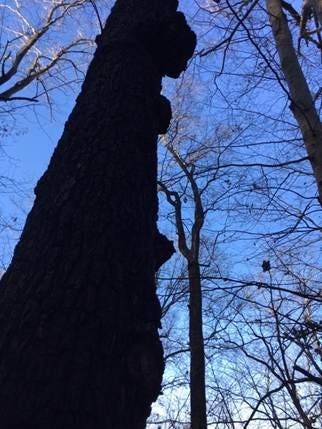
I wrote the following reflection after a particularly powerful conversation I had with Lumpy back in 2019. It is included in the leadership development chapter in my book Power Shift.
The more time I spend alone in my forest, the more the trees seem alive and take on familiar traits. Old Lumpy represents the image I had inherited of what a leader looks like—larger than life, standing tall above all the others, and bearing scars from past battles. With its rock-solid trunk and sprawling branches, it commands respect.
My father was an Old Lumpy kind of leader. He was very thick and tall. He owned a small business with many branches, employing dozens of people. Many of his employees came to him as high school youth and he invested in them, trained them, and mentored many to become co-owners in his small restaurant chain. He was the hardest-working person I have ever known. While he was surrounded by employees and faithful customers, I do not remember my dad having a peer group. Like Old Lumpy, he stood alone.
When my father took his own life in 1997, it was as if a giant tree in the forest had fallen, knocking down everything in its path. The wounds it caused my family are deep, and I doubt any of us will ever fully heal from them.
As I gazed up at Old Lumpy during my sabbatical in 2019, I realized that the strain of being an Old Lumpy-style leader was too much for me to bear. I got a sense that Lumpy had a message for me. In that moment, Old Lumpy felt to me like a kind of Grandmother Willow figure from the Disney Movie, Pocahontas. But at the same time, its huge misshapen branches and unique, nearly black, color gave it an eerie feel—more like the whomping willow of Harry Potter fame. It was both awe-inspiring and a bit terrifying.
While I had admired Lumpy, I had never really lingered here under its branches before my thirty days in the wild. Not only was its appearance a bit ominous, but I had discovered fresh bear claw marks on one side of it. As a result, this part of the trail always felt a bit dangerous to me.
In a similar fashion, I had seldom spent much time thinking about my dad. When memories of him did pop into my mind, I quickly pushed them away because of the tears that always followed. I had long ago accepted that I would never understand why he chose to die. Like Old Lumpy, my dad had a disease. As I sought Old Lumpy’s wisdom that winter day in 2019, I realized that I had spent so much time trying to avoid the pain of my father’s death that I had never considered what I might learn from his life. The words of Henry Nouwen, one of my favorite wise trail guides, challenged me:
Your grown-up self has to become very childlike, hospitable, gentle and caring—so your anxious self can return and feel safe…Your deepest, truest self is not yet home. It quickly gets scared…Avoid the temptation to let your fearful self run off. Let it teach you its wisdom; let it tell you that you can live instead of just surviving.
I wondered what message Old Lumpy and my father might have for me. My dad had been a man of few words. He showed his love in his big strong arms that would hold me tight in his pillowy belly. He was like a large lumbering teddy bear, his intimidating size masking a large and gentle heart. I longed for his comforting embrace in this season of disillusionment. As I glanced up at old Lumpy, I felt a glimmer of paternal presence, and tears began to flow down my cheeks. Sobbing, the words “I want to see you be brave,” floated into my mind. It was the chorus from “Brave” by Sara Bareilles, one of the songs to which I had listened that day while out hiking.
What would it look like for me to be brave, I wondered? I glanced down at the pen and journal in my lap. Embossed on the cover of this brown leather journal was a bear. A few weeks before my sabbatical, my daughter Kristen had given me this particular journal. She is very intuitive and keenly aware of what others are going through, even when they themselves can’t name it.
Inside the cover of this journal, my daughter had pasted a sheet of kind words others had said about my first book from the Amazon comment section. It was a book I had imagined would be only the beginning of my writing career, but it had sat alone without a companion for a decade.
When I opened the journal that previous Christmas morning and saw all the kind words my daughter had included on the inside cover, I burst into tears right there in front of my whole family. It had been the most powerful rush of emotion that I had felt in years. I had felt alone and silenced for so long, terrified that my winding path held no value to anyone. As I sat there under Old Lumpy, I knew instantly that this wise elder was inviting me to find the courage to write and to share with others my experiences, warts and all.
When we can’t see the new work the spirit initiated through our wounds, we lose our creative spark. Spiritual combat is the struggle to keep moving toward the light precisely when the darkness is so real. —Henry Nouwen
As I have shared previously, my work as a community cultivator begins with a few core beliefs. Everyone has gifts, and everyone has dreams. If we discover our shared dreams and invest our collective gifts, we can bring those dreams to life. I have witnessed these truths in dozens of communities initially as a grassroots organizer and daily in my role as a coach and trainer.
Discovering your gifts and those of your community members is the easy part. Finding the courage to share your gifts and creating safe spaces for others to find the courage to do the same is often terrifying. I know this firsthand.
Shortly after my tearful encounter with Old Lumpy, I began working on my second book, Power Shift: A Field Guide for Community Cultivators Everywhere. Most of the stories, tools, and reflection pieces in Power Shift were written years before, They had sat in files on my computer collecting dust. I have been using Power Shift as our core curriculum in my trainings and with my coaching clients since 2022, and have been blessed by the way our training participants have shared their own stories in response to mine.
I have been writing on Substack for nearly 6 months. As I shared in my first post, I put off writing here for a very long time. I had a myriad of excuses and shared them in my first post 5 Reasons Not to Write on Substack.
Thankfully, every time I pass Old Lumpy on my forest hikes, he would ask me the same question, “What would it mean for you to be brave?” Eventually, I pushed the submit button just to make Lumpy proud, and I am glad I did. I have met so many wonderful writers here and have reconnected with old friends and made new ones. Turns out, once again, Lumpy’s guidance put me on the right path.
Thank you for allowing me to share my gift with you. I pray that you find the courage to share your true, authentic self and your gifts with others. I would be honored if you would share your Lumpy-inspired stories with me.
I used to look at Old Lumpy in fear, but now I see the beauty and the wisdom in the scars.
What would it mean for you to be brave?
What gift do you possess that you are not currently sharing?
How would you describe the leadership models that you have inherited?
If you enjoyed this post, I hope you will consider subscribing, sharing your thoughts in the comment section, and sharing this post with others. All materials on my site are free, and 100% of any paid subscriptions are donated directly to Embrace Communities, a public charity.
This post is a part of my Field Notes from the Wild series. Here are a few other posts inspired by our more-than-human kin.
Meet George, a Rule-Breaking Non-Conformist with a Message
An Invitation to be a Cow: Following Beauty in the Midst of Devastation
Love the questions, Wendy. Good advice from your teacher trees. 💕🌳