

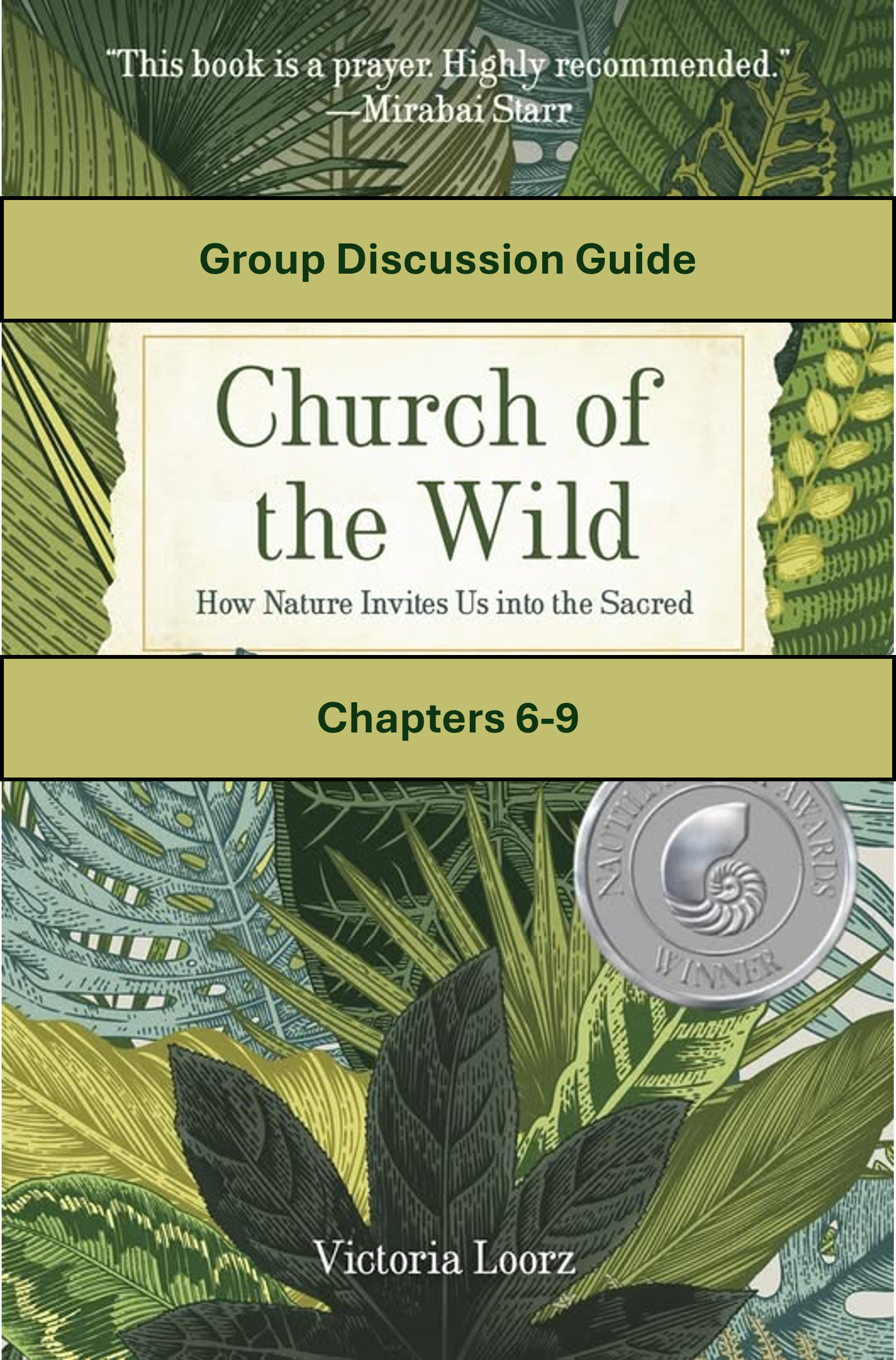
Sunday, July 12th, we will host our final discussion of Church of the Wild. You can find the full details here. Every week, I have been updating this article with a few quotes from the chapter read that week. This article includes chapters 6-9, which we will discuss at our discussion groups. If you are interested, you can find the Discussion Guide for chapters 1 - 5 here.
Your Invitation to Join the Conversation
Anyone is welcome to join the online discussion. You can respond in the comment section, based on the readings, or in response to my personal reflections and quotes. Please keep your comments to 500 words or fewer. Please be respectful and kind to those who share.
Don’t feel limited to the reflection questions posted below. They are simply prompts to help you get started. You can share in whatever order or format you like.
1. What stood out to you from the chapter or my reflections?
2. How do you feel about what you read?
3. What did you find most challenging?
4. What questions would you like to discuss with others who are reading the book?
I will pull insights and questions from everyone’s reflections and use them to draft our discussion guide for our group gatherings.
My Personal Reflections
Chapter 6: In the Beginning Was the Logos
Below are the quotes that stood out to me from this chapter:
The idea of a divine indwelling at the center of the whole universe, with every unique part in conversation with the others, has many names. What Thich Nhat Hanh names the web of interbeing is aligned with what Robin Wall Kimmerer calls sacred reciprocity. David Whyte calls it the conversational nature of reality, and quantum scientist David Bohm uses the term implicate order. Martin Luther King Jr. called it an inescapable network of mutuality, which he said was “tied in a single garment of destiny. Whatever affects one directly, affects all indirectly.” The ancient ancestors of Christianity called it logos.
Logos is about the divine relationship between all things. The system of their connection: conversation.
Christ as radical solidarity, as primal and ongoing relationship, as how life works. Christ as the Conversation between everyone and everything.
Christ as that sacred Conversation that brings all things into being and links all things together.
And I offer another relevant metaphor for our time, yet rooted in a forgotten tradition: Christ as Conversation. Christ as Conversation says to me that the oak tree and that deer in the meadow are not God. And I’m not God. But we both carry the Christ, the Logos, the Tao, the spark of divine love within us. And the conversation between us: that is the manifestation of the sacred, moving forward the evolving kin-dom of grace. The wild Christ.
This chapter felt more theological. The general concept of all things containing a spark of the divine has been a continual refrain. This chapter places Christ as the conversation that connects it all.
Chapter 7: Courtship of the Particular
Below are a few of the quotes that stood out to me:
Wendell Berry, “People exploit what they have merely concluded to be of value, but they defend what they love. To defend what we love we need a particularizing language, for we love what we particularly know.”
But when you feel that the earth loves you in return, that feeling transforms the relationship from a one-way street into a sacred bond.”4
“You can only protect what you love. You only love what you know. You only know what you are in deep relationship with.”
Belden Lane, in The Great Conversation, remarks that “only in risking ourselves to wind and fire, cave and tree, birdsong and wolf-cry can we grasp the language of glory whispered through it all.”
all beings are a reenactment of the divine incarnation.
I have been traveling a lot over the past year and have had some wonderful encounters with the more-than-human community members I have met along the way. However, I realize relationships of deep abiding love require time and attention.
Do I love the dolphins at First Landing, or Callie’s cow George, the same way I love Lumpy the chestnut tree? That is a hard question. All give me joy, but I can do little to protect the dolphins or George. I do feel the language of glory has whispered through them all.
The deeper question is, do they love me? I choose to believe they all feel my presence and experience a connection that is rooted in our shared divine incarnation.
Chapter 8 : Love is as Strong as Death
Below are a few quotes from Chapter 8 that stood out to me.
I can hear sacred truths better if they aren’t couched in strictly religious language.
It was Andreas Weber, a German biologist and philosopher, who helped me to see that for a great spiritual truth to be true, it needs to be seen echoing through the physical, creative world.
love really is at the center of all things.
Embracing the mystery of life into death into new life, and offering our own lives to others in sacrificial love, is not just the moral, religious thing to do. It is the way the whole system of life evolves and grows.
Dowd says, “what opens up when we remember who we are, accept the inevitable, honor our grief, and prioritize what is pro-future and soul-nourishing. A fierce and fearless reverence for life.”
Love requires that we feel the pain of our beloveds.
The more time I spend with my more-than-human companions, the more I feel their pain. The clear-cutting going on around me causes me so much grief. I ran over a turtle accidentally this past weekend and felt deep remorse for my carelessness.
However, I also feel tremendous joy when I see the fritillaries enjoying my pollinator garden, or see the black-eyed susans that we did not mow in the back yard leaning their golden heads toward the sunlight, or hear the dozens of bird species singing to me at daybreak from the young forest across the road that is returning after it was clear-cut a decade ago.
We need a balance of grief and joy and death and life. I find myself getting so overwhelmed by all the death and destruction that hopelessness and feelings of powerlessness slip in. I know from my ABCD training that you can’t build on broken. We have to find what is working, and knowing that decay leads to life as a natural rhythm is a helpful way of metabolizing grief.
Seeing the Appomattox youth planting milkweed last week at the Pollinator Garden at Holliday Lake, made me so happy! They are my hope pollinators.
Chapter 9: Wild Ordination
Here are a few of the quotes that stood out to me from Chapter 9.
The call comes from within kindred relationship, as we commit ourselves to what Bill Plotkin says is “the largest story we’re capable of living, serving something bigger than ourselves. We must dare again to dream the impossible and to romance the world, to feel and honor our kinship with all species and habitats, to embrace the troubling wisdom of paradox, and to shape ourselves into visionaries with the artistry to revitalize our enchanted and endangered world.”
Parker J. Palmer, in his inspiring book on vocation, says that calling, at its deepest level, is “something I can’t not do, for reasons I’m unable to explain to anyone else and don’t fully understand myself but that are nonetheless compelling.”
“Ah, yes, I have been preparing for this all my life.”
The arrogance of belonging simply says, “I am here. I belong here. I have a role here in the whole.” …It takes a degree of arrogance, holy arrogance of belonging, to say yes and step into the unknown, trusting that you will know what to do as you take the steps. Holy arrogance is also paradoxically humble. As part of a great, interconnected story, we are never called to act alone.
Intimacy with nature, he agrees, helps us to remember that we belong to a greater story. Our call is to learn our unique and important role in advancing that story.
This new story will come into being through what systems thinker and writer Margaret Wheatley calls emergence. In her article outlining stages of emergence, she explains, “Emergence violates so many of our Western assumptions of how change happens. . . . In nature, change never happens as a result of top-down, preconceived strategic plans. . . . Change begins as local actions spring up simultaneously in many different areas. . . . When they become connected, local actions can emerge as a powerful system with influence.
By connecting our small, local actions, we are making the pathway together.
This kin-dom of God, the new and yet ancient story, is emerging through us.
“Stop and love what is right before you.” May we all awaken to her invitation to recognize the sacred presence in our glorious world.
This is a theological comment about the word Logos. It takes a book to explain that word, and to connect it with the Hebrew analogues. But here is an attempt of AI to summarize the history of the meaning of logos. Did early Christianity use the word to refer to the “divine indwelling at the center of the whole universe?” (Or more precisely the whole cosmos?) It helps me to see the bigger picture while I am trying to connect to the Gospel of John or to Victoria Loorz in our book.
AI:
The history of the word logos (λόγος) is fascinating because its meaning evolved over centuries and became one of the most important concepts in philosophy, Judaism, and Christianity.
1. Early Greek Meaning: “Word,” “Speech,” “Account”
In the earliest Greek literature, such as the works of Homer (8th century BCE), logos primarily meant:
* A spoken word
* Speech
* A story or narrative
* An account or explanation
It comes from the Greek verb legein, meaning “to gather,” “to count,” “to say,” or “to speak.”
Even at this stage, logos was more than just a single word. It often referred to a meaningful statement or reasoned account.
2. Classical Greek Philosophy: Reason and Rational Explanation
By the 5th and 4th centuries BCE, philosophers expanded the meaning.
Heraclitus (c. 500 BCE)
Heraclitus was the first major thinker to give logos a profound philosophical meaning.
For him, the Logos was:
* The rational principle underlying the universe
* The pattern or order behind change
* The universal law governing reality
Although everything appears chaotic, Heraclitus argued that a deeper Logos gives coherence to the cosmos.
Plato and Aristotle
Plato and Aristotle used logos in several ways:
* Rational discourse
* Logical argument
* Human reason
* Explanation
Humans were distinguished from animals because they possessed logos—the ability to reason and communicate rationally.
3. Stoicism: The Divine Rational Principle
The Stoics transformed the concept further.
For Stoic philosophers such as Zeno of Citium:
* Logos was the rational principle permeating the universe.
* It was both divine and natural.
* The cosmos itself was organized by Logos.
They sometimes spoke of the logos spermatikos (“seminal Logos”), meaning the rational seeds or principles present throughout creation.
At this point Logos had become something like:
* Divine reason
* Cosmic order
* The organizing intelligence of nature
4. Jewish Thought: God’s Creative and Revealing Word
The Hebrew Bible was written primarily in Hebrew, not Greek, so it does not use logos in the philosophical sense.
However, it contains related ideas:
The Word of God
In Genesis:
God said, “Let there be light.”
Creation occurs through God’s speech.
In the prophets:
“The word of the Lord came…”
God’s word is active, powerful, and effective.
Wisdom Traditions
Books such as Proverbs portray divine Wisdom as present with God at creation.
Wisdom becomes almost personified as God’s agent in ordering the world.
5. Philo of Alexandria: Bridge Between Judaism and Greek Philosophy
A crucial figure was Philo of Alexandria (c. 20 BCE–50 CE).
Philo combined:
* Jewish scripture
* Platonic philosophy
* Stoic concepts
For Philo, the Logos was:
* God’s rational thought
* God’s intermediary with creation
* The pattern according to which the universe was made
The Logos was not quite a separate divine being, but it functioned as God’s instrument in creation.
Philo provided an intellectual bridge between Greek philosophy and later Christian theology.
6. The Gospel of John: Logos Becomes a Person
The most famous use appears in the opening of the Gospel of John:
“In the beginning was the Logos, and the Logos was with God, and the Logos was God.”
(John 1:1)
In Greek:
En archē ēn ho Logos.
John deliberately chose a word that resonated with both Jewish and Greek audiences.
For Jewish readers:
* Logos echoed God’s creative Word.
* Logos echoed divine Wisdom.
For Greek readers:
* Logos echoed cosmic reason and universal order.
But John made a startling claim:
“And the Logos became flesh.”
The Logos was identified with Jesus of Nazareth.
This was a major departure from earlier philosophy. The cosmic principle became a historical person.
7. Early Christian Theology
Christian theologians such as Justin Martyr and Origen developed the idea further.
The Logos became:
* The eternal Son of God
* The agent of creation
* The revealer of God
* The source of reason and truth
The doctrine eventually contributed to the formulation of the Trinity in councils such as the First Council of Nicaea.
SUMMARY OF THE EVOLUTION
Period Meaning of Logos
Early Greek: Word, speech, account
Heraclitus: Rational principle of reality
Plato/Aristotle: Reason, argument, explanation
Stoics: Divine reason permeating the cosmos
Jewish Scripture: God’s creative and revealing word
Philo: Divine intermediary between God and creation
Gospel of John: The preexistent Christ
Christian Theology: The eternal Son of God
One way to see the development is that logos moved through a series of increasingly expansive meanings:
word → explanation → reason → cosmic order → divine creative power → Christ.
That progression helps explain why John’s opening was so powerful. He chose a single Greek word that already carried centuries of philosophical and religious significance and then reinterpreted it around the person of Jesus.