

Sunday, June 7th, we will host our first discussion of Church of the Wild. You can find the full details here. Every week, I have been updating this article with reflections on the chapter we read that week. This article includes chapters 1-5, which we will discuss at our discussion groups.
Your Invitation to Join the Conversation
Anyone is welcome to join the online discussion. You can respond in the comment section, based on the readings, or in response to my personal reflections and quotes. Please keep your comments to 500 words or fewer. Please be respectful and kind to those who share.
Don’t feel limited to the reflection questions posted below. They are simply prompts to help you get started. You can share in whatever order or format you like.
1. What stood out to you from the chapter or my reflections?
2. How do you feel about what you read?
3. What did you find most challenging?
4. What questions would you like to discuss with others who are reading the book?
I will pull insights and questions from everyone’s reflections and use them to draft our discussion guide for our group gatherings.
My Personal Reflections
Chapter 1: A Communion of Subjects May 10th
What Stood Out to Me:
The Broken Conversation
What stood out to me from this chapter can be summed up in this quote:
“Spirituality and nature are not separate. Attempts to keep them apart break the world.”
This premise is supported by the lead quote from Thomas Berry, which I love,
“The divine communicates to us primarily through the language of the natural world. Not to hear the natural world is not to hear the divine.”
I also appreciate the reference to nature as the “First book of God.”
Defining Those on the Sacred Journey
I have struggled with the label Christian with the current political hijacking of that label, which ascribes a definition that is far from my own beliefs. I feel more comfortable with the label of edge-walking nature mystic as defined by Loorz. She defines a mystic as
“someone who has an experience of union with The One—and The One may be God, it may be Mother Earth, it may be the cosmos.”
Nature mystics are defined as
“those who experience the presence of the sacred through nature.”
Her definition of an edge-walker as those
“wandering along the hemlines of the Christ tradition.”
These edges are a narrow space between religious tradition and “very personal experiences in nature that have revealed a truth of their own.”
I have felt drawn to the writings of mystics throughout my faith journey and believe this Meister Eckhart quote to be true,
“Theologians may quarrel, but the mystics of the world speak the same language.”
All of them describe moments where they experienced a oneness and interconnectedness with all that is. Loorz states,
“Mystical experiences in nature—those moments when you sense your interconnection with all things—are more than just interesting encounters. They are invitations into relationship.”
The Challenge of Our Time
I agree with Loorz’s statement,
“We are staring at the slow-motion collapse of empire. Standing at the threshold of profound change.”
As well as her naming of the root problem,
“The top environmental problems are selfishness, greed, and apathy, and to deal with these we need a spiritual and cultural transformation.”
My Challenges and Lingering Questions
“There have always been edge walkers: those who didn’t follow along with the status quo, who didn’t swallow the version of religion offered by those on top of the hierarchy as The Only Way.”
Do you relate to Loorz’s definition of an edge-walking nature mystic?
What personal experience have you had with this wilder form of spirituality?
Redefining Church
Like Loorz,
“I longed for church to be a place where Mystery is experienced, not explained.”
I also appreciated her spacious definition of the church simply
“as a place of intentional connection with the sacred.”
I am struggling with using the word church to define this type of nature-rooted spirituality, not because I don’t believe it is deeply spiritual, but because of the baggage the word “church” carries both for those inside and those outside the institutional versions of that word.
How do you define the word church?
What is another word that better fits gatherings of those seeking to connect with the sacred through nature?
The New Story
I think this collapse and these root problems are evidence of Thomas Berry’s recognition that we need a new story.
“We are in trouble because we do not have a good story. We are between stories. The old story is no longer effective. Yet we have not learned “the new story”. We are talking only to ourselves. We are not talking to the rivers; we are not listening to the wind and stars. We have broken the great conversation. By breaking that conversation, we have shattered the universe.”
What in our current story needs to be revisited?
How can we help discover and reveal a new story?
Chapter 2: When You Realize Something is Missing May 17th
What Stood Out to Me:
The Need to Examine the Pieces
“Sometimes it takes years of collecting moments of insight before you are ready to dump it all out onto the table to see what you’ve got, find the patterns, make connections, and allow yourself to see what you never noticed before.”
My post Reconnecting Land, Spirit and Community was my attempt to make connections of a multitude of conversations over decades, with Loorz’s book being one of the best weavings of these threads that I have found so far.
“The root prefix trans means “through” or “across,” meaning we are formed as we move through the ways life changes us: from life through death to new life. Transformed, metamorphosed to be more like who we truly are meant to be. Which is another way to say more wild.”
This quote has been true for me. The times of greatest growth for me have come after seasons of tremendous darkness when I have withdrawn into wild places. I wrote about the lessons I learned from the most recent dark season. This journey together is a part of my own search for the new life that I hope will come from the pain.
My Challenges and Lingering Questions:
Wholehearted Living inside Heartless Systems
“Brother David was able to clarify the problem. He said, “You know that the antidote to exhaustion is not necessarily rest? . . . The antidote to exhaustion is wholeheartedness.””
This rings so true for me personally, but it feels like we live in a world where this idea of wholeheartedness is absent.
I have a number of friends who are struggling to live wholeheartedly and who appear to be losing faith that it will ever be possible. They are constrained by financial demands and systems that break the spirit of those who strive to live wholeheartedly in the name of efficiency and conformity. Perhaps on the other side of their own dark night, they will emerge transformed in a way that will allow them to resist the broken systems or change them from within.
How do we cultivate wholehearted communities that recognize not only the spiritual side of wholeheartedness but also the cultural resistance to this idea?
Is the solution to continue to fight the broken system, resist it, escape it, or create alternatives that center wholehearted living over profit and personal financial reward?
Continuing to Struggle with this Discussion as an Alternative Church Structure
“The growing number of “nones” (those without church affiliation) find nature a better church than a building and an institution. Nature, according to the researchers, provides for this group a “personal, subjective, non-institutionalized, and unmediated experience with the sacred. . . . When a person hikes in a forest to connect with the sacred, she or he may not feel the need to affiliate with a religious organization because her or his spiritual demands are met.”
I have read dozens of books about the value of spending time in natural spaces and have personally experienced the transforming power of such experiences. I can fully understand this trend and would count myself among those who prefer a wild form of communion. I prefer the word communion over the word church or even worship. All three words are likely too churchy for most “nones.” I am still searching for better language.
What I am sitting with is that I have also had transformative experiences inside church buildings and through scripture, sermons, and in conversations with members of faith communities. I think the two forms can enrich one another. As Loorz states, “There comes a point when you need to withdraw from what has become too familiar in order to see again.”
I think the sacred speaks in multiple languages, or as the Saint John of the Cross quote states, “all things are God.” What I don’t want to do is create a dualistic way of thinking and swap one boxed-up version of the sacred for another. I see this whole conversation as an expansion - a willingness to see “the way” the sacred moves in our lives as being beyond human ability to fully comprehend.
How do we use the language to expand and not constrict our understanding of the sacred?
Where have you seen language about the sacred used to expand the imagination, deepen communion, and cultivate wholeheartedness?
Chapter 3: Into the Mountains to Pray May 24th
What Stood Out to Me:
In this chapter, Loorz illustrates that the wilderness way is embedded throughout Christian scriptures.
A Christian Case for the Wilderness Way
“Jesus didn’t go to the buildings to pray. Jesus went to a mountain—or along the lakeshore, or to the wilderness.”
“The word wilderness is used more than three hundred times in the Bible.”
She provides a multitude of examples of this connection between heroes of the faith and wild places.
Liminal Spaces and Times
“it’s not just that the wilderness invites us into the presence of the sacred; there’s the mysterious reality that the sacred also calls us into the wilderness.”
“The wilderness is the place to go when you are standing at the threshold, like Jesus was, of a calling that asks you to risk everything and embody all you are created to be. In the wilderness—the place that speaks—you find that you are not alone.”
My most profound experiences in the wild have come during some of the most difficult times of my life, when I felt called to separate myself from the human world in order to reorient myself to the sacred and find spiritual clarity.
Responding to an Invitation From the Other
“There is a mysterious union that happens when we enter into a relationship with the wild and practice sacred conversation.”
“The living world is where we can be opened up in receptivity to a divine encounter. There is an invitation here, offered to all of us: in order to listen for the holy, to engage in intimate conversation with the sacred, one goes into the wilderness.”
For me, the conversations that are most profound start with a kind of call to pay attention. Something stands out and feels like it is an invitation more than me forcing or even initiating a conversation.
My Challenges and Lingering Questions:
A Fringe Practice or Common Experience
When I shared my story of George the Cow, I was a bit afraid I would be seen as a tad too far out there for most folks. Instead of hitting the unsubscribe button, several individuals sent me images of cows they encountered, or confessed privately that they have had similar conversations with rebels like George.
When I started hanging out with Mamma Winfree, my charismatic spiritual mother, she was convinced everyone could speak in tongues. She staged multiple interventions trying to prove that even I was capable of doing it. She and the other matriarchs in our community laid hands on me, prayed over me, and honestly, I have never felt more uncomfortable. After several attempts, she gave up on me.
The Methodists among us have the quadrilateral of scripture, tradition, reason, and Christian experience. This helps shape how they think about pathways to the sacred.
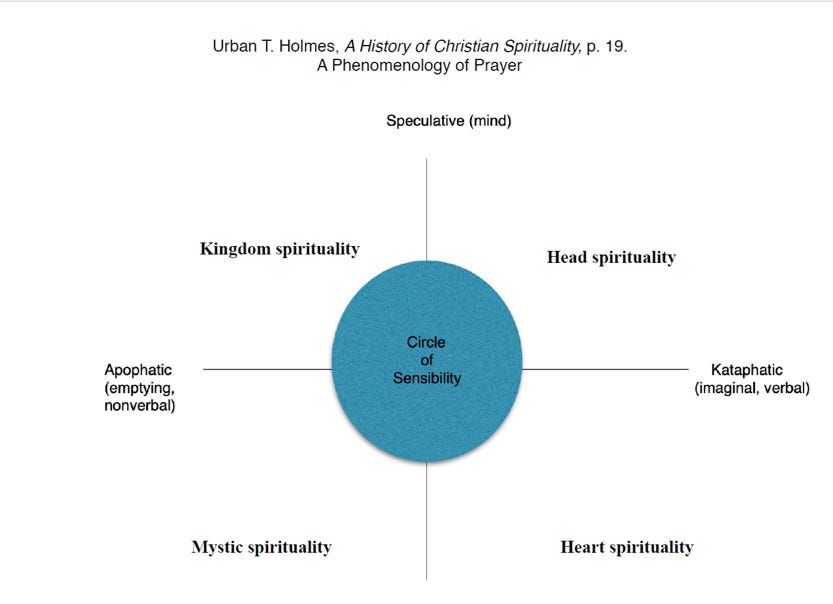
Along the same lines, Father David Perkins introduced me to Holmes’ 4 Spiritualities. David said most people gravitate toward one or two of these spiritual pathways.
Are these kinds of experiences limited to a narrow band of nature mystics, or is this kind of encounter more about receptivity, timing, and cultural comfort and conditioning?
Chapter 4: Allured into the Wilderness May 31st
What Stood Out to Me:
The Power of a Wild Wander Experience
Loorz’s description of the wander resonated with me. This week I shared a post that grew out of one of my earliest wanders back in 2019, titled Cultivating Courage with the Help of Lumpy Old Chestnut Oak.
My Challenges and Lingering Questions:
Seeing Gifts Through an Ecological Lens
In this chapter, Loorz shares insights from Bill Plotkin’s Nature and the Human Soul.
He says that all of us are “born to occupy a particular place in nature—a place in the Earth community . . . a unique ecological role, a singular way you can serve and nurture the web of life . . . as unique as that of any birch, bear, or beaver pond.”
Making the invisible gifts we all have visible is a huge part of my life’s work. This reframing of giftedness through an ecological lens grabbed my attention. I currently ask those I work with how their gift can help bring about their shared dreams for their community. I am pondering, How would this broader frame change the question and the resulting answer? What if we asked ourselves and others, “How might I share my gift to nurture the web of life?” or “What is your unique ecological role?”
I wonder if the gifts that emerge would be different than those made visible through my current focus on strengthening human communities?
Does this larger ecological frame make a different community dream possible?
The Larger Ecospiritual Narrative
Loorz goes on to say:
“the inner beloved is an archetype, the part of you who is your guide to soul. I think it is not much different from Thomas Merton’s mystical language of true self, or what Carl Jung named the anima or animus. It is the wild twin that Martin Shaw talks about in his lyrical retelling of the ancient European myth, “The Lindworm” “The part of ourselves that we generally shun or ignore to conform to societal norms.””
To the metaphors shared by Loorz I would add Howard Thurman’s Sound of the Genuine (included below in resources) and Henri Nouwen’s Inner Voice of Love. All these mystics use different words, but they all sing the same song – loving our unique selves while recognizing our universal belonging and responsibility to the whole.
I keep coming back to Thomas Berry’s challenge to embrace a new theological story that has the power to change the trajectory of existence from one pointing toward the destruction of the earth to one of thriving wholeness for all earth’s inhabitants.
How do these more contemplative and mystical archetypes change the narrative?
What is the meta-narrative that shifts the direction of our story?
Chapter 5: Restoring the Great Conversation June 7th
What Stood Out to Me:
This is one of my favorite chapters and includes quotes from many of my favorite wise guides - Thomas Berry, Robert Macfarlane, Francis Weller, Robin Wall Kimmerer, and Howard Thurman.
Loves Twin Sister
“Grief and love are sisters, woven together from the beginning. Their kinship reminds us that there is no love that does not contain loss and no loss that is not a reminder of the love we carry for what we once held close.” Francis Weller
This quote reminds me of my Lumpy post from earlier this week.
Loving Thurman More
“When I was young, I found more companionship in nature than I did among people. The woods befriended me…I could talk aloud to the oak tree and know that I was understood…There were times when it seemed as if the earth and the river and the sky and I were one beat of the same pulse. It was a time of watching and waiting for what I did not know—yet I always knew there would come a moment when beyond the single pulse beat there was a sense of Presence which seemed always to speak to me. My response to the sense of Presence always had the quality of personal communion. There was no voice. There was no image. There was no vision. There was God.” Howard Thurman
I did not think I could love Howard Thurman any more than I already do. Then I read this. I had always heard he was a mystic, but now I know we both talk to Oak trees; perhaps that shared language is why he speaks so deeply to me.
Belief Verses Attention
“I began to realize that my identity depended not upon any beliefs I had . . . [but] actually depended on how much attention I was paying to things that were other than myself—and that as you deepen this intentionality and this attention, you started to broaden and deepen your own sense of presence.” David Whyte, Galapagos Islands marine scientist
This contrast between “believing the right things” and “paying attention” to what is all around us caught my attention. I believe the universe will show you what you need to know when we pay attention at a soulful level. I am not sure if that is what Whyte is saying, but that is my own experience.
Much of this chapter (Whyte’s quote above, Macfarlane below) reminds me of Mary Oliver’s poem:
Instructions for living a life:
Pay attention.
Be astonished.
Tell about it.
My Challenges and Lingering Questions:
Learning to Tell About It
Loorz writes,
“Mystical conversations defy language. But not naming them leaves them without context, unable to grow into their meaning…Language is fundamental to the possibility of re-wonderment,” Macfarlane reminds us, “for language does not just register experience, it produces it.” [Emphasis mine]
I have been journaling daily for several decades. It allows me to “tell about it” if only to the pages of my journal. The practice allows me to register the experience and produce meaning from it. I began this practice while in seminary and was able to share my thoughts with my professor and my classmates, which was both terrifying and edifying. Since I began writing on Substack, I feel like I have released a log jam; I now have a way of sharing beyond my journal. What I lack is any real interaction, like what I received during my seminary years. I am not sure if that kind of conversation is even possible outside that container, but I would like to explore the possibility.
I am not sure that a 30-minute wander with a 10-minute debrief is enough time to fully glean the meaning of an encounter. I am a part of a writers’ group. Every month, we write to a prompt provided by the teacher and then share what we wrote when we reconvene. It is a bit monotonous as she provides no length limit, but the requirement to write outside of class has produced the desired objective – to encourage us write.
I wonder if starting with that kind of voluntary “check-in” with the “prompt” being whatever grabbed your attention, might deepen the sharing and allow for more meaning-making both individually and collectively. Instead of going around the full circle, we could share in triads.
I know my encounter with George worked on me for weeks and continues to unfold layer after layer of meaning. I don’t think it should be required, but perhaps an option, perhaps a check in question like this one, “What did your wander experience tell you since we last met?”
Not everyone likes to write, so perhaps inviting all forms of creative expression to be how we share meaning with one another.
What practices might help us register experience and share in a way that produces meaning?
Animating Community
Robin Wall Kimmerer proposes a new “grammar of animacy,” one that takes cues from her Anishinaabe language, where other species are “recognized not only as persons, but also as teachers who can inspire how we might live.”
“In Landmarks, Macfarlane tells a story of how citizens of an island township called Lewis, on the Outer Hebrides of Scotland, saved their homeland by restoring intimate conversation with their landscape.
They launched a two-year campaign to inspire residents to restore intimacy with their land through specific storytelling. Restoration through re-storying. They called for the sharing of detailed and loving experiences that people had with particular places, encouraging them to tell stories, recall poems, create paintings and photographs, remember songs, recall lost words, map favorite hidden spots, and recount histories about particular places in their township. The activists hoped to restore intimacy with the moor by encouraging particular conversations that reconnected the people and their place.”
The campaign revived the citizens’ sense of kindred belonging to their place.”
I loved this question, “Tell me about the land who raised you.”
When Chris and I first started camping, I found myself strangely drawn to the many amphitheaters I ran across in state parks. They grab my attention and have been speaking to me for years.
This summer, Ruth and I are working with the Theater Kids in Appomattox. Yesterday, Chance said, “Maybe the kids would do short skits around my Friday night campfire circle.” With my conversations with George, Lumpy, and my prior experiences doing oral storytelling projects in my head, I had a vision.
What would it look like to actually bring the “characters” of our community to life around the campfire?
What kinds of conversations might Harold the turtle, Lumpy the Chestnut Oak, Hisstopher the snake, George the cow, Bob the “oldtimer”, Abby the young nature lover, and the rest of the drama kids, other members of the community, past and present, have together?
All Community is Sacred Community
“We are talking only to ourselves. We are not talking to the rivers, we are not listening to the wind and stars. We have broken the great conversation… we will recover our sense of wonder and our sense of the sacred only if we appreciate the universe beyond ourselves as a revelatory experience of that numinous presence whence all things came into being. Indeed, the universe is the primary sacred reality. We become sacred by our participation in this more sublime dimension of the world about us. Then, you’ll find you are fully present with yourself. And you’ll begin to tap into a conversation going on all around you that is bigger than you. It’s as big as God.” Thomas Berry
Loorz makes an interesting point.
“When we invest time and attention in connecting with others as sacred, as Thomas Berry said,“we become sacred.” It’s almost as if the connection between, the conversation itself, is how the sacred is manifested.”
My favorite definition of community is a group of people wrapped in mystery. Mystery is the connection, conversation is the vehicle for cultivating connection. No AI program can forecast how people will connect, or force a connection. Perhaps a better definition of community might be, “a group of individuals (human and more than human) stitched together by the sacred, one meaningful conversation at a time, forming a sacred bond of oneness.”
What do you think of this definition of community?
Other Resources:
During our first gathering, I shared a modified version of Soul Collage that I found helpful in my conversations with our non-verbal kin. I wrote about one such conversation in this week’s article titled, Meet George, A Rule-Breaking Non-Conformist with a Message.
One of our book group participants, Jill Hames, wrote a lovely piece along these lines on her Substack this week titled “Delight as Worship.” I encourage you to check it out.
I think Howard Thurman is one of the most skilled at using language that expands. I love his use of the metaphor “The Sound of the Genuine.” Here is an excerpt:
There is in every person something that waits and listens for the sound of the genuine in herself (or himself.)… If you cannot hear the sound of the genuine within you, you will never find whatever it is for which you are searching, and if you hear it and then do not follow it, it was better that you had never been born...
If you cannot hear the sound of the genuine in you, you will all of your life spend your days on the ends of strings that somebody else pulls…So the burden of what I have to say to you is, “What is your name—who are you—and can you find a way to hear the sound of the genuine in yourself?”
[The sound of the genuine] is the only true guide you will ever have and if you don’t have that you don’t have a thing. Cultivate the discipline of listening to the sound of the genuine in yourself.
Now if I hear the sound of the genuine in me, and if you hear the sound of the genuine in you, it is possible for me to go down in me and come up in you. So that when I look at myself through your eyes having made that pilgrimage, I see in me what you see in me and the wall that separates and divides will disappear and we will become one because the sound of the genuine makes the same music.
—Howard Thurman, Spelman College Commencement Address 1980
Valerie Loorz hosted a follow-up conversation this past week. She shared this poem that I thought others might enjoy:
When I was the stream, when I was the
forest, when I was still the field
when I was every hoof, foot,
fin and wing, when I
was the sky itself,no one ever asked me did I have a purpose, no one ever
wondered was there anything I might need,
for there was nothing
I could not love.It was when I left all we once were that
the agony began, the fear and questions came,
and I wept, I wept. And tears
I had never known before.So I returned to the river, I returned to
the mountains. I asked for their hand in marriage again,
I begged — I begged to wed every object and creature,and when they accepted,
God was ever present in my arms.
And He did not say,
“Where have you
been?”For then I knew my soul — every soul—
has always held
Him.(Often credited to Meister Eckhart, but likely Daniel Ladinsky in Love Poems from God)
I have been reading Jim Palmer’s publication Deconstructionology with Jim Palmer. This week’s article is Jesus After Religion. This collection of articles might be of interest to some of you. Bruce and I had a fun exchange along these lines on a note I shared here on Substack earlier this week.
I was dumbfounded at the perspective that it's normal to keep nature and spirituality separated. Even growing up on the conservative side, it never occurred to me that you couldn't talk in church about experiencing God in nature, through nature. Of course, you have to be careful in how you phrase it so that you aren't saying nature *is* The Divine, but I can't fathom feeling like you have to keep the two loves separate. At the same time, I did write in my seminary application that I think caring for nature is a form of ministry. I wanted to get rejected by any place where that would be a problem.
I was able to finish reading the first five chapters, and I resonated with so much of Victoria’s experience. Her vulnerable sharing of her journey helps to imagine it, and to reflect on my own. I see her struggle with institutionalism, with the corollary of rigidity and exclusivity, with the objectification of anyone who doesn’t fit the mold, and with individualism. Historically every great renewal movement has institutionalized at the high cost of those who were seeking purpose and meaning. I think Augustine was one of the first to put his finger on this paradox, “The Church is a whore, but she’s my mother.” I would call him the first “edge walker.”
However you frame it, the struggle is real. I appreciate the Methodists adding experience to the three legged stool they inherited from Thomas Hooker, who first articulated the authority of scripture, tradition, and reason. To his credit, Hooker actually meant “reason” as inclusive of experience rather than simply cerebral, but I think it was helpful to make experience explicit.
I do have a different antidote for exhaustion on the social activist path (besides wholeheartedness.). As Gregory Boyle puts it, “Saving people is for the Coast Guard. Our mission is to SAVOR them.” “And guess what?” he says. “Since everything is connected to everything else, when people are savored, they are saved. And WE are saved.” Savoring is something Victoria does so naturally in nature, and that’s what makes her wholehearted. Maybe she and her son, Alex, could think about a “savoring” movement to recover from all the social warrior exhaustion.
Victoria’s journey is so authentic that it is inspiring, and I couldn’t help but to think of the Spiritual Types you posted as a wider lens through which to look at her spiritual path — and ours. (I’m referring to the diagram you posted in the Chapter Questions and Comments — the diagram Urban Holmes created with the horizontal and vertical axes of apophatic-kataphatic and speculative-affective dimensions. (Can you add “affective” to the bottom of your chart?) However it was Corrine Ware who labeled the four types — Head Spirituality, Heart Spirituality, Mystical Spirituality, and Social Action Spirituality (which she also called Kingdom Spirituality). Here is a link to the explanation and questionnaire used by Corinne. https://carollanfear.weebly.com/uploads/1/0/5/1/10516291/the_ammended_spirituality_wheel.pdf
I can see Victoria rejecting head spirituality, embracing heart spirituality and mystical spirituality, and finally social action spirituality. And then I think she is moving toward integration of her spiritual paths. But I also feel like Victoria defies being analyzed and labeled from an outside observer. So what I can say more personally is that reading about her struggle and using the phenomenology of prayer chart created by Urban Holmes along with the spiritual types identified by Corinne Ware, helps me to examine my own past journey, and to become more intentional about how my journey might be more integrated in the future. What I hope is to continue my head spirituality with my interfaith dialogue group and my engagement with a local Episcopal Church, to pursue my mystical journey with my discussion group on the Biblical Foundation of Christian Spirituality followed by Centering Prayer each week, to savor my homeless friends and support them in challenging the political obstacles to ending homelessness in Corpus Christi, and to create opportunities to savor my non-human friends who I do have a deep desire to know more intimately, but am not prioritizing. I think it is the glue I need to hold me together, to integrate my journey, and to transform me into a more authentic person.