

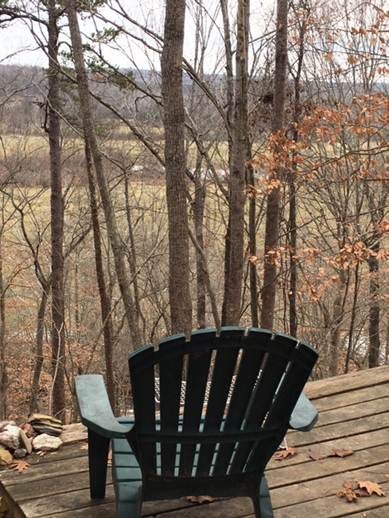
Our “cabin” is basically a 12-by-24-foot shed that we purchased in 2005. We placed it high up on the ridge because I loved the view, especially in the winter months when you can see the creek and its large sandy beach below.
If you listen closely, you can hear the water as it rushes across the rocky creek bottom. Just beyond the creek, the land opens into a lovely pasture. The large sycamore trees that grow along the creek rise a hundred feet into the air, their stout white trunks standing out against the field.
Because of the steepness, we had to create a level pad for the structure to sit on. We did so by pushing dirt into a mound and then covering it with gravel.
At the same time, we built a road from the gate to the cabin.
Over the years, the gravel has washed down the road.
Ten years later, when we built a second pad for a travel trailer, my husband insisted on using much larger rocks—even though I hate walking on them.
Over the past few years, heavy rains have continued to ravage our roads.
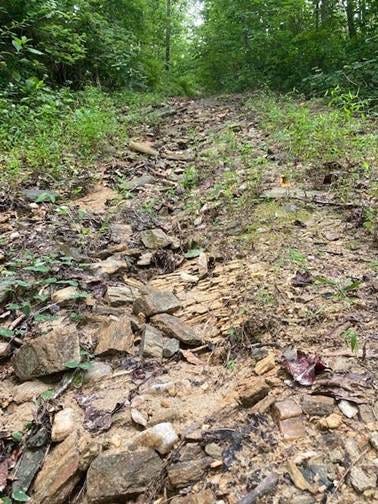
These floodwaters moved even the larger stones, and ruts formed in the road. The rains have been so extreme that in places the floodwaters have completely eroded the topsoil to the point that the bedrock is now exposed.
The bedrock was the only surface the floodwaters could not wash away.
CommUnity Bedrocks
In chapter 1 of part 1 of this series, I shared how the community I had cultivated through genuine relationships washed away as we slowly followed conventional growth-oriented advice that prioritized resource distribution over authentic long-term relationships.
Transitioning Embrace back to its original beloved community vision set off a series of metaphorical storms with funders, board members, and volunteers who did not understand why I was letting go of the furniture bank.
I moved my office to the back corner of our windowless building as far from people as I could get. I spent many months with my door closed crying and wondering if I had made a terrible mistake.
I felt alone and misunderstood.
Projects, like aftercare support, for which I had high hopes, had proven to be flawed.
Funding that I thought would be a blessing turned into a curse as we felt pressured to deliver outcomes that no longer felt authentic to what we had learned about our community.
The relationships that I thought were solid were being washed away by all the stress and demands of multiple stakeholders who did not measure success in the same way.
I needed something deeper than another strategy.
I needed something that could hold me steady while everything around me seemed to be shifting.
During this season of discontent, I needed to cling to something—to find my bedrock—when it felt as if I would be swept away by the raging floodwaters of unmet expectations.
I began collecting sayings and passages from ancient wisdom texts, quotations from wise authors, and song lyrics from musically gifted poetic prophets.
I also began paying close attention to what the more-than-human world was trying to tell me.
See the Connections
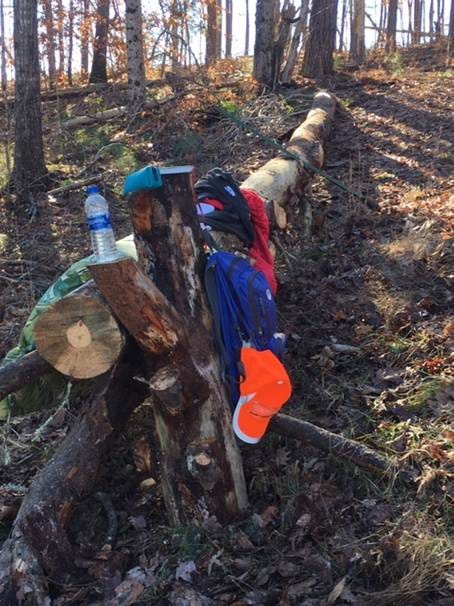
During this time period, my husband and I started taking weekend retreats to our property in Appomattox. It was the only place I felt safe and clear-headed enough to think. During one such escape, I noted that a storm had toppled a huge old pine tree. My husband subsequently turned it into a bench from which I could watch the sunrise. He knew my practice of facing the dawn every morning was spiritually nurturing for me.
One morning, to my great joy, the first ray of light to peek over the distant ridge made its way across the sky and landed just a few feet in front of me. Within minutes, I was enveloped in warm sunlight, and it felt as if all of creation was giving me a big hug.
As the beams of light spread out in front of me, they illuminated dozens of tiny webs woven throughout a pile of dead tree branches.
Some threads spanned a dozen feet, and others simply connected one dead branch to the next. As a gentle breeze caught these webs, the light flickered. It was like watching a private laser light show.
I noticed these invisible lines of connection one morning when I was walking around the property. A heavy dew had fallen, making them fully visible, and I was stunned that they had been there all this time, hiding in plain sight.
As I sat reflecting on all of this, the words “It is all connected” entered my mind. I jotted them down, not yet clear what they meant but knowing they contained a truth that I needed to understand more deeply.
If you spend any time in the natural world, its interconnectedness becomes clear very quickly. Professor of forest ecology Suzanne Simard discovered that vast mycorrhizal networks of fungi connect individual plants and transfer water, carbon, nitrogen, and other nutrients and minerals.
Some scientists like Peter Wohlleben in his book The Hidden Life of Trees, have even documented that trees use these networks to communicate with one another, sending out signals when they are under attack that help their network defend against the threat.
Plant life has a similar interdependent connection with the animal kingdom. The soil feeds the plants which feed the animals. The trees hold the soil in place and prevent erosion, and the soil gives the trees the nutrients they need to grow. Insects promote the decay of dead trees, and birds feed on the insects. Birds and other animals use the trees as their homes and as a food source, and their waste falls to the ground and enriches the soil. It is an amazing system of mutual interdependence.
The same is true in a healthy, thriving human ecosystem. We are all connected through invisible webs of relationships, and we interact in a reciprocal fashion with our environment. The community members support the businesses which support the community members. The students, parents, and other stakeholders support the schools and vice versa. Mutuality and interdependent relationships mark all healthy ecosystems. Likewise, community cultivation is all about connections; seeing them, naming them, valuing them, and leveraging them toward the common good.
Every Monday when I had to drive back to Richmond, I could not escape the pull to return to what felt like home there in the forest community.
Somehow, I got caught up in its web, and rather than devour me, it made me stronger. I began to feel as if the sunrises, sunsets, and encounters with the forest and its creatures were personal, as though the forest was showing me affection as I allowed its beauty to embrace me.
I formed an attachment to this place and somehow, it made me healthy and whole.
Scientists and therapists are attempting to study and name this experience of attachment to the natural world, which is closely related to our sense of belonging, but this is a mystery I think is best articulated in the language of poets, mystics, and artists.
This mystery of belonging to one another is found in those invisible lines of connection we experience in our human communities.
The connections between community members serve as the connective tissue that brings a community to life and helps to ensure that all thrive.
When I wrote Power Shift, all I knew was that the life force of community was not in the individuals but in the connections between them. I had never heard of the concept of Interbeing, which I discussed in Chapter 3.
But I can now see that the mystery goes even deeper.
There is a “oneness.”
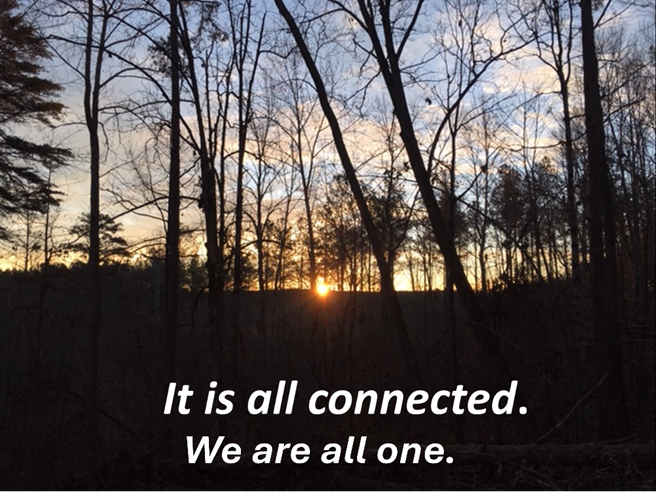
These words remind me of truths that were at the foundation of what soul knew long before my mind had words for it.
They echoed the sound of the genuine in me.
And perhaps this is what I was beginning to see: the relationships I had spent years cultivating were not simply a strategy for building stronger communities. They were a way of becoming aware of something that had been true all along—the deep interconnectedness of life.
Interbeing was the deeper truth.
Relationship is how it is experienced.
Naming the Bedrocks
As I began looking for a path forward in my work, I became aware of Robert Putnam’s research on human connectivity, which he terms social capital. Putnam identifies two forms of social capital: bonding and bridging.
Bonding social capital results from connecting people with similarities. I think of it as peer to peer connections, or to use John McKnight’s phrase, circles of friends.
Bridging social capital develops when you connect people with those outside of their community.
Putnam concluded , “society as a whole benefits enormously from the social ties forged by those who choose connective strategies in pursuit of their particular goals.”
In Power Shift, I named this bedrock principle of connection Bond-building Relationships.
While bridging relationships are valuable, it is these peer connections that turn a group of individuals into this mystery we call community.
My understanding of the importance of connections was expanded through the work of Johann Hari. I picked up Hari’s book Lost Connections: Uncovering the Real Causes of Depression—and the Unexpected Solutions, during the pandemic out of concern for how isolation was impacting those I cared about.
What I found in Hari’s solution made my community-cultivating heart sing. He was naming the same truth that Putnam was naming, just through a different lens.
Hari identifies nine causes of anxiety and depression—the top two mental health challenges we face as a nation. He discovered that the key element in all these nine causes was the concept of losing connection. Losing connection to meaningful work, others, personal values, the natural world, and so on leads to anxiety and its twin sister, depression.
Not surprisingly, one of the top causes identified is a loss of connection to others. He writes:
“Loneliness hangs over our culture today like a thick smog.”
“humans need tribes as much as bees need hives.”
True relationships require more than the mere presence of another person: they require mutuality. Hari states,
“You also need to feel you are sharing something with the other person, or the group, that is meaningful to both of you. You have to be in it together—and “it” can be anything that you both think has meaning and value… A one-way relationship can’t cure loneliness. Only two-way (or more) relationships can do that. Loneliness isn’t the physical absence of other people, it’s the sense that you’re not sharing anything that matters with anyone else… To end loneliness, you need to have a sense of “mutual aid and protection.”
The need to co-create experiences of meaning and value takes me back to the heart of what I learned during this first chapter in my journey as a community cultivator.
These wise guides confirmed what I already knew but they gave me language, evidence-based research, and a bit of clarity about how to move forward in my effort to shift from focusing on a cause (homelessness in this case) to community.
What the Floodwaters Taught Me
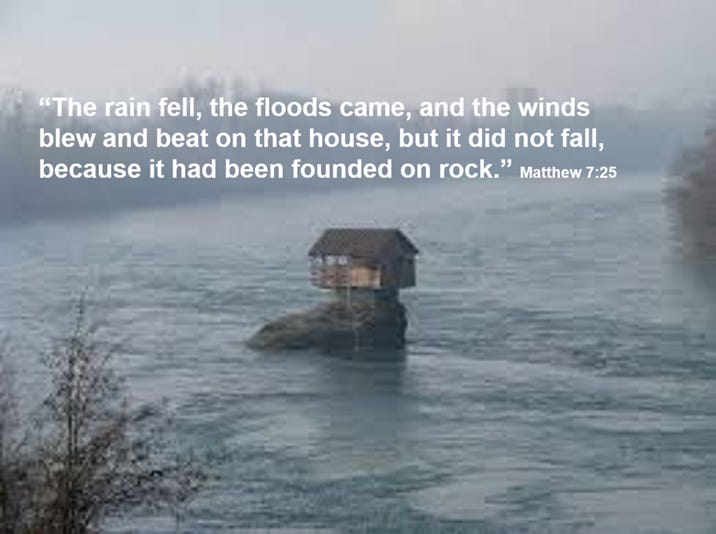
For me, the bedrock principles that I have articulated over the years have become an anchor.
They held me in place as I watched much of what I had been building wash away.
They also became a light illuminating my forward path once the waters began to recede.
I knew that if I was going to rebuild, I needed to rebuild on what was genuine to who I was and not simply based on the ever-shifting demands of others.
When I started Embrace in 2005, I could feel the connections that were forming between Stephanie, Rosalind, Brickhouse, and the rest of the team.
However, I had no real understanding of the values and principles that had made that first community so powerful.
The shifts toward an institutional approach felt small, but little by little they eroded what made the community work.
Years later, when I was introduced to the ABCD Institute and the work of McKnight and Kretzmann, I immediately recognized the foundation on which Embrace had originally been built.
The foundational truths to which we cling emerge from our belief systems, and these truths shape the narratives we tell ourselves and others.
Those narratives shape our communities.
In the early years, it was the story of Stephanie’s dream of helping others that deeply shaped us.
When we stopped telling the story, we disconnected from the pay-it-forward ethos that had launched the effort.
The foundation upon which I had built my work was crumbling.
To put it in Howard Thurman’s language, I was no longer following the sound of the genuine.
I needed to dig deeper—to rediscover the bedrock upon which I could rebuild.
During this season, it was the bedrock of bond-building relationships.
I think we all experience seasons during which we feel as if we are being swept along by strong currents, seasons in which we feel as if we can barely keep our heads above water.
While my hope for those I coach is to prepare them to be effective community cultivators, I have a secondary desire:
I want everyone to have a firm foundation that can hold them steady when the storms come.
I recently completed a Master Naturalist training program and have a whole new level of appreciation for the role that bedrock plays in the ecosystem.
I learned that the soil we see on top of the bedrock is made up of organic matter that falls from plants and animals, but it also consists of elements from the bedrock that are slowly eroded by rain and other conditions.
These particles provide much-needed minerals.
In other words, what lies beneath the surface shapes what can grow above it.
Communities are similar. Their health depends on the condition of the soil.
For human communities, this is often defined as the culture. The health of a culture can erode gradually before we realize what we’ve lost.
I did not destroy Embrace’s community-rich culture in one dramatic decision; it eroded incrementally through small decisions to follow institutional rules from outside our community instead of listening deeply to the sound of the genuine in our own community members.
As the common adage goes, “If you don’t stand for something, you will fall for anything.” I learned this lesson the hard way.
Sadly, I have seen this pattern repeated over and over again among those I coach who jump quickly into this work without clarifying the bedrock principles that they want to build upon.
Evolving Bedrocks
The question that emerged for me as I began writing this chapter is, “What bedrock principles are solid ground upon which to build what seems to be emerging in the next chapter of my community cultivation work?”
In other words, have my bedrock principles evolved or are they evolving?
In my previous chapter, I named the narrative of Interbeing as the spiritual thread that connects my human community and my more-than-human community. This is not a new concept to me. However, I had never brought this lens into my community work, at least not in a conscious way.
However, as I think about the bedrock principles upon which genuine community is cultivated, I think Interbeing is the narrative behind the Bond-Building Relationship Principle.
When I first wrote Power Shift, my focus was on authentic relationships, which I now see as the vehicle through which we become aware of Interbeing.
That realization deepens my understanding.
Bond-building relationships are not simply a technique for developing social capital.
They are not merely a strategy for improving outcomes.
They are one of the ways we awaken to the reality that we belong to one another.
Everything starts here.
Treehouse Invitation
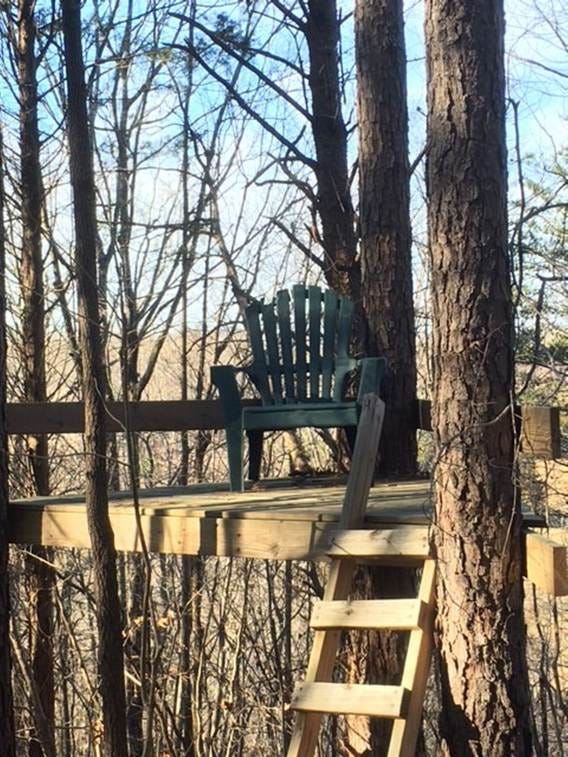
We have covered a lot of ground in part 1 of this series.
My friend Peter Pula has graciously offered to host a session this Thursday, Oct. 1st for anyone who is interested in reflecting together on this part of the Power Shift Revisited series.
You can get more information and register to participate, HERE.
Deeper Dive Tools
The tools below are for those who are interested in putting the principles shared in part 1 of this series into practice in their own community.
Making the Shift from Relief to Development: The Fishing Pond Tool
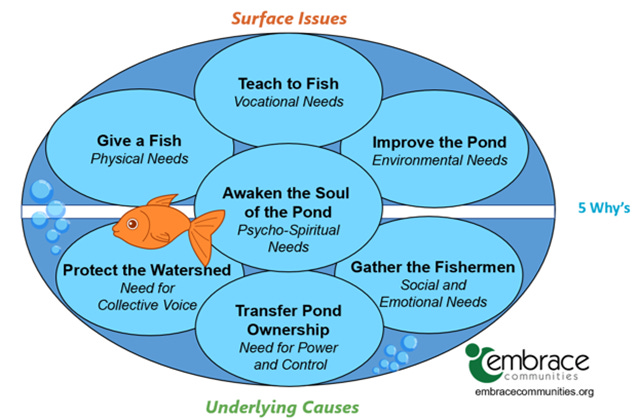
To help my coaching clients see below the surface needs of a community, I often use a tool developed by my mentor and coach, Jay Van Groningen, which we call the Fishing Pond Tool. I have modified this through the years but the general concept remains true to Jay’s original version of the tool.
This tool explores the seven needs found in every community and how to shift from those that are simply symptoms of deeper unmet needs and get below the surface to see those invisible causes such as social isolation, loss of power and control, psycho-spiritual needs and the need for collective voice.
You can access this Deeper Dive Article HERE
If you enjoyed this post, please hit the like button, add a comment and/or share with others. It means a lot to me to know others are reading and appreciate the effort it takes to craft the articles.
All materials are and will remain fully free to all subscribers. However, if you would like to contribute financially, 100% of paid subscriptions are donated to Embrace Communities to support our network of Community Cultivators.
Another great chapter! <3