

This past week I participated in the bi-weekly Cultivating Community conversation with community cultivators from across the globe, hosted by Peter J Pula at Citizen Studios. The following poem by Welsh poet W.H. Davies, titled Leisure was read:
What is this life if, full of care,
We have no time to stand and stare.
No time to stand beneath the boughs
And stare as long as sheep or cows.
No time to see, when woods we pass,
Where squirrels hide their nuts in grass.
No time to see, in broad daylight,
Streams full of stars, like skies at night.
No time to turn at Beauty’s glance,
And watch her feet, how they can dance.
No time to wait till her mouth can
Enrich that smile her eyes began.
A poor life this if, full of care,
We have no time to stand and stare.
We were then asked to share a story of a time when we stood and stared.
The following story, taken from my book Power Shift: A Field Guide for Community Cultivators Everywhere, came to mind.
In late February 2016, the most powerful tornado in the recorded history of this area tore a path through small communities and a portion of the Appomattox-Buckingham State Forest near my rural woodland home. It killed one person and injured seven others. It destroyed the hardwood forests in its path in a matter of minutes and uprooted giant oaks and hickories that had taken more than a century to grow.
It was in this part of the state forest that I felt called to begin a thirty-day sabbatical journey in January of 2019. That first cool January evening as I arrived in that storm-ravaged part of the forest, I felt as barren and as violated by the events leading up to my sabbatical as did this once peaceful forest.
I do not know why I felt led to this place on the first day of my soulful journey. I had been here many times in the preceding years, each time hoping to see signs of new life, but instead being confronted by death and decay. Each time I came here, I placed quartz rocks brought to the soil’s surface by the uprooted trees onto what remained of the tree trunks as a kind of marker honoring the loss of nature’s gifts. This forest is now a vast graveyard of tree trunks covered with white gravestones—a place of grieving for what might have been. It has become my altar of lament.
That first evening of my sabbatical, I had climbed up onto one of those stumps. As the sun receded, it lit up the sky, and something unexpected happened. The sun’s beautifully brilliant colors in stark contrast to the mangled roots of one of those old wise trees created an image of eerie beauty. It took my breath away, and I heard these words whispered on the wind, “Stay close to beauty, and she will lead you home.”
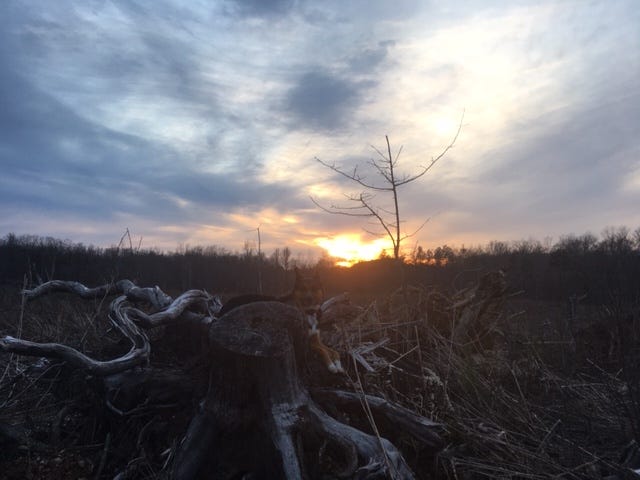
The words invited me to look beyond the obvious and very real destruction in front of me, and in that brief moment, my soul breathed a sigh of relief. I felt at peace for the first time in a long while. As the final ray of light turned to darkness and I ambled through the silent graveyard toward my own uncertain future, the words “Stay close to beauty“ continued to resound in my mind.
The idea of staying close to beauty is closely aligned with practicing gratitude, with thankfulness, and with experiences that evoke awe. Sunsets, oceans, and mountains have such a profound impact on humankind. They remind us that we are connected to something much bigger than self. Psychologists, therapists, and pastors alike have written a multitude of books on the benefits of practices that cultivate this kind of soulful connection. Some, like Johann Hari, point to a loss of connection with nature as contributing to our current mental health crisis.
Others, like Florence Williams, author of The Nature Fix: Why Nature Makes Us Happier, Healthier, and More Creative, offer a more holistic assessment of nature’s impact on all aspects of human thriving.
In a society obsessed with reminding us of all the things that are broken, this practice of noticing and cherishing nature’s beauty is a form of resistance, reminding us that some things in life don’t have to be earned or fixed: they just have to be noticed. Even in the midst of the worst situations, we can be surprised by beauty if we cultivate the practice of paying attention and allowing ourselves to be astonished. Grace-filled moments remind us that at its core, life is good even when it feels unbearably bad. We simply have to be open to seeing it.
In all my personal times of heartache, if I sat in the pain, not dismissing it but asking it to teach me its truths, I have found some shred of promise or hope that helped me take a step forward. Those messages of hope were most often revealed through unexpected encounters with natural beauty.
By beauty, I am referring here to those moments in which you have a sense of awe that opens the door to a sense of deep connection or oneness. Perhaps a more helpful way of describing it would be attraction or connection. That sunset moment amid the uprooted trees, I felt deeply attracted to and connected with this part of the forest, the wounded part. The contrast of mangled gray roots and the magnificent colors that filled the sky, touched me and produced in me a sense of peace. I realized that despite the devastation left behind by winds, real or metaphorical, the worst of the storm was over and I had survived. That glimmer of hope was enough to keep me moving forward.
Grace-filled beauty and the types of insights that these encounters illicit are a type of hope pollinator, and if we listen to it, we will bloom and bear fruit somewhere down the road. Hope is the spark we need to fuel our dreams. Without hope in a brighter future, we become stuck and cannot find our way out of difficult seasons. I know this reality all too well.
Sometimes our encounters with beauty, like the one above, make such a profound impression on us that they stick in our minds. At other times, the encounters are much more subtle, and it is only in hindsight that we understand them. Simply writing down what we see, drawing a picture, or snapping a photo in those moments can serve as a reminder. Imagine the universe as an invisible Hansel or Gretel leaving breadcrumbs in the form of encounters with beauty for you to find. Journey through life with a journal, pencil, and camera in hand, ready to capture those glimpses of grace.
That one hour of standing and staring, of noticing and being astonished, of reflecting and listening, was the first of 30 days of following beauty in a very intentional way. That sabbatical experience in 2019 led me to sell my house in Richmond and move to the middle of nowhere, Virginia, with a desire to spend more time standing and staring.
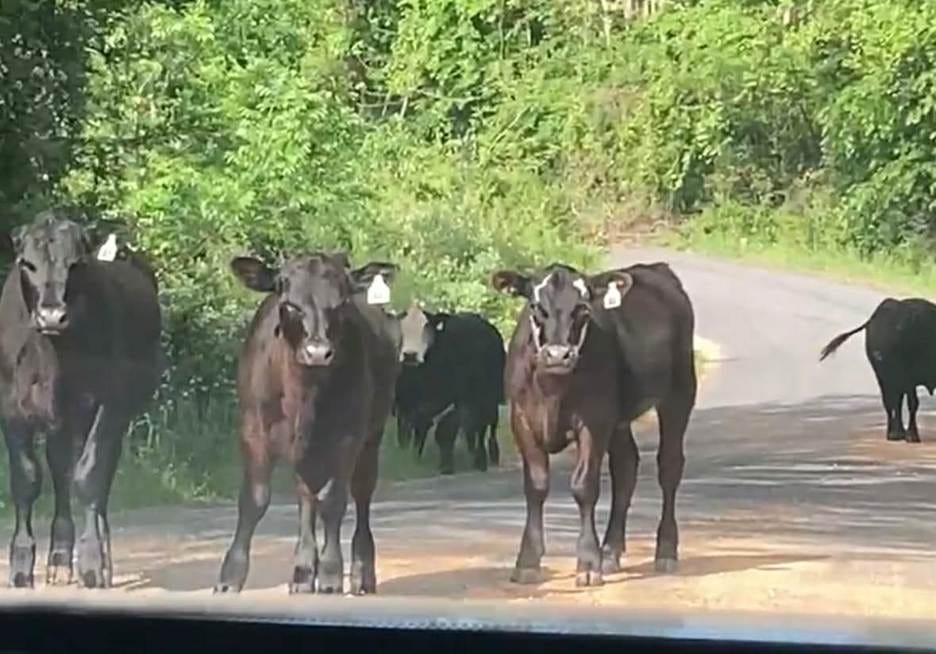
My favorite line in the poem is “And stare as long as sheep or cows.” My closest neighbors here in my rural home are cows; I suspect they outnumber the humans by a significant margin. I see them grazing in the field down in the valley when I am hiking in my forest. I see them in fields all along the country road when I am driving.
The other day I even saw them walking en masse down the road! I pulled my car right up to them. They stared at me. I stared at them and smiled. I do believe they smiled back. I swear they whispered, “Thanks for stopping to stare with us.”
Do you have a story of a time when you stood and stared?
What message did you receive?
How did that encounter shape you and your actions?
If you found this post helpful, I hope you will consider subscribing, sharing your thoughts in the comment section, and sharing this post with others. All materials on my site are free, and 100% of any paid subscriptions are donated directly to Embrace Communities, a public charity.
I love this so much. Thanks for the reminder to stare! For me, the arts feed my spirit. Playing the piano, watching a beautiful movie, hearing someone sing or seeing art. And I do love the animal kingdom, watching all the little critters and birds around us. When we moved here, I really missed the ocean, coming from a harbor town in Maine. But our area has the most stunning sunsets, which are *almost* as majestic. :)
“Time to stand and stare,”
at beauty, life, like cows... now?
McCaig, Davies dare.